
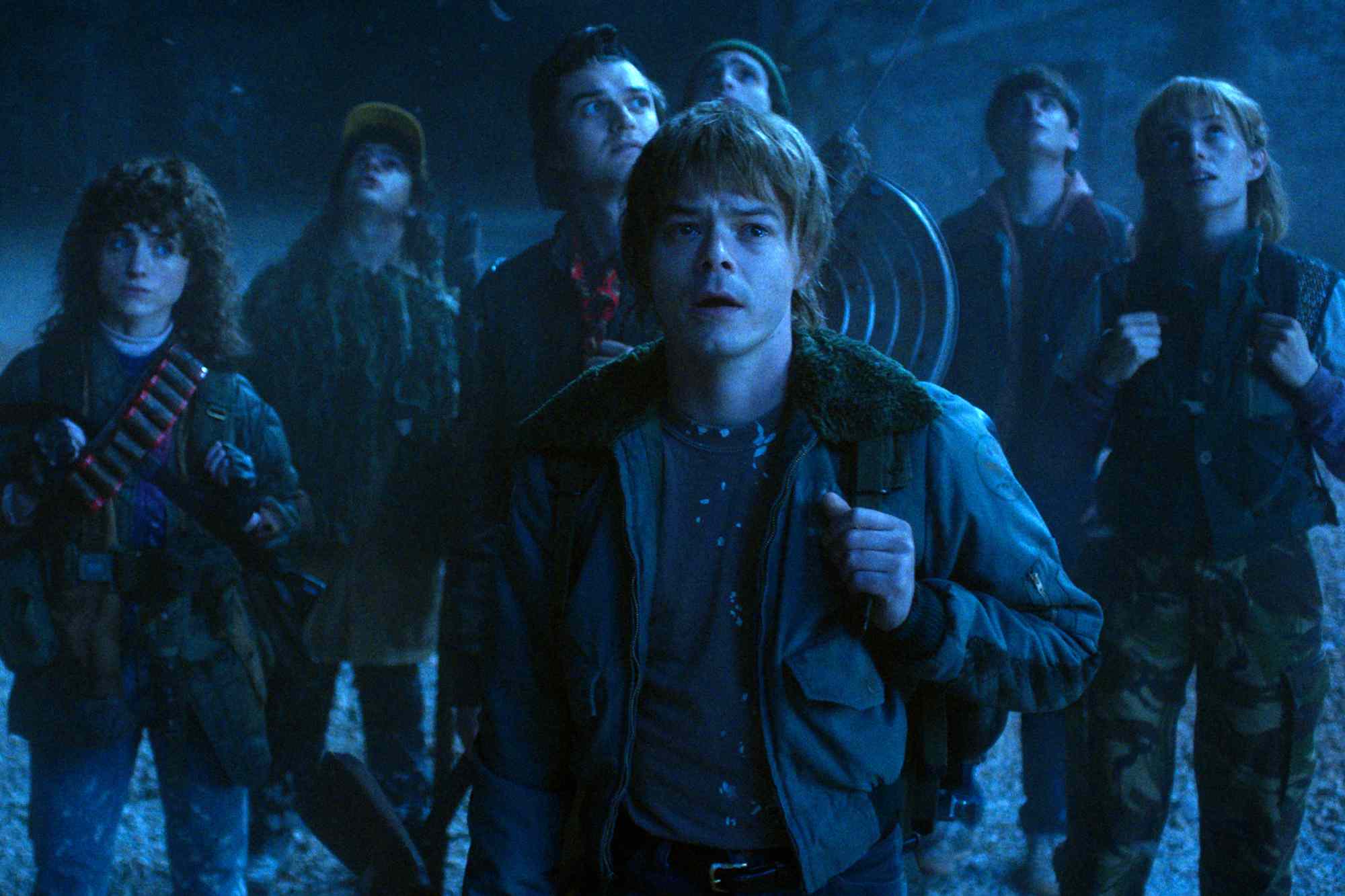
The release of the final season of Stranger Things is a cultural landmark. It is widely seen as the symbolic end of a “golden age” of television that ran roughly from the early 2000s to the early 2020s. The Netflix hit series House of Cards triggered years of streaming wars and the proliferation of high-quality, big-budget scripted shows, including some genuinely great programming. Stranger Things debuted in 2016 and has taken ten years to complete five seasons. It has been a cultural juggernaut, having generated 1.4 billion combined views globally in seasons 1–4. With the streaming platforms’ recent cutbacks in quantity of new programming, Stranger Things may be what some have called the “last gasp” of golden age blockbuster television series.
Hence, it is rather striking that the series finale delivered a subtle but powerful pro-life message. (Warning: spoilers follow.)
The series follows a quartet of dorky youngsters who spend their time playing Dungeons and Dragons: Mike, Dustin, Lucas, and Will. The D&D world turns out to be a microcosm for the small Indiana town of Hawkins, which is invaded by monsters from the “Upside Down,” a parallel dark Hawkins. The monsters can only be stopped by our young heroes and an increasingly motley crew of outcasts who join their party. (In this respect, the 1980s-set show is not immune from preoccupations with current day zeitgeist-driven identity politics, including shoehorned homosexual characters and plotlines in the later seasons.) Foremost among the party is Eleven, or El, a girl with preternatural abilities of telekinesis and telepathy who was experimented upon and abused in a secret governmental program before escaping and getting secretly adopted by Hawkins’s police chief, Hopper, who becomes the father she never had.
The big baddy of the series is a fellow former test subject with similar preternatural powers to El, Vecna. The finale reveals that he has fused with a shadowy monster called the Mind Flayer to become a kind of Black Thing in the spirit of Wrinkle in Time. His diabolical plan involves kidnapping and enslaving twelve children in order to crash an alien planet, the Abyss, into earth and eradicate all human life. To stop him, the party must defeat the Black Thing and blow up the Upside Down, which is actually a wormhole that connects Earth to the Abyss.
Such a shrewd, pro-truth, and pro-life stratagem is entirely congruent with Thomistic principles.
The heroes ultimately defeat the Black Thing and save the kids. But one problem remains: the US government. Its shadowy secret military program to weaponize the preternaturally gifted is quite dark: Eleven’s blood is to be perpetually harvested and forcibly infused into the bodies of drugged and imprisoned pregnant women to create superhuman babies. Eleven and the only other gifted child who escaped, Eight (or Kali), come up with a plan. They will commit suicide after defeating the Black Thing in order to end the government’s secret program to weaponize their blood, as well as protect their loved ones who would be killed for trying to protect them.
Thus Stranger Things presents us with a version of an age-old ethical dilemma: Can the deliberate killing of an innocent person be justified by foreseen good consequences? In this case, El contemplates achieving a greater good by means of suicide, which by the lights of natural and divine positive law is always a gravely immoral act.
El’s adoptive father Hopper learns of the plan and implores her to reconsider. He gives a moving pro-life speech acknowledging her painful and traumatic childhood but also reminding her that she courageously fought through adversity and should do so again. He argues she ought to find a nonviolent way to achieve the end of defeating the governmental agents of evil. And he contends that the life she could build, and the new life she can create through motherhood, is worth fighting for, and deserving of resistance to the suicidal temptation. El’s reply is that she is grown up now and that her father should respect her choice, and trust she will choose best.
All of this sets up an apparent suicide. Just as the government agents seem to have her in their clutches, El goes back into an imminently doomed Upside Down and is seen by everyone to die after Hopper triggers the bomb destroying the realm. Or did she? Did the heroic Hopper really assist the suicide of his adopted daughter? What actually happened is left ambiguous when Mike posits a theory that she faked her death with an illusion cast by Kali and imagines what her life might be like, living anonymously in exile to protect them. In this case, El made the superheroic choice for life, knowing that it would be one marked by the psychological pain and suffering of living the rest of her days apart from her family, true love, and best friends.

As they recollect the event a year later, the quartet “chooses” to believe Mike’s pro-life theory, not knowing if it is really true or not. A careful review of the scenes in question neither clearly confirms nor disconfirms the pro-life theory. But, in her telepathic goodbye to Mike—El’s best friend and romantic interest—she tells him that he will “understand” her choice one day and be able to explain it to their friends. The suggestion is that he finally came to understand that she chose life and that the pro-life theory is the correct one.
At any rate, the pro-life option is pretty clearly presented as the objectively better choice. El is faced with the problem of governmental tyranny threatening her and her friends’ life, liberty, and pursuit of happiness. She prudently reasons that the tyrants need to believe she is dead in order to protect her loved ones. But the audience being deceived includes the very loved ones she aims to protect. She utters no falsehood—it is an axiom throughout the show that friends don’t lie—she simply ensures everyone witnesses her apparent death. It is all the more striking that the ruse is cloaked in the seemingly pro-euthanasia language of autonomous individualism. Such a shrewd, pro-truth, and pro-life stratagem is entirely congruent with Thomistic principles.
While some aspects of the show reflect unwholesome features of the zeitgeist, the subtle pro-life message about the disvalue of suicide is a welcome sign of contradiction. Consider, for example, that since the enactment of the (Orwellian-named) MAID law in Canada in 2016, tens of thousands of people have died by “assisted” suicide. Meanwhile, Europe has been trending pro-euthanasia. In the last ten years, Italy, Germany, Spain, Portugal, and Austria have judicially or legislatively liberalized their euthanasia and assisted suicide laws. So have several American states, including Hawaii, New Jersey, Maine, Colorado, and New Mexico.
Although season 5 and the finale have clear flaws, in the end, Stranger Things delivered a striking if subtle pro-life message about the intrinsic dignity and goodness of life, the need for loving encouragement from family and friends in the face of suicidal despair, the redemptive value of suffering, and the heroism needed to value one’s own life enough to preserve it. That’s not a bad ending of an era.