
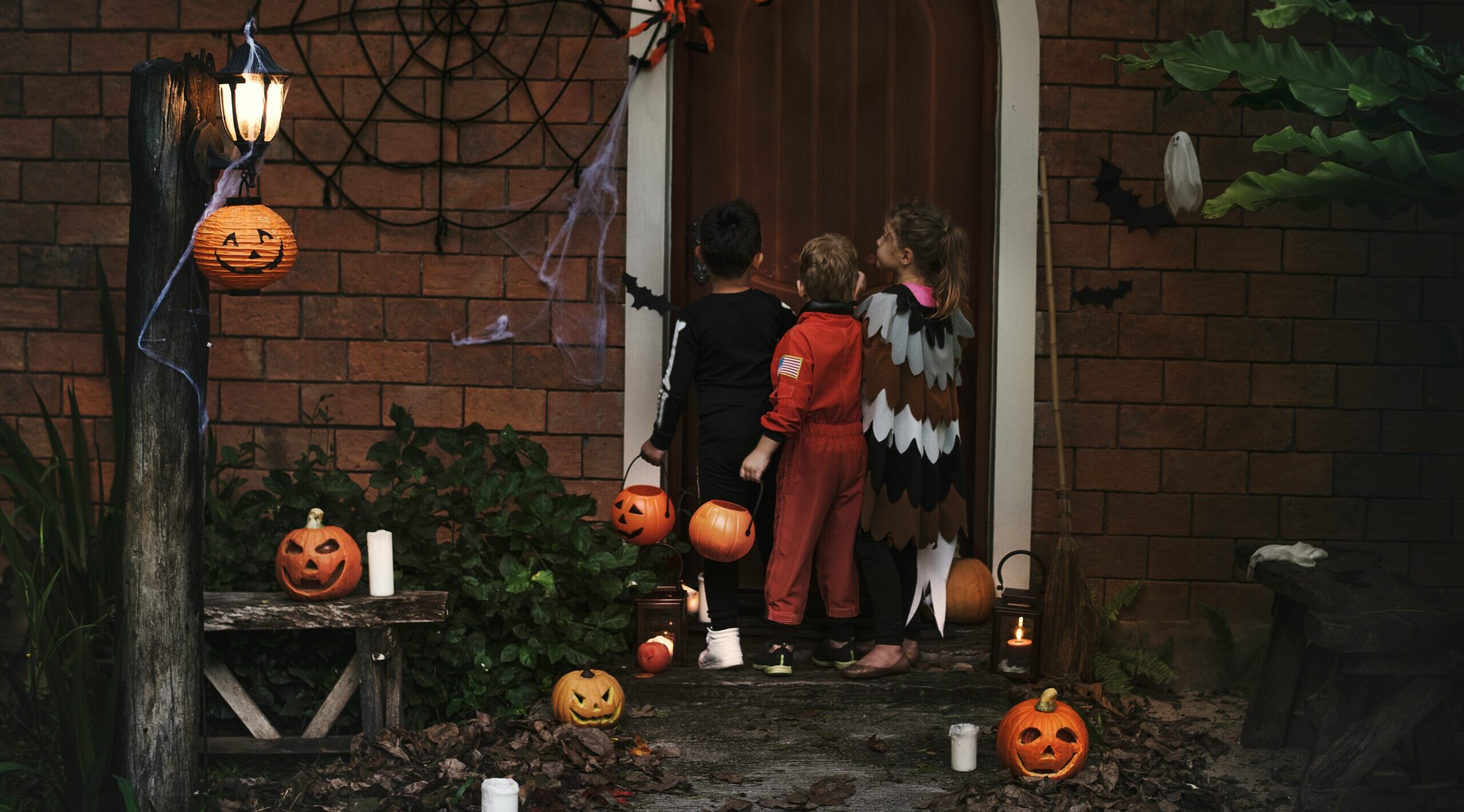
It’s that time of year again. The leaves rattle crisply down the sidewalks. The evening skies burn orange and pink. Everywhere you look, pumpkins, goblins, witches, and ghouls stand guard on the neighbors’ doorsteps.
There is no denying it. Over the past couple of decades or so, our culture has seen a significant rise in the popularity of Halloween. What used to be a minor one-day event on the calendar has been transformed into a major seasonal holiday for many families. Terms like “sweater weather” and “harvest” are out. “Spooky season” is in.
Interestingly, it is not just the secular world that has fallen in love with Halloween. It is the Catholic world too. The idea of reclaiming Halloween is trending right now among many Catholics. One simply has to open Instagram in October to be hit with a slew of educational videos from Catholic influencers and major companies, all championing the idea of celebrating Halloween. Not only is it okay, they say. It is good. Not only should Catholics get comfortable with the idea of Halloween. They should embrace it.
On the other side of the argument are the Catholics who still fear, deep down, that there is something problematic about embracing Halloween. A holiday that seems to glorify death and despair seems at odds with the Christian message of hope and the dignity of human life.
Who is right? Is it even possible for Catholics to reclaim Halloween? In order to answer this question, we must look carefully at the logic on both sides of the argument.
Those in favor of reclaiming Halloween will almost always point to the same set of facts, which make up what may be called the “historical argument” for celebrating Halloween. This argument explains that Halloween is actually a part of the Catholic liturgical calendar. It constitutes the first night of Hallowtide, a three-night “triduum” of sorts, celebrating the many parts of the Body of Christ. Halloween (originally called “All Hallow’s Eve”) was traditionally the night when Catholics prayed and prepared for the coming feasts of All Saints’ Day and All Souls’ Day. In medieval Ireland and Great Britain, peasants would go door-to-door selling soul cakes in exchange for prayers for the dead. The practice of souling is one of the many traditions that influenced modern-day trick-or-treating.
If Halloween was originally All Hallow’s Eve, an important day on the Christian liturgical calendar, then why surrender it to the forces of evil?
Proponents of the historical argument say that because Halloween is Catholic in its roots, we should reclaim the holiday today by celebrating it fully. Trick-or-treating, dressing up, and exchanging candy are harmless nods to these older traditions, much like putting up a Christmas tree in December. Spooky decorations don’t have to be seen as evil, they say. They are a reminder to keep always before us the reality of our own mortality (memento mori), so that we might live not for this earth but for heaven.
Against the historical argument for celebrating Halloween stands what may be called the “argument from modernity.” This argument focuses not on what Halloween used to be, but on what it has become. The argument from modernity objects that while Halloween may have been celebrated by Christians in the past, it has become a completely secular holiday filled with grotesque and even demonic imagery and practices.
Proponents of this view are quick to remind us that Halloween stands as the highest feast day on the Satanic calendar. They assert that it is the night of the year on which the most human sacrifice takes place. Ex-witches admit to cursing their property on Halloween night as well as the candy they hand out to unsuspecting children. Proponents of this argument are quick to cite the many ex-occultists and ex-Satanists who emphatically warn Christians against participating in even the most seemingly innocent aspects of Halloween. There is no middle ground when it comes to Halloween, they say.
Unfortunately, there are problems with both the historical argument and the argument from modernity. The historical argument fails because it equivocates the Halloween of old with the Halloween of today. Just because Halloween in its roots was Catholic does not mean that Halloween as it is celebrated today is Catholic. Halloween has become undeniably mixed up with evil practices and imagery. It’s virtually impossible to celebrate Halloween without exposing (and potentially desensitizing) ourselves to this imagery. Unlike Christmas, Halloween’s secular turn was not innocent; it was dark. Families are right to be cautious about a holiday that presents death and gore as fun and innocent. To say that the secular version of Halloween is worthy of our participation simply because some aspects of it used to be Christian is a weak argument.
As Christians we must be cognizant and prudent about the desensitization that happens when we expose ourselves to darkness.
Additionally, the historical argument diminishes the fact that Halloween practices don’t come from exclusively Christian traditions. They also come from pagan ones. For example, the practice of trick-or-treating does not only come from the Christian tradition of souling. It also has roots in the Celtic pagan feast of Samhain, on which people would dress in disguises so evil spirits couldn’t bother them, and the Scottish and Irish tradition of “guising,” dressing up in costumes and performing small tricks in exchange for food or coins. Scottish and Irish immigrants brought all of these traditions overseas with them—the pagan as well as the Christian—and they all influenced what we call trick-or-treating today. Tracing the practices of Halloween back to exclusively Christian roots is not as straightforward as some would like to believe.
But the argument from modernity also has issues. Those who believe that Halloween belongs exclusively to the devil are perhaps giving up the fight too soon. If Halloween was originally All Hallow’s Eve, an important day on the Christian liturgical calendar, then why surrender it to the forces of evil? An attack from Satan is not a reason to step out of the arena. It is a reason to step in and fight the good fight, bringing light to the darkness and combating evil with good. If Satan’s army works harder on Halloween, then Christians should too. We have a duty on Halloween night, and it is not to simply lock our doors and be passive.
So what are Catholics to do? In the end, the answer is not as simple as either side would like it to be. To start, we must admit that the world’s version of Halloween is not trying to glorify God. Most people aren’t trying to remember their mortality and cling to the things of heaven when they put witches, skeletons, and dismembered body parts in their lawns. Evil is at work on this night, and it would be foolish to turn a blind eye to this. As Christians we must be cognizant and prudent about the desensitization that happens when we expose ourselves to darkness. If we pretend that there is a “fun” or “innocent” version of darkness, we are playing right into the enemy’s hands.
However, we also ought not give up the fight. Catholics can and should reclaim Halloween, just not in the way that some think. Catholics won’t reclaim Halloween simply by going to secular Halloween parties or trick-or-treating. Catholics won’t reclaim Halloween by participating in haunted houses or watching horror movies. Catholics never reclaimed anything in the world by simply doing what everyone else was already doing.
Catholics will reclaim Halloween by going to Mass on the evening of October 31. Catholics will reclaim Halloween by praying for their departed family members by name on that night. They will reclaim Halloween by inviting their friends to a Rosary walk at the local cemetery. Above all, Catholics will reclaim Halloween by honoring its place within the larger celebration of Hallowtide, and especially by leaning into the culmination of the feast two days later on All Saints’ Day, when we celebrate the Church triumphant over death in all her glory.