
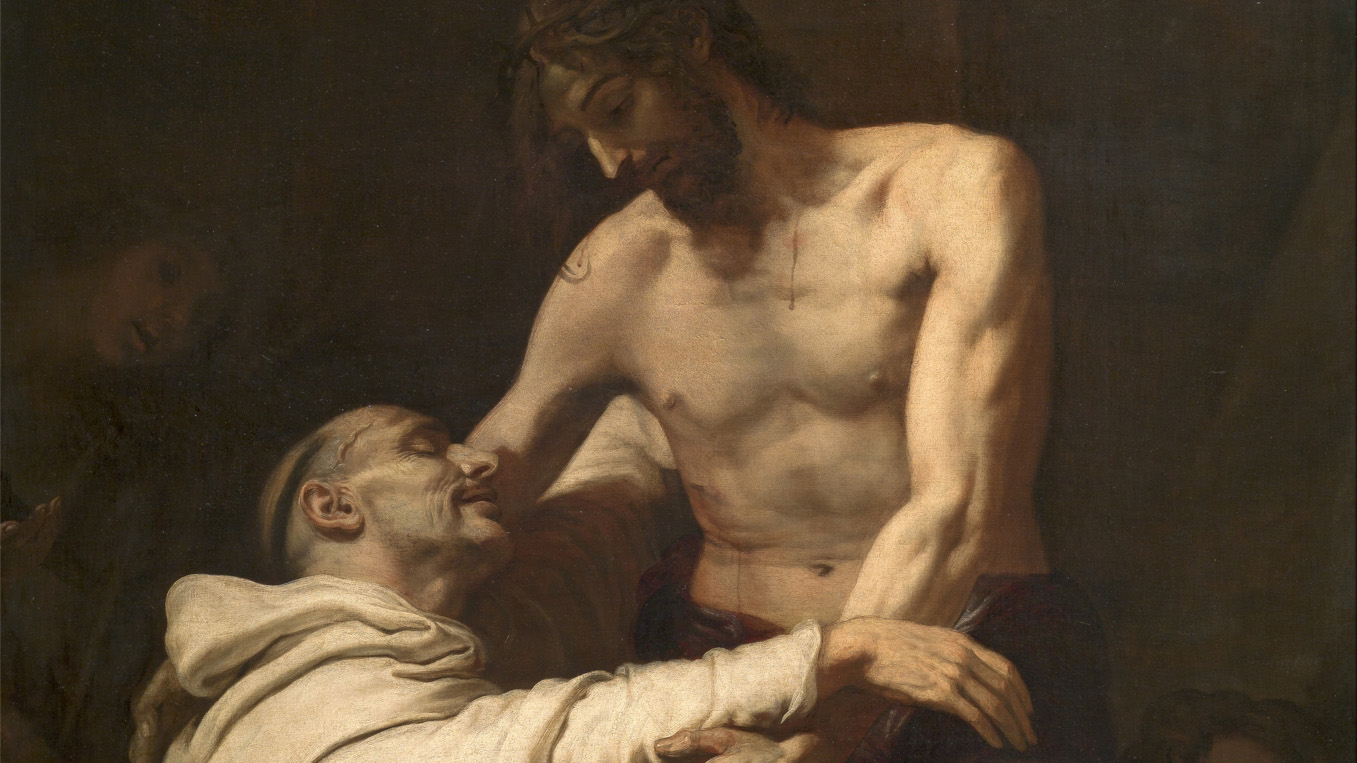
Its walls breached and temple razed, Jerusalem, the city of God’s worship, was laid to waste by the destructive power of Babylon. In the aftermath of this disaster, Baruch prophesied its meaning, reproving Israel for her infidelity while promising her redemption. These twin themes color his message as he contrasts the ruinous effects of idolatry with the glory of godly worship. Escalating toward an apocalyptic vision of their exaltation, Baruch reveals a new and hallowed name for God’s people, indicating their identity: “your name shall be named forever by God: the peace of justice, the glory of God’s worship [δόξα θεοσεβείας]” (Bar 5:4 NABRE).
Modern life, marked as it is by competing philosophies and challenges to the faith, shares similar social confusions as pre-exilic Israel. Uprooted from a culture of established worship, modern man has become uncertain of his creation and calling. Seeking meaning, he exchanges earthly causes and material pursuits, each betraying him. Our call nevertheless remains the same as those Israelites who were urged to renounce idolatry and to recover their vocation in right worship. In this sense must each Christian lay claim to his authentic identity and exalted name bestowed by God, “Righteous Peace, Godly Glory,” (Bar 5:4) which he shares in and through Christ, the true temple.
The modern project of secularism, which exiled God from the public sphere, has produced new forms of idolatry, fracturing society—a reality reflected in man’s own interior life. In this sense is our cultural crisis of identity mirrored in man himself. No longer grounded in his faithful foundation, man pours himself into countless forms, constructing his identity from below, rather than receiving it from above. Because these mutable identities are unstable, the contemporary mind is often plagued by anxiety and despair.
Whereas idolatry scatters man’s powers and personality—so vividly shown in Israel’s own exile—right worship produces unity. Notably, this unity is not only an outward communion among peoples, but an interior integration within one’s own self. Gathered from such dispersion, man recovers himself, worshipping in spirit and truth. This implies integration within Christ’s own body of sacrifice and therefore also entails one’s own self-gift.
The modern project of secularism, which exiled God from the public sphere, has produced new forms of idolatry, fracturing society—a reality reflected in man’s own interior life.
It is well known that Christ is high priest and perfect sacrifice, the one who offers and is offered at each Holy Mass, though our participation in this twofold role of priest and victim is often less considered. Baptized into the universal priesthood, each of us is privileged to partake in that Eucharistic liturgy wherein the priest, acting in the person of Christ the head, offers “my sacrifice and yours” to God the Father, as we the laity, the very members of Christ’s body, unite ourselves to this sacrificial action. In this way do Christians fulfill St. Peter’s command to be “built into a spiritual house, to be a holy priesthood, to offer spiritual sacrifices acceptable to God through Jesus Christ” (1 Pet 2:5). Though the ordained priest acts in an order altogether distinct from the laity, the baptized all rightly participate in the Eucharistic offering, donating their very lives and selves together with Christ’s sacrifice.
As Christ is offered to God the Father at the Mass, his members are likewise called to be conformed to and included in this sacrifice. For this reason, St. Paul commands Christians to “present your bodies as a living sacrifice, holy and acceptable to God, which is your spiritual worship” (Rom 12:1). Worshipping in “spirit and truth” (John 4:24), Christians are gathered in Christ’s spirit and incorporated in the temple of his body. Thus united to his sacrifice, we are jointly offered at the Mass, realizing spiritual worship.
By this wholly unique act, man may discover his authentic identity, for this mystery is not manifest by consumption, conformism, nor capitulation to passions—that is, self-enclosed acts of idolatry—but by realizing his rational capacity for love, which in a composite being of body and soul implies some manner of embodied self-giving. This way of heroic love was forged by Christ upon the cross, a deed made sacrament in the Eucharistic gift.
That man’s identity may be evinced in worship is a mystery that may be contemplated in light of the ground of reality itself—that is to say, the Trinity. For we may observe that the identity of God the Son, who existed from all eternity, is realized in relation to God the Father. Indeed, each of the persons of the Trinity is constituted as relations: Each is a self-communication, as it were, to the other.
The Son alone, however, took on flesh, drawing his humanity into the self-giving dynamic proper to his person. This profound reality is manifest in the sacrificial action of the cross, wherein his humanity bears witness to his donative love. Responding to this gratuitous love, our call is to graft ourselves into Christ’s Body of worship, finding ourselves in this self-giving act. Caught up in Christ’s self-offering, our false selves fall away, even as our own weak love is purified and our own dim vision clarified. United to him in Holy Communion, we become one body, confirming our identity.
As they simply are relations, the Trinitarian Persons would not be themselves, so to speak, apart from their self-giving communication. Accordingly, man is not made to be a self-enclosed monad but one in self-giving relationship. The act of worship allows man to break forth from the prison of self; it actualizes his radical potency for self-communication, which must be fulfilled for him to be himself.
Idolatry turns man inward as he focuses on consumption and control: the consumption of sense goods and the control of all things. True worship, however, reverses this paradigm, drawing man from himself so that he yields to God, seeking him for his own sake. The path to the divine is thus one of renunciation and surrender. In right worship—that integrated act of self-gift which takes place in and through the Son—we respond to that love with which the Father first loved us, offering him thanksgiving in Christ. In this act, we are conformed to the Son, realizing our identities in his body of self-giving love. Reflecting on these themes, St. Augustine connects the mystery of the Christian identity to the mystery of faith, writing:
If you are the body of Christ and its very members, then the Mystery of your identity is upon the Lord’s table. You receive the Mystery of the Lord, responding “amen” to what you are, and by responding, assent. As you hear, “the body of Christ,” you respond, “amen.” Be then a member of Christ’s body that your “amen” may be true.
Modern culture often thinks itself beyond idolatry, viewing the infidelity of societies such as pre-exilic Israel as historical ignorance. Nevertheless, modern observance of the Lord’s Day has been forsaken by the greater part of humanity as man invests himself in creation. In this way does contemporary man practice far graver idolatry, rejecting the revelation of the Incarnate God, choosing exile. Notably, all such idolatry effaces one’s identity; the undue honor of created things degrades man, reducing him to their level. For this reason, the Psalmist sings:
The idols of the nations are silver and gold, the work of human hands. They have mouths, but they do not speak; they have eyes, but they do not see; they have ears, but they do not hear, and there is no breath in their mouths. Those who make them and all who trust them shall become like them (Ps 135:15-18).
By contrast, St. Paul says of Christians: “Clean out the old yeast so that you may be a new batch, as you really are unleavened. For our paschal lamb, Christ, has been sacrificed” (1 Cor 5:7). Remarkably, Christians are said to be unleavened because of Christ’s sacrifice. As sin is a foreign agent, incompatible with both nature and grace, it must be cast out that man may recover his true face. This reality takes place by uniting oneself to Christ’s sacrifice, present daily upon the altars of the Church.
Observing the dictates associated with the Lord’s Day, man is gathered from the dispersion of his powers and from the world so that his heart may rest recollected in adoration. Living an integrated life of sacrificial worship, Christians may fulfill their call to become the “praise of his glory” (Eph 1:12) and the “glory of God’s worship” (Bar 5:4 NABRE), rejecting the dark allures of idolatry. Eucharistic Prayer IV in the Roman Missal summarizes these themes in a single sentence:
Look, O Lord, upon the Sacrifice which you yourself have provided for your Church, and grant . . . to all who partake of this one Bread and one Chalice that, gathered into one body by the Holy Spirit, they may truly become a living sacrifice in Christ to the praise of your glory.” (emphasis added)
The self-affirmations of secularism will not suffice for us to recognize the mystery of our making in God. Nor will self-referential worship draw us from ourselves, revealing our relational nature. Until we lay our hearts prostrate in perfect praise and self-offering, they will never be manifest, remaining self-contained and hidden. It is not in self-satisfaction but in self-offering that we discover that profound mystery of our identity in Christ as he foretold, “Whoever wishes to save his life will lose it, but whoever loses his life for my sake will find it” (Matt 16:25).
In worship, our ineffable identity is revealed as a mysterious member of Christ. Made by him and for him, made anew in him and into him, we find ourselves by giving ourselves to God. In this way is our prophetic call and identity realized as the “glory of God’s worship.”