
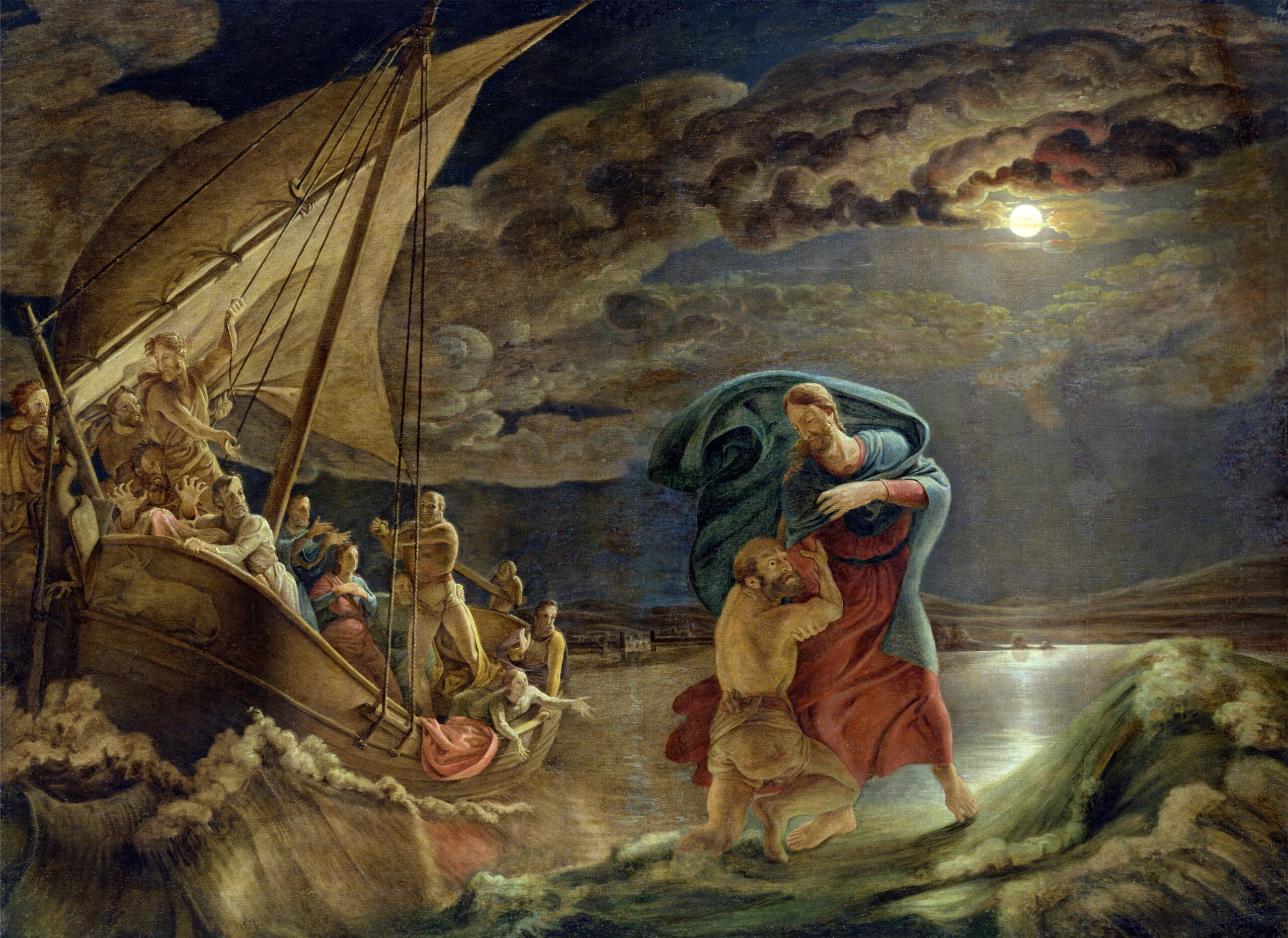
Drawn upon the watery abyss, St. Peter fleetingly appeared to overturn nature and her laws, advancing toward Christ. The disciples, clinging to the boat in that fearful storm, surely locked eyes upon him, a mortal man treading upon the deep. What appeared a pure contravention of nature paradoxically revealed a deeper reality—a truth less perceptible to the senses. Standing upon the waves without support, Peter manifested the ultimate source of man’s support, both metaphysically and spiritually.
Though Christians often misunderstand man’s relationship to the Creator, holding to naive models of the deists, this passage wakens us to the radical and immediate manner in which God upholds creation. This metaphysical truth further speaks to God’s action in the spiritual life as he is likewise sovereign. In this sense, Peter’s miraculous stance upon the sea portrays for us that total confidence we ought to have in God, whose providence embraces all things. As the source of existence and font of every blessing, God is the ground of both nature and grace.
As the source of existence and font of every blessing, God is the ground of both nature and grace.
To many, creation is a historical product of God’s action—self-sustaining and essentially complete. Accordingly, God need only observe the universe from without, intervening where necessary. This, of course, was the error of the deists, who distanced God from his own creation, casting doubt on his spiritual care. In truth, however, the mystery of creation is far deeper, more intimate, and indeed more magnificent than such impersonal models, which contradict revealed religion and reason. Creation is a now event. The present moment—with all that it entails concerning both time and space—is pure gift, immediately known and loved into existence. It is not a self-sufficient reality, spun into motion in days past, simply speaking, but a nexus of contingent realities that ultimately rely upon God in this moment.
Though God gave creation the dignity to exist in its own right, all is ultimately underwritten by him. He alone necessarily exists, for his nature is to be. All of creation, by contrast, is radically contingent, unable to sustain itself. Consequently, it is wonderfully comprehended and sustained in the divine gaze.
When St. Peter stepped upon the water, it was not on the strength of his own estimated powers but with faith in the one God who had made all things (Gen 1:1), commanded the wind and seas (Ps 107:29–30), and for whom the heavens themselves give glory (Ps 19:1). This is to say, Peter knew from Scripture that creation proceeds from God, is sustained by God, and is at the service of God—not the other way around. As St. Paul would say, “In him we live, and move, and have our being” (Acts 17:28).
If St. Peter was so radically suspended between reality and void, as we have established, it stands to reason that his position upon the sea was little different than that upon land. Radically held in existence by God, and subject to his providence, Peter ought to have had little less confidence upon water than land, little more confidence upon earthen rock than sea. In the grand state of affairs, Peter was known, held, and called forth by the One who stood before him.
While God ordains that creation should operate within a natural set of causes, fostering rational order, the apostles’ moral failure—found in the parallel account from St. Mark—touches on matters of providence, revealing the deeper significance of this episode. Faulted for their fear in the tempest, we are told that the apostles “did not understand about the loaves, but their hearts were hardened” (Mark 6:52)—an apparent non sequitur. What appears as a misplaced remark, referencing Christ’s multiplication of the loaves, manifests the central mystery at hand: The apostles utterly fail to recognize providence.
God, the giver of every good gift, had spread a table before them earlier that day, allowing them to taste of his provident care; nevertheless, they trusted not in him but in the material circumstances around them. When similarly tested with such existential distress, Christ spurned the sufficiency of materiality, declaring, “Man shall not live by bread alone, but by every word that proceeds from the mouth of God” (Matt 4:4). Observing Christ’s words, the apostles would have pierced the veil of secondary causes, finding refuge and shelter in their author and ultimate cause.
God’s existential protection is boldly treated by that eminent teacher of providence Julian of Norwich, who writes: “If a man or woman were under the broad water, if he might have sight of God, so as God is with a man continually, he should be safe in body and soul, and take no harm: and overpassing, he should have more solace and comfort than this world can tell.” Appealing to God’s absolute creative power, Julian assures that the constellation of material circumstances prove secondary for him who is united to God.
Each movement in the spiritual life begins with God’s extension of grace.
Strengthened by the knowledge of God’s creative nearness—his immediate metaphysical providence—we may discern this same care in the life of grace. We might imagine that we stand upon our own hard-won virtue, praiseworthy actions, or sacrifice, but everything stands on mercy. That is to say, each movement in the spiritual life begins with God’s extension of grace, which is itself a created reality, and every good work is thus sustained. In this way, we may choose to be caught in the divine current, flowing from God’s heart to our own, bearing us up to eternal life. The sum of all such movements are known from eternity as Christ implicitly assured, “You have not chosen me, but I have chosen you” (John 15:15, DR).
Man’s hallowed aspirations do not fall outside of God’s providence but find their genesis and fulfillment in him. This, of course, was the ancient Church’s position against Pelagius, who supposed man’s own actions preceded grace, whereas God is the very cause of our holy desires. Reassuring souls that their prayers originate in him, God revealed to Lady Julian: “I am Ground of thy beseeching: first it is my will that thou have it; and after, I make thee to will it; and after, I make thee to beseech it and thou beseechest it.” Ever anticipated by grace, our paths are foreknown and made plain by God’s solicitous care.
Our consequent role in spiritual standing, or advancing forward, is much the same as St. Peter’s physical walking. If we look to our own resources, we will ever find ourselves wanting, unable to persevere in a life of grace. We must be stripped of all things, left unsupported and unfettered, so that the animating breath of grace may draw us aloft. Stilling ourselves, we must look alone to Christ who is full of grace (John 1:14), allowing him to act. All false supports must be cast aside—the world’s good graces, self-satisfaction, and deceit. It is for this reason that Julian of Norwich frames the spiritual life in terms of contrary postures, assuring us that “in the Beholding of God we fall not, and in the beholding of self we stand not.” Only when we are rooted in Christ alone do we stand secure, immune to the winds of adversity from without and the waves of instability from within.
Freed from constraints and impelled by love, St. Peter was, for a few blessed moments, able to step upon the broad waters and walk toward Christ—“without support, yet with support,” as St. John of the Cross would express it. These luminous words, which depict the sentiments of one who has transcended all things so as to rely on God alone, resonate with the mystic sense of this passage. John’s poem “Gloss on the Divine” continues:
My soul is detached
from every created thing
and raised above itself
in a sublime life
supported by its God alone.
Therefore, it may be said
what I value most
is that my soul sees itself
without support, yet with support.
The modern tendency to circumvent the practice of asceticism means that man may ever stand on created supports—corruptible and traitorous. But one cannot have God and the world, assimilating them as equals. All created things need to be utterly submerged into the divinizing fire of the Godhead, subordinated to him who orders all. As St. John emphasizes, the soul must be radically disentangled from all finite provisions, relying on God alone. In this sense, trust becomes the key to casting ourselves upon the Creator, without merit and without reserve, knowing that he will not suffer us to fall. Thus did Christ encourage the apostles in the storm: “Take heart, it is I; have no fear” (Matt 14:27).
It is only through surrender to God and divestment from the world that man will find himself in that transcendent stance supported without support.
Far from advocating an ill-conceived fatalism, quietism, or rashness, the path here described is little other than humility. When man believes his own strength sufficient, pride soon reveals the sum of his created powers, and he falls upon his nothingness. Indeed, there is no weight so heavy for dragging us to the earth as our own ego. It is humility profound that permits man to rise high amid spiritual dangers and to walk upon storms, standing in the might of God. Cooperation is necessary. Human agency is necessary. But it is only through surrender to God and divestment from the world that man will find himself in that transcendent stance supported without support.
The post-Enlightenment West lost sight of God’s metaphysical presence in the world before it lost its mystic faith. Recovery of both is necessary to move man from reality’s center so that God will be found in his rightful place. God not only intimately upholds the material moment but lovingly sustains us in the life of the spirit. The immediacy of such providence ought to inspire us with great confidence in the workings of grace, ever underwriting our holy aspirations, ever drawing us toward our final goal. In light of these truths, Christ’s question to St. Peter is all the more poignant and all the more distressing. How Christ’s heart must have ached when obliged to ask, “Why did you doubt?” (Matt 14:31).