
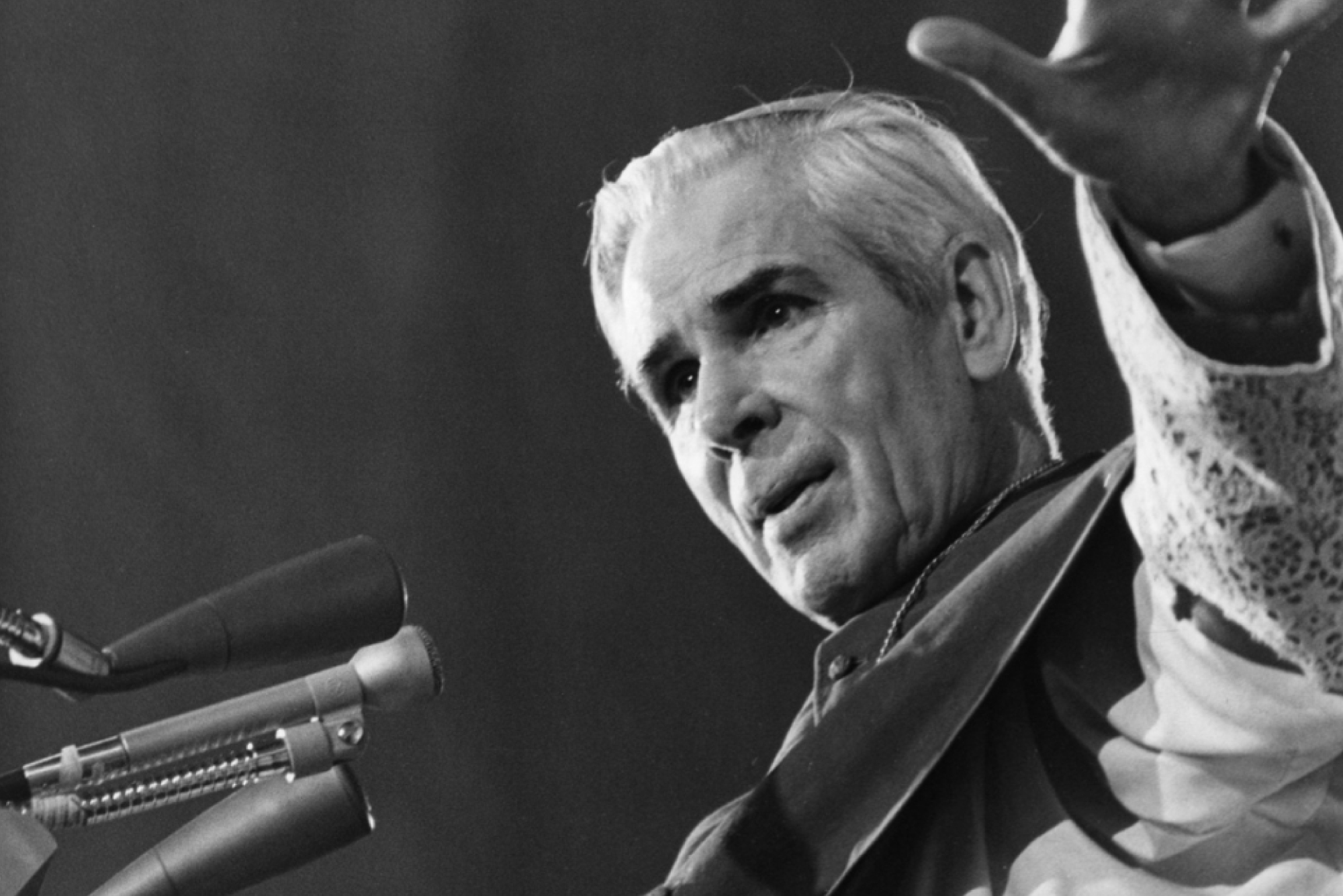
On September 24, a man already beloved by multitudes in the Catholic Church will finally receive the title of “Blessed.” Though not yet canonized, he is already a household name throughout the United States. He was the first television evangelist in history, with an influence so pivotal that the FBI kept a file on him for much of his life and America magazine called him “the greatest evangelizer in the history of the Catholic Church in the United States.” Perhaps America’s favorite priest, he is Bishop Fulton J. Sheen.
On May 8, 1895, the first of four sons was born to Newton Morris Sheen and Delia Fulton in the second-floor apartment above Mr. Sheen’s hardware store in El Paso, Illinois. He was christened Peter John Sheen in the diocese of Peoria. Unfortunately, he was sickly as an infant and was usually taken care of by Delia’s side of the family, and so, when enrolled in school, he was enrolled as a Fulton. He eventually went by Fulton Sheen.
As a boy, Fulton never desired any path other than the priesthood. When he was eight years old, he was altar serving for Mass with Bishop John Lancaster Spalding—the historic first bishop of Peoria and co-founder of the Catholic University of America (CUA)—as the celebrant. A cruet was dropped and smashed into pieces, and Bishop Spalding had a talk with the young future bishop after Mass. Somewhat out of the blue, Spalding predicted to the small, shaking altar boy that he would one day study in Louvain, Belgium. And then he said, “Someday, you will be just as I am.”
Fulton attended high school at the bishop’s own Spalding Institute. Now a tall, slender figure, his intense blue eyes were so deeply set they looked black. He did well in the academic world and went on to St. Viator College followed by the Saint Paul Seminary in Minnesota. He was ordained on September 20, 1919, at the age of twenty-four but continued his studies at CUA. In 1921, Fr. Fulton Sheen did indeed go to Louvain, Belgium, to further his studies and then to Paris and Rome from 1923 to 1925.
What was supposed to be a two-week stint turned into a regular occurrence as the listeners couldn’t get enough of Fr. Sheen’s talks.
In 1926, when he was thirty-one, he taught theology at St. Edmund’s College in England. Former teachers of his recommended him for prestigious positions, but his bishop called him back to a small parish in Illinois. He was only there for eight months, however, before being assigned to teach at CUA. Fr. Sheen asked the bishop why he didn’t just send him immediately to CUA instead of waiting eight months. The bishop replied, “I was afraid you might become proud. I wanted to find out if you were obedient and would do what you were told.” Sheen would teach at the university for twenty-three years, and countless numbers of students and visitors would overflow in room 112 in McMahon Hall to hear a lecture by the revered professor.
His reputation for speaking meandered off the campus, and in 1926, Fr. Fulton was asked to record a series of Sunday evening sermons for a New York radio station. In 1930, he was asked to fill in for an absence on the radio program, The Catholic Hour. What was supposed to be a two-week stint turned into a regular occurrence as the listeners couldn’t get enough of Fr. Sheen’s talks. He ended up speaking on the show for twenty more years.
In addition to his classes and regular radio appearances, Fulton Sheen began teaching classes to converts, taking the train from Washington, DC, to New York almost every weekend. He also started preaching on street corners in the South, accompanied by a sign that read, “Questions cheerfully answered.” His work attracted more than a few, and in 1934, Pope Pius XI granted him the honored title “Monsignor” when he was only thirty-nine.
In 1937, he wrote to the university’s rector, Msgr. Corrigan, and said,
During the past year letters demanding personal attention have run between 75 and 100 a day. . . . This coupled with classes never given with less than six hours preparation for each lecture has left me physically exhausted. However the good to be done is such that one dare not shrink from its opportunities for apostolate.
Msgr. Sheen did not slow down but spoke all over the United States and was a columnist for the secular press. On Easter Sunday 1940, he preached in history’s first televised Catholic religious service on what would later be New York’s WNBC. Ten years later, the beloved professor at last left the university and became the national director of the Society for the Propagation of the Faith.
On June 11, 1951, at the age of fifty-six, the monsignor was consecrated a bishop. That fall, Bishop Sheen launched his beloved television series Life is Worth Living. With an estimated thirty million viewers, it was the most widely-viewed religious TV series in the history of television. He was awarded an Emmy for Most Outstanding Television Personality and appeared on the cover of Time magazine.
When filming, Sheen never used notes or prompters, but he did not credit his speaking as extemporaneous; each thirty minutes of showtime came from thirty hours of preparation. Ted Bergman from the DuMont Television Network said, “Bishop Fulton Sheen didn’t wear a watch. But he came out at 22:30 every single time out. How he did it, I never knew. I finally went to him and said, ‘Your Excellency, how can you do this? Do you have a clock in your head?’ He said, ‘When you’ve been teaching as long as I have, you know exactly how long to talk.’”
In 1966, when his radio and television presence had progressed for some forty years, he was assigned to be the bishop of Rochester at seventy-one years old. Sheen had always been very absorbed in the plight of the poor, and that certainly didn’t change now, but, for unclear reasons, the diocese of Rochester didn’t want to pursue that mission with him. Among other disagreements, Bishop Sheen had requested that every parish set aside five percent for the needy, but not every parish followed his lead right away. There were objections, and they wanted to talk about it.
During Sheen’s term as Bishop of Rochester, everyone felt they needed to be listened to; everyone had an opinion, and it needed to be heard. Sheen, on the other hand, was from a generation of priests who simply did what their bishop asked of them. They were from the generation of dialogue—he was not. He resigned in 1969, stating, “I am not retiring, only retreading.”
He began spending his time giving retreats for priests in America, Canada, England, and Ireland. He was very concerned about the loss of priestly identity he was witnessing. The alter Christus, sacrificial nature of a priest was being forgotten, drowned out by social work and apostolates. Distracted from Christ, there was a growing crisis of priestly identity, and vocations were plummeting. His chief recommendation was for priests to spend an hour in front of the Blessed Sacrament every day; for the laity, he prescribed at least thirty minutes.

After a long battle with heart disease, Bishop Sheen went in for open-heart surgery in July 1977. From that point on, he began slowing down, and his public appearances lessened. Two years later, on October 2, 1979, a crowd of Catholics filled St. Patrick’s Cathedral in New York. His Holiness, John Paul II, would be giving an audience there soon, but hadn’t arrived yet. An eighty-four-year-old bishop entered the church, and, recognized by everyone there as their beloved Bishop Sheen, applause erupted from the entire congregation. This would be his last public appearance. When the pope arrived, he called Fulton J. Sheen forward. He hugged him, and as the two future saints embraced, the pope said, “You have written and spoken well of the Lord Jesus. You are a loyal son of the Church!”
On October 11, 1979, Pope John Paul II wrote to Fulton Sheen, congratulating him on his six decades as a priest: “God called you to proclaim in an extraordinary way his dynamic word . . . in these six decades of your priestly service, God has touched the lives of millions of the men and women of our time.” Sheen wrote back, “I bow in humble gratitude for the Pontifical approval of my ministry of the Word.”
On December 9 of that year, the beloved bishop died on the floor of his private chapel in front of the Blessed Sacrament, likely praying his holy hour as he had always done.
In all, he wrote sixty-six books and was responsible for countless conversions, including several well‑known celebrities. He had raised millions for the Catholic missions, and no one could deny the influence he had. In Vatican II, he had worked very closely with the future Benedict XVI, who later recalled in a 2012 interview, “Fulton Sheen . . . would fascinate us in the evenings with his talks.”
He had all the prominence, all the intellect, and all the diplomacy to be a cardinal, but he was never elevated to that rank. This fact perplexed many people, and in a 60 Minutes interview with Mike Wallace, Sheen was asked why he thought this was the case. The bishop hinted that he could have risen, had he wanted to pull strings. Wallace asked him, “Are you an ambitious man?” Sheen thought and answered, “I suppose there certainly must be ambition in me, because ambition is really, in a certain sense, drive for perfection. But I have never deliberately sought any kind of honor. It is possible for a man in the church to go up and up, and I could have gone higher and higher and higher. But I refused to pay the price.” Evidently, there were church politics that Sheen didn’t want to be a part of, but he never spoke about it.
Bishop Fulton Sheen was not afraid to be a Catholic, whether that be on a local radio station or on television for an audience of thirty million, and the modern world of Catholic media in America owes it all to him.
His lack of cardinal status did not diminish the scope and success of his mission nor the endurance of his legacy. The education archivist for CUA said, “Catholics had pretty much been excluded at the national level . . . he instilled in them a sense of confidence that enabled their inclusion into American society.”
Fr. Charles Connor, an accomplished church historian, was asked what we can learn from Sheen’s legacy, to which he replied, “The lesson that can be learned is: Be Catholic. Be authentically Catholic, nothing but Catholic, and don’t water down . . . be what you are, and nothing less than what you are.”
Bishop Fulton Sheen was not afraid to be a Catholic, whether that be on a local radio station or on television for an audience of thirty million, and the modern world of Catholic media in America owes it all to him. There are now more Catholic radio programs than ever before, even more televised and online sermons, and the presence of the Church in the world of media now seems like a given—but Bishop Sheen was the first to do it all.
He gave a resounding voice to Catholics—and who could forget that voice? Who could forget his words, so grave yet, at times, so comical? Who could forget his deep-set stare, so austere yet so bright? Who could forget his theatrical way of speaking and the flourish of his writing on his ever-present chalkboard? It seems fitting to close with the unforgettable words that the beloved Sheen used to end every episode: “Good-bye now, and God love you!”