
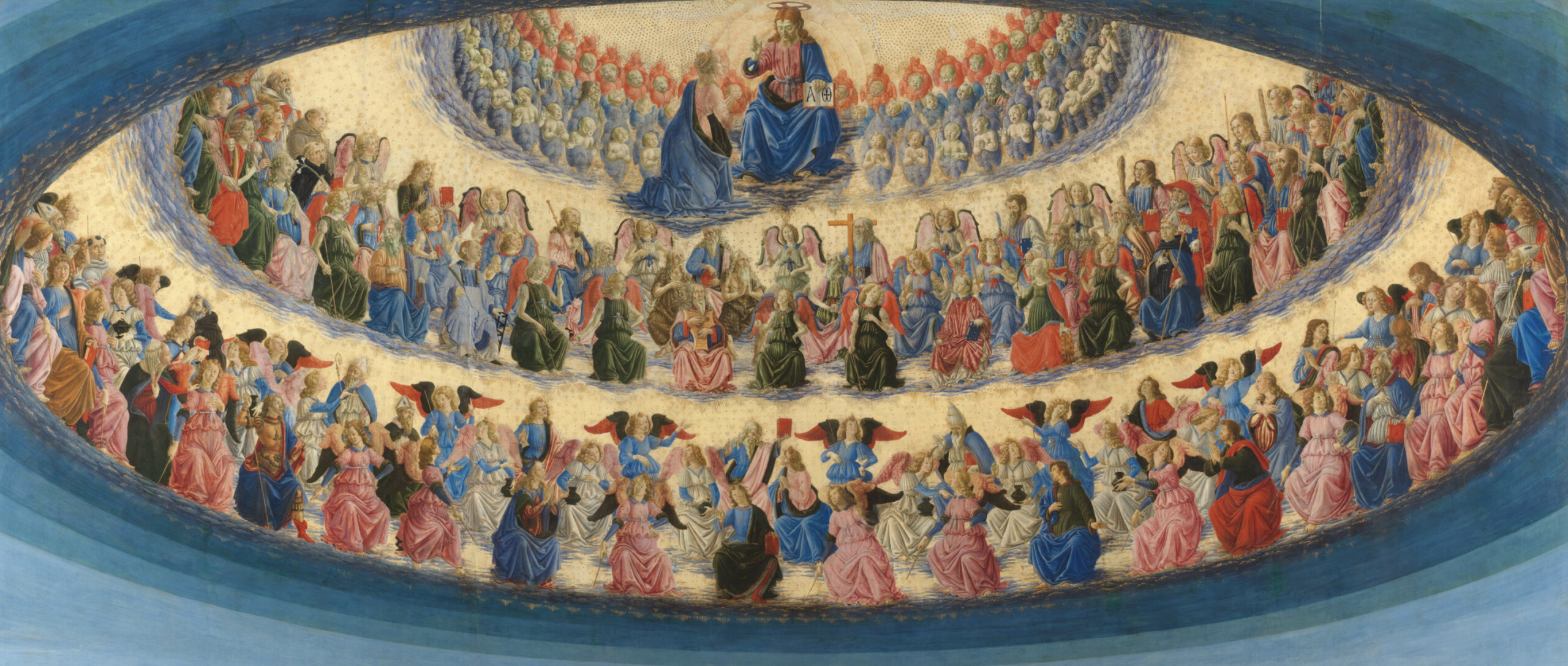
On August 15, the Catholic Church celebrates the Solemnity of the Assumption of the Blessed Virgin Mary (the “Dormition of the Mother of God” on some Eastern Catholic liturgical calendars). While an exhaustive and conclusive treatment of this dogma—that the soul and uncorrupted body of the Virgin Mary was taken up into heaven at the end of her earthly life—cannot be mounted in a short article such as this, I nevertheless wish, in honor of this solemn feast, to provide some brief insights into this beautiful truth and point the reader to some valuable resources for further study.
Famously, Pope Pius XII defined the assumption of Mary as a dogma on November 1, 1950, in his apostolic constitution Munificentissimus Deus (Most Bountiful God). Because of the rather recent dating of this dogmatic definition, some people have the false impression that belief in Mary’s assumption is quite novel. In reality, however, Mary’s bodily translation into heaven has been explicitly held by Catholic, Eastern Orthodox, and Oriental Orthodox Christians from very early on. Before the so-called Protestant Reformation, no major ecclesial body denied Mary’s bodily assumption. Actually, even some reformers affirmed Mary’s assumption, such as Heinrich Bullinger (1504–1575, a Swiss reformer and the successor of Zwingli).
Although the solemn definition of this dogma occurred via the exercise of papal infallibility, it was anything but a top-down imposition. Quite the contrary, as Pope Pius XII remarks in the document, “When we were elevated to the throne of the supreme pontificate, petitions of this sort [to declare the assumption a dogma] had already been addressed by the thousands from every part of the world and from every class of people, from our beloved sons the Cardinals of the Sacred College, from our venerable brethren, archbishops and bishops, from dioceses and from parishes” (9).
Pius XII had these petitions collected and “carefully evaluated” (10). Their publication took up two volumes (see note 3). Taking this grassroots and universal petition seriously, Pius XII “commanded that, by corporate effort, more advanced inquiries into this matter should be begun” (10). Additionally, he petitioned the bishops throughout the world, requesting their written response to the following questions: “Do you, venerable brethren, in your outstanding wisdom and prudence, judge that the bodily assumption of the Blessed Virgin can be proposed and defined as a dogma of faith? Do you, with your clergy and people, desire it?” (11). They “gave an almost unanimous affirmative response to both these questions” (12).
Mary’s bodily translation into heaven has been explicitly held by Catholic, Eastern Orthodox, and Oriental Orthodox Christians from very early on.
From a Catholic perspective, that fact alone carries a lot of weight. The teaching of the ordinary and universal magisterium as well as unanimity among all the faithful cannot be in error when asserting that something is to be definitively believed or held (see Lumen Gentium 12 and 25). Hence, in Munificentissimus Deus, Pius XII states: “The concordant teaching of the Church’s ordinary doctrinal authority and the concordant faith of the Christian people which the same doctrinal authority sustains and directs, thus by itself and in an entirely certain and infallible way, manifests this privilege as a truth revealed by God and contained in that divine deposit which Christ has delivered to his Spouse to be guarded faithfully and to be taught infallibly” (12).
The results of intensive studies—both ordered by the pope and conducted by independent academic initiatives—also concluded that the assumption could be dogmatically defined. After all, it was celebrated as a liturgical feast in both the East and West since the patristic era. Many Churches were named after the assumption and/or dormition. It was promoted and taught by Church Fathers and Doctors, saints, and eminent theologians alike. It was already a long-standing mystery contemplated in the Rosary. Without binding the faithful to accept each and every argument offered in favor of the assumption, Pius XII nevertheless cites writings of Church Fathers, statements by popes, and liturgical texts of the undivided Church (i.e., before the schism of 1054).
One of the most well-respected preconciliar scholastic works, the Sacrae Theologiae Summa, cites many of the same and additional sources. With respect to the liturgy, it states: “The feast of the Assumption was celebrated certainly at least from the middle of the 6th century in Alexandria, from the beginning of the 6th century in Jerusalem, from the end of the 7th century in France, from the years 604–687 in Rome, from the 9th century in Spain; more probably also from the close of the 5th century in Jerusalem” (vol. IIIA, 486).
From the existence of such early liturgical development, one can conclude that belief in the assumption goes back even farther. As Pius XII argues: “Since the liturgy of the Church does not engender the Catholic faith, but rather springs from it, in such a way that the practices of the sacred worship proceed from the faith as the fruit comes from the tree, it follows that the holy Fathers and the great Doctors, in the homilies and sermons they gave the people on this feast day, did not draw their teaching from the feast itself as from a primary source, but rather they spoke of this doctrine as something already known and accepted by Christ’s faithful” (20).
Moreover, as Pius XII makes clear, “All these proofs and considerations of the holy Fathers and the theologians are based upon the Sacred Writings as their ultimate foundation” (38). That last statement might be shocking, but it must be kept in mind that traditional biblical interpretation—even with respect to dogmatic questions—does not demand indubitably clear explicit statements about a singular truth. Rather, typology and the entire overarching biblical narrative are valid means of discerning the truth that God is revealing, especially when authoritatively interpreted by the Church. (For more on this, I recommend the book by Dr. Matthew Levering Mary’s Bodily Assumption, especially Ch. 4 on “The Validity and Scope of Typological Exegesis.”)
As one particularly poignant example, Genesis 3:14ff has traditionally been referred to as the protoevangelium (Proto-Gospel), because—from the beginning of the fall—the promise of salvation in Christ is already announced. Notably, this promise pertains not only to the seed of the woman but also to the woman herself. And, as I have written elsewhere, the Church Fathers frequently saw Mary as the new Eve. On this score, the Sacrae Theologiae Summa argues: “In the Proto-Gospel the complete victory of the Redeemer and His Mother are announced. But this victory was not only over sin, but also over death. Therefore Mary had to conquer death completely. But also this complete victory over death is not had except by incorruption and glorious immortality, which is what is meant by the assumption taken formally. Therefore Mary was assumed into heaven” (487). In the lengthier explication of the argument, the authors point to the link between sin and death in Romans 5:12ff as well as in 1 Corinthians 15:21–26 and 15:54–57. The Proto-Gospel is frequently coupled with Revelation 12’s depiction of the savior’s mother, a woman “clothed with the sun, with the moon under her feet, and on her head a crown of twelve stars” (12:1), who was taken to a place prepared by God (12:16) saving her from the dragon.
In book five, part two of Matthias Joseph Scheeben’s remarkable Handbook of Catholic Dogmatics, extensive arguments are likewise given, especially in §281: “Mary’s freedom from the dominion or the bonds of death: the singularity of her death, the incorruptibility of her body, and her anticipated resurrection” (579–605). Originally published in German in 1887, this work on soteriology predates the dogmatic definition of the assumption by several decades yet provides incisive arguments in favor of the doctrine’s certitude.
It is additionally noteworthy that Scheeben forms his arguments “primarily according to the biblical-traditional idea about Mary’s dignity and position” (585), which he had already established in an early section of the volume (see §277, 487–501). Among his arguments is the typology seen between “the Ark of the Covenant made out of imperishable wood” and Mary as the new ark (see 591). (See another article of mine on this theme, where the uncanny parallels between 2 Samuel and Luke 1 are shown.) Returning to this motif later in his work, he speaks of “a fully-justified typology when Christians since Modestus and Andrew of Crete have referred the words of Ps 132:8, ‘Arise, O Lord, into thy resting place: Thou and the Ark which Thou has sanctified,’ along with the threefold transfer of the Ark of the Covenant (across the Jordan into the Promised Land, onto Mount Sion, and into Solomon’s Temple), to Mary’s assumption into Heaven, and indeed her bodily assumption, since the Ark of the Covenant is above all precisely the type of Mary’s body” (596). He continues by pointing out the further allusion made in Revelation 11:19: “Then God’s temple in heaven was opened, and the ark of his covenant was seen within his temple,” which is the verse directly before Revelation 12:1’s depiction of the woman clothed with the sun, strengthening the connection between the two.
The assumption of Mary is based upon her relation to her Son, Jesus Christ.
A notable feature of Scheeben’s argumentation is that it goes beyond the idea of mere fittingness. For, as he admits, fittingness shows why something would be sensible but not that it must be the case absolutely speaking (see 593). Much more strongly, Scheeben seeks to show—through his extensive argumentation that goes beyond the scope of this brief article—that the assumption must be true because the corruption of Mary’s body would be wholly unfitting and therefore abhorrent. He writes: “The incorruptibility of Mary’s body is not a question of what is merely fitting (conveniens), whereby the contrary would continue to be conceivable, but rather is a question of what is appropriate (decens), the contrary of which would be perfectly absurd, so that the thought of its possibility makes Christian sentiment shudder” (592).
His arguments bring together several points already demonstrated throughout earlier sections of his work. In brief, they stem around Mary’s dignity and position with respect to God’s saving plan and her status as the Mother of God. The most succinct summary of his arguments involves what he calls “internal causes of the incorruptibility of Mary’s body” (593), which he divides into four different categories: legal (her freedom from sin), theological (her divine motherhood), economical (an extension of her divine motherhood), and analogical (her perpetual virginity).
While the divine motherhood seems to be the most powerful cause, I will focus here on its economic implications, which strike me as particularly illuminating. Without going into the fully elaborated argument here, I will only quote his succinct statement of the claim: “The economical cause is the same Divine Motherhood, insofar as Mary thereby is the Mother of grace and of all the fruits of grace, therefore also of incorruptibility, and her body is the seat and instrument of the principle of incorruptibility and the means of its union with all mankind” (593). As he writes a little earlier, “The reason which leads to corruption for other human beings comes to nothing in Mary’s case on account of her complete freedom from sin; and if this freedom from sin is also based in turn only on redemption by Christ, then it would nevertheless be quite contrary to the Redeemer’s dignity and the whole economy of redemption if the body which was the seat and instrument of the principle of liberation from all decay, and the means of His union with other redeemed persons, were abandoned to corruption” (591). How could it be that the body from which Christ himself took his flesh and by which he thus united himself to humanity should itself be left to rot in the grave?
In all of these arguments, the assumption of Mary is based upon her relation to her Son, Jesus Christ. It is her unique association with Christ, which no other human has, that leads to her special prerogatives. In this vein, I conclude with the words of Pius XII:
Consequently it seems impossible to think of her, the one who conceived Christ, brought him forth, nursed him with her milk, held him in her arms, and clasped him to her breast, as being apart from him in body, even though not in soul, after this earthly life. Since our Redeemer is the Son of Mary, he could not do otherwise, as the perfect observer of God’s law, than to honor, not only his eternal Father, but also his most beloved Mother. And, since it was within his power to grant her this great honor, to preserve her from the corruption of the tomb, we must believe that he really acted this way. (38)