
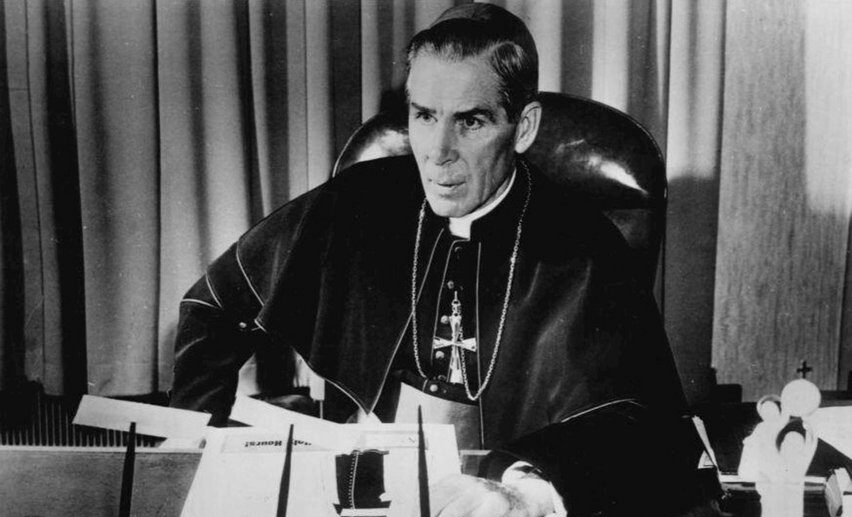
Ven. Fulton J. Sheen will be beatified on September 24, 2026, in St. Louis, Missouri. As a fan of Archbishop Fulton Sheen since my childhood, I was thrilled to hear this news! Looking forward to that event, I would like to give an overview of this holy bishop’s life and accomplishments.
Fulton Sheen was born in El Paso, IL, in 1895. I only recently learned from the Archbishop Fulton J. Sheen Foundation that his given name at birth was actually Peter John Sheen. However, while still a child, he began to be called Fulton, which was his mother’s maiden name. He was raised in the Catholic faith and was always devoted to Our Blessed Mother.
Fulton was high school valedictorian, graduating from Spalding Institute (a Catholic high school in Peoria, IL) in 1913. Thereafter, he attended St. Viator College before becoming a seminarian for the Diocese of Peoria. He was ordained to the priesthood on September 20, 1919. The next year, he began further studies at the Catholic University of America (CUA), earning an ecclesiastical degree in canon law (J.C.B.). The following year, he moved to the Catholic University of Louvain (Belgium), where he earned a PhD in philosophy in 1923, winning the Cardinal Mercier Prize for International Philosophy. In 1924, he earned the degree of Doctor of Sacred Theology at the Pontifical University of St. Thomas Aquinas in Rome (a.k.a., the Angelicum).
According to the Encyclopedia Britannica, Sheen then spent another year of study in Belgium, followed by a year of priestly ministry in London. He returned to his home diocese and worked as a parish priest in 1926. That same year, however, he joined the faculty at CUA.
As the university’s Fulton Sheen biography states: “For the next 23 years, Catholic University was where Father Sheen honed his skills as a scholar, educator, orator and evangelist. He worked, first in the School of Theology and Religious Studies, then in the School of Philosophy.” He taught courses such as “Philosophy of Religion,” “God and Society,” and “God and Modern Philosophy.” During this time, he was given the title of monsignor by Pope Pius XI in 1934 at the age of thirty-nine.
Fulton J. Sheen’s work and legacy extend far beyond his mass media presence.
While still undertaking his professorial duties, Sheen did not remain in the ivory tower of academia. Known for his skills as an orator, Sheen expanded his reach through a weekly radio program, The Catholic Hour, starting in 1930 and lasting for about twenty-two years with an estimated audience of four million listeners.
In 1951, Fulton Sheen was consecrated as an Auxiliary Bishop of the Archdiocese of New York. That same year, he started his weekly television program, Life is Worth Living, which is probably what he is most known for today. Within a couple of months, the number of stations carrying his program jumped from three to fifteen. “Over the course of the show, Sheen’s Life is Worth Living competed for airtime with popular television stars such as Frank Sinatra and Milton Berle. . . . and in 1953, just two years after its debut, he won an Emmy Award for ‘Most Outstanding Television Personality.’” Apparently, his show, which ran until 1957, had a weekly viewership of a staggering 30 million!
On October 21, 1956, Bishop Sheen appeared on a popular game show What’s My Line? as a mystery guest. The purpose was to raise money for 300 leper colonies run by the Society for the Propagation of the Faith, for which Sheen became the director in 1958.
From 1961 to 1969, “he hosted another popular television show, The Bishop Fulton Sheen Show.” In the middle of that time period, he participated in every session of the Second Vatican Council (1962–1965). According to the CUA website, “he worked closely with then Father Joseph Ratzinger, who was a theological expert on the commission for mission.” During Ratzinger’s tenure as pope, he spoke of how “‘Fulton Sheen . . . would fascinate us in the evenings with his talks.’” Benedict XVI declared Fulton Sheen “Venerable” in July 2012.
Following the council, Sheen was appointed as Bishop of Rochester, NY, in 1966, serving until 1969 when he resigned at the age of seventy-four, a year before the standard retirement age. As Matthew McDonald reports, “Sheen’s three years in Rochester were difficult.” He had tried to donate “a lightly attended inner-city parish church and its land for a federal public housing project for poor people,” but it “drew so much opposition that parishioners threw pebbles at his car when he visited.”
A man of principle, he received backlash from the right and the left. On the one hand, Bishop Sheen met with resistance from the local faithful who did not agree with his manner of implementing the reforms of Vatican II. On the other, “he also drew fire when he defended Pope Paul VI’s anti-contraception encyclical Humanae Vitae,” McDonald notes. Additionally, he was against the United States of America’s involvement in the Vietnam War as well as strongly opposed to Communism.
After his resignation from Rochester, he was named titular Archbishop of Newport, Wales. “From 1976 until his death three years later,” according to Encyclopedia Britannica, “Sheen served Pope Paul VI as assistant to the Pontifical Throne. . . . he died shortly after open-heart surgery in 1979 at the age of 84.”
Fulton J. Sheen’s work and legacy extend far beyond his mass media presence. As CUA records: “He published 34 books during his 23-year teaching career . . . and another 32 after he left the University.” A list of these books, in chronological order of publication, can be found here. Furthermore, “he also was a syndicated columnist in the secular press.”
Sheen’s public notoriety, however, is not even the most admirable aspect of his sanctity. “Admirers of Sheen see markers of holiness throughout his life, including his charity (he gave away millions in royalties, salary and gifts); his concern for troubled souls (he would drop everything to help a single person in need); and his Holy Hour, a 60-minute time in prayer before the Blessed Sacrament that he performed every day,” writes McDonald.
Ven. Fulton J. Sheen’s charity and good work did not end with his death. As a standard requirement for beatification, a miraculous healing has been attributed to his intercession. As reported by Joseph Pronechen, the miracle occurred on September 16, 2010. A baby boy had been stillborn to parents Travis and Bonnie Engstrom from Peoria, IL. The family and friends of the baby’s parents had been imploring Archbishop Fulton Sheen’s intercession since the birth began. Two medical professionals present at the home-birth tried to provide emergency help, but nothing was working. The boy’s father conducted an emergency baptism, naming him James Fulton, after the late bishop. The infant was rushed to the hospital, “where medical professionals tried every possibility to revive and save him. But with no pulse or sign of life after 61 minutes, and doctors about to record his time of death, James [Fulton] came to life.”
While the doctors were obviously astounded at this miraculous return to life, they still gave a poor prognosis. They said that, because he must have suffered “massive organ damage . . . [he] would soon die,” writes Pronechon. When that did not happen either, they were certain he would at least be “severely handicapped.” Afterall, an MRI showed brain damage from the lack of oxygen. Yet, three months later, at a follow-up examination, his brain scans were normal. Now, eight days after his sixteenth birthday, James Fulton Engstrom and his parents will attend the beatification of the holy archbishop, whose own life has inspired multiple generations of Catholic faithful.