
This article appears in Issue XXVIII: “The Cardinal Virtues” of the Word on Fire Institute’s quarterly journal, Evangelization & Culture.
Courage, the virtue which “ensures firmness in difficulties and constancy in pursuit of the good,”1 can be dramatic in its expression, but can also appear in subtle, quiet ways in ordinary life. We can learn a great deal from personal examples of courage and from its exploration by skillful novelists; the English Catholic author R. H. Benson gives us powerful instances of both. Benson is best known today for his 1907 science-fiction dystopia The Lord of the World, a book praised by Pope Francis, but there is much more to discover about his literary gifts and his personal story.
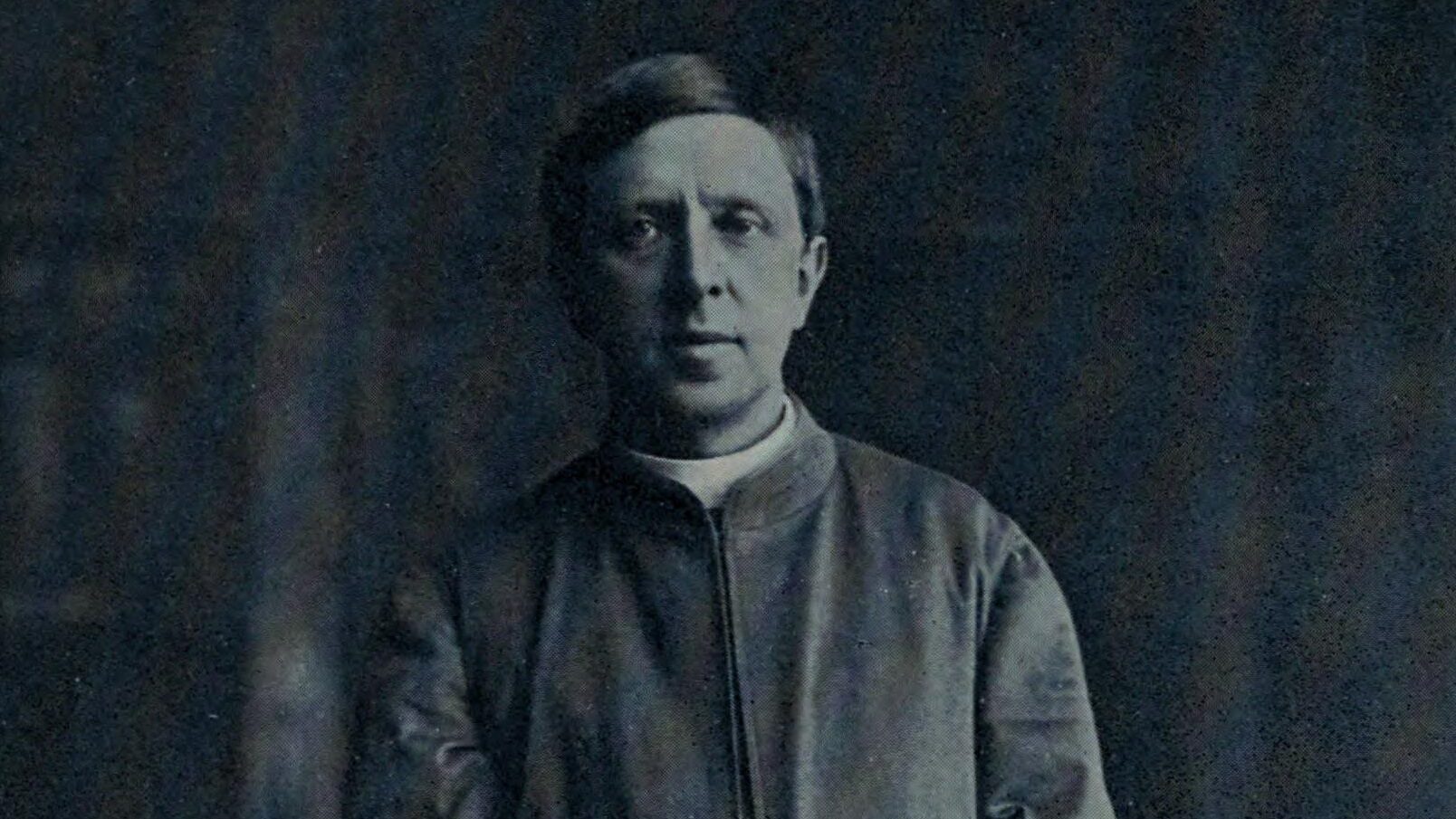
Born in 1871, Robert Hugh Benson, known as “Hugh,” was the youngest of the six children of the formidable Edward White Benson, the archbishop of Canterbury, and Mary Sidgwick Benson, whom William Gladstone once called “the cleverest woman in Europe.”2 The Bensons were remarkable both for their prodigious literary talent and their experience of suffering. Of Hugh’s siblings, Martin, the firstborn, died of meningitis at age seventeen. Nellie died of diphtheria in her twenties. Maggie became an Egyptologist and author, but experienced a severe mental breakdown and spent the rest of her life hospitalized. Arthur became Master of Magdalene College, Cambridge, and a noted essayist and poet, writing the lyrics to Elgar’s “Land of Hope and Glory”; he also suffered from bipolar disorder and endured years-long stretches of debilitating depression. Edward Frederick, or “Fred,” seems to have escaped the mental illness that plagued the family; an author like his brothers, he is best known today for his ghost stories and his comedic “Mapp and Lucia” novels.
It cannot have been easy for Hugh to find his way in this talented, socially prominent, and emotionally volatile family. After studying at Eton and Cambridge, he decided to follow his father’s example and, in 1895, was ordained a clergyman in the Church of England. A year later, after the sudden death of his father and with his own health weak, Hugh began traveling, both with his family and alone, in an attempt to recover his strength. In his memoir Confessions of a Convert, Hugh recalled that his time abroad opened his eyes to the contrast between the cultural dominance of the Church of England at home and its position abroad as one minor sect among others. He began to feel uneasy about the nature of the Church of which he was a member and clergyman, and began a years-long search for the real basis for authority within the Church.
In 1903, after seven years serving in the Church of England, Benson took a momentous step and was received into the Catholic Church; a year later, he was ordained a Catholic priest.
Was Benson courageous for following his conscience and taking a step that opened him up to savage criticism and left his future uncertain?
Most Catholic converts in early-twentieth-century England faced social disapproval and overt prejudice, and the conversion of the son of the archbishop of Canterbury was instantly newsworthy. Was Benson courageous for following his conscience and taking a step that opened him up to savage criticism and left his future uncertain? Or was he, as some critics averred, cowardly for seeking the comfort of authority in the Roman Church rather than rising to the challenges in the Church of England?
Benson’s decision had not been easy; he had agonized over this move and taken every possible step to test his conscience on the matter. By the time he took his step, he was utterly drained:
I do not suppose that anyone ever entered the City of God with less emotion than mine. It seemed to me that I was utterly without feeling; I had neither joy nor sorrow, nor dread nor excitement. There was the Truth, as aloof as an ice-peak, and I had to embrace it. Never for one single instant did I doubt that, nor, perhaps it is unnecessary to say, have I ever doubted it since.3
As it happened, Hugh’s mother and surviving siblings accepted his decision, with a greater or lesser extent of sympathy, but at the time, he would have known full well that he was risking a total break with his family.
As a Catholic priest, Benson used his distinctive gifts for preaching, lecturing, and writing a steady stream of articles and books. So unrelenting was his schedule that chronic overwork contributed to his tragically early death from pneumonia in 1914, aged forty-two.
It is one of the strange twists of literary fate that Hugh’s novels of contemporary fiction represent his most compelling writing but are also mostly out of print. These undeservedly forgotten books include the outstanding Initiation (1914), which, happily, will be reissued by Word on Fire Luminor in 2028, as well as other excellent novels such as An Average Man (1913) and The Coward (1912).
In The Coward, Benson explores the difference between real courage and its social perception. The protagonist, a young man named Val, repeatedly tries and fails to demonstrate the kind of physical courage that his family esteems. After one humiliating episode, he decides on suicide as a proof that he can act bravely and decisively. Waiting until everyone in the house is asleep, he plans to drink a dose of poison when the clock strikes three. Benson depicts Val’s inner conflict in a passage well worth quoting at length:
If he kept his resolution he would be dead in ten minutes – dead. . . . [ . . . ] every one of those things by which he assured himself of his own identity and in which he expressed it; his own heart which he could hear drumming in his ears, his wet hands that now were knitted tightly one about the other, the pulses in his body—all those things by which he knew self—these would be gone; and he — ? . . .
And, on the other side, he could just go to bed and pour this silly stuff out of the window, take off his clothes as usual and put on his pyjamas and go to bed, and awake to-morrow with Charles in the room and the morning light on the floor . . . and begin again.
And no one would ever know.
But he would have broken his resolution!—that resolution he had made so deliberately, that resolution by which he had demonstrated to himself so forcibly that all the world was wrong about his cowardice and he right.
But no one would ever know.
Besides, had he not already proved that he was no coward? What coward would have done all this—bought the poison, faced death for over twenty-four hours unflinching, made his last dispositions so tranquilly and sincerely? Surely he had conquered interiorly, and that was all that mattered! He had meant to die, had done all things necessary for death. He had proved himself to himself! And if he was no coward interiorly and really, what would it matter what the world thought? [ . . . ] Would it not be far finer to live? . . .
He sat up as this brilliant light broke on him. For a moment or two he saw himself as magnificent and transfigured—a heart of steel and fire within, yet misunderstood and misrepresented without; a man desperately courageous in all that mattered, of whom the world was not worthy . . . a soul of infinite tenderness as well as of courage.
Then down on him again came a sense that he was more of a sham than ever—a braggart, a liar, who posed splendidly when there was no danger, who failed miserably always when the point came. He had swaggered about his boxing at Eton, and had refused a fight; he had talked big about his riding, and had funked Quentin; he had swung his ice-axe and rehearsed his dramas of Switzerland, and had cried out like a woman at the bad place; he had galloped after Gertie and saved her, but had meant to draw off if the edge of the quarry came too near; he had slapped a blackguard’s face on the Pincian, and had let Austin go to the duel in his place. And now he had written his letters and poured out his poison . . . and. . . and was not going to drink it.4
Val chooses to live, but tells no one of his silent and lonely struggle; his family would not understand the genuine moral courage that it required.
Hugh Benson acted with courage himself in choosing to obey his conscience and become a Catholic, quietly and without fanfare; he saw his brother Arthur demonstrating courage day by day in enduring severe depression; he has given us vivid literary portrayals of moral courage in the face of social pressure. In his fiction and his life, he offers a compelling invitation to reflect on how we can show courage in our ordinary lives.
1 Catechism of the Catholic Church 1808.
2 Rodney Bolt, As Good as God, as Clever as the Devil: The Impossible Life of Mary Benson (Atlantic, 2011), prologue.
3 R. H. Benson, Confessions of a Convert (Longmans, Green, 1913), 129.
4 R. H. Benson, The Coward (Hutchinson, 1912), 341–43.