
Scott Adams passed away recently, losing his battle with prostate cancer. How will he be remembered?
To many, he’ll always be the “Dilbert guy.” The long-running cartoon strip satirized the corporate and cubical life of the American white-collar worker. The funniest ones to my mind poked fun at pointless meetings. In one favorite, the obnoxious pointy-haired boss says, “Let’s have a little premeeting to prepare for tomorrow’s meeting.” Dilbert dryly replies, “Whoa! Do you think it’s safe to jump right into the premeeting without planning it?” To which the boss concedes, “Okay, let’s get this preliminary premeeting going.”
To younger generations, I suspect he’ll likely be more remembered for his social media presence as a political analyst. In the 2015—2016 Republican presidential primaries, Adams famously bucked conventional wisdom by predicting Donald Trump would win the presidency based on his abilities as a “master persuader.” His early videos pointed out that Trump had an uncanny ability to win over people through nicknaming his opponents. For example, Adams argued that Trump’s label of establishment-favorite Jeb Bush as “low energy” was genius, reframing how the voters saw their contest.
Needless to say, this was not a popular prediction among political scientists. Nor was openly supporting Trump for president a popular choice. It was a position that, by his own testimony, had drastic costs to his social life and his career. Adams, it must be said, was a risk taker. Agree or disagree with him politically, it is hard to deny that the man was genuinely courageous. And for a cartoonist-turned-pundit, it is remarkable how much he accurately predicted.
Beyond politics, he became something of a life coach to his listeners and readers. His repeated fundamental precept for success was “Be Useful.” By his own reckoning, his books have largely flowed from this concept of providing utility, benefits, communicating goodness to others as the key to living a meaningful and fulfilled life. Many of his ideas were not only practically useful but broadly consonant with traditional virtue ethics, such as his emphasis of systems (forming certain daily habits) over big, abstract, distant goals.
In the end, Scott Adams’s greatest wager was to place his faith in Jesus Christ.
Adams’s videos eventually grew into the Real Coffee with Scott Adams podcast. While I was not a regular listener of this podcast and only occasionally caught clips of this show circulating on social media, the man clearly continued to have interesting insights and political analyses. More importantly to him and his regular listeners, the podcast grew into a place where a lot of folks found community and defeated loneliness.
All of this deserves remembrance. But I think the thing he should most be remembered for is this: At the end of his life, he took Pascal’s wager.
Adams had revealed that, while he was not hostile to religion, he was a religious skeptic. In this respect, he seemed to be something of an Andrew MacPhee in C. S. Lewis’s That Hideous Strength, the resident skeptical rationalist and empiricist who doubted the supernatural aspects of Ransom’s mission but was a morally serious and intellectually curious person.
But in a striking video released not long before his death, he said that he planned to convert to Christianity. He laid out his reasoning thus: Christianity seemed to him the most-likely-to-be-true religion on offer. If it turned out that after death he had ceased to be (i.e., that mortalism and materialism are true, what might be called “naturalism”), then he would be no worse off for his Christian faith. But, if it turned out that Christ really did defeat death, and eternal life would be had with or apart from him, then he would end up with a much better outcome than if he had chosen unbelief.
In his excellent book Taking Pascal’s Wager: Faith, Evidence, and the Abundant Life, Michael Rota argues that the wager is and remains a powerful argument for Christian faith, which the following draws from.
Imagine I offered you a game to play. You can flip a coin. If it is heads, I pay you two dollars. If it is tails, you pay me one dollar. You can play as many times as you want. Is it rational to play? The answer is yes: The expected value over time is fifty cents per play. But the expected value of not playing is zero. It is rational to play. One can see it even more clearly if the payoff is: heads, you win one million dollars; tails, you pay me one dollar. It’s very obvious you should play this game!
Now, the rationality of playing depends on flipping a fair coin—a 50/50 chance. Consider the following chart, which proposes the outcomes of belief vs. unbelief, in the cases that it turns out after death that Christianity is true, and that it is false:
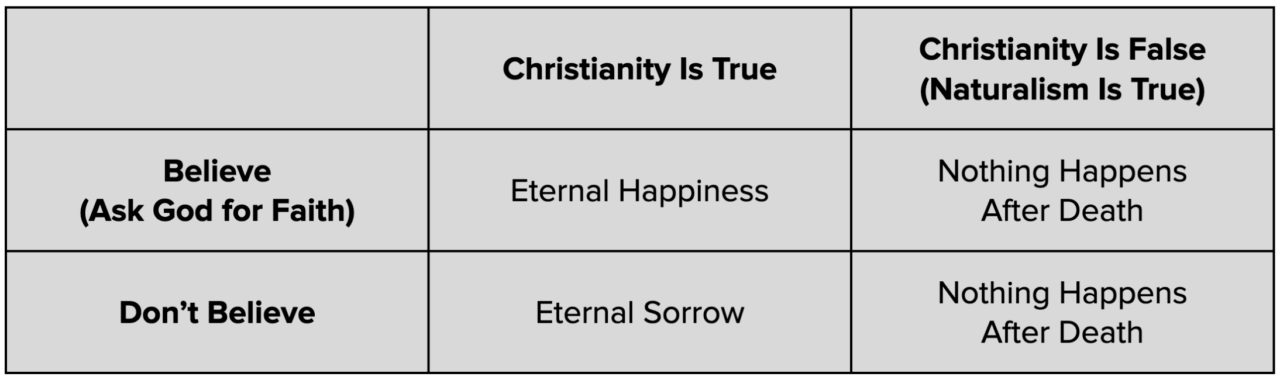
If Christianity is at least 50 percent likely to be true—that God is real and became man to offer you eternal life with him—then it is rational to take the leap of faith, to “play.” Even if it is a coin-flip likelihood that there is no God because naturalism is true (and hence that the man who claimed to be him, Jesus Christ, was not), it is still the more rational choice to believe. For the expected value of belief is way higher than the expected value of unbelief, of declining to play. The choice to believe, in the best case, comes with extreme reward, and in the worst case, no cost. The choice of unbelief, on the other hand, comes with the outcomes of either no cost, or extreme cost.
For cases of persons not on their deathbed considering whether to take the wager, the chart can be complicated by various temporal “costs” of belief in the case that Christianity is false (the upper-right quadrant)—costs of time (going to church), treasure (tithing), psychological (lifestyle changes, worries about inauthenticity, etc.). But as Rota shows, these are at least balanced out, if not outweighed, by the temporal benefits of religion on subjective sense of well-being, health, social capital, etc.
In the end, Scott Adams’s greatest wager was to place his faith in Jesus Christ. He passed on to his reward on January 13, 2026. He was sixty-eight.