
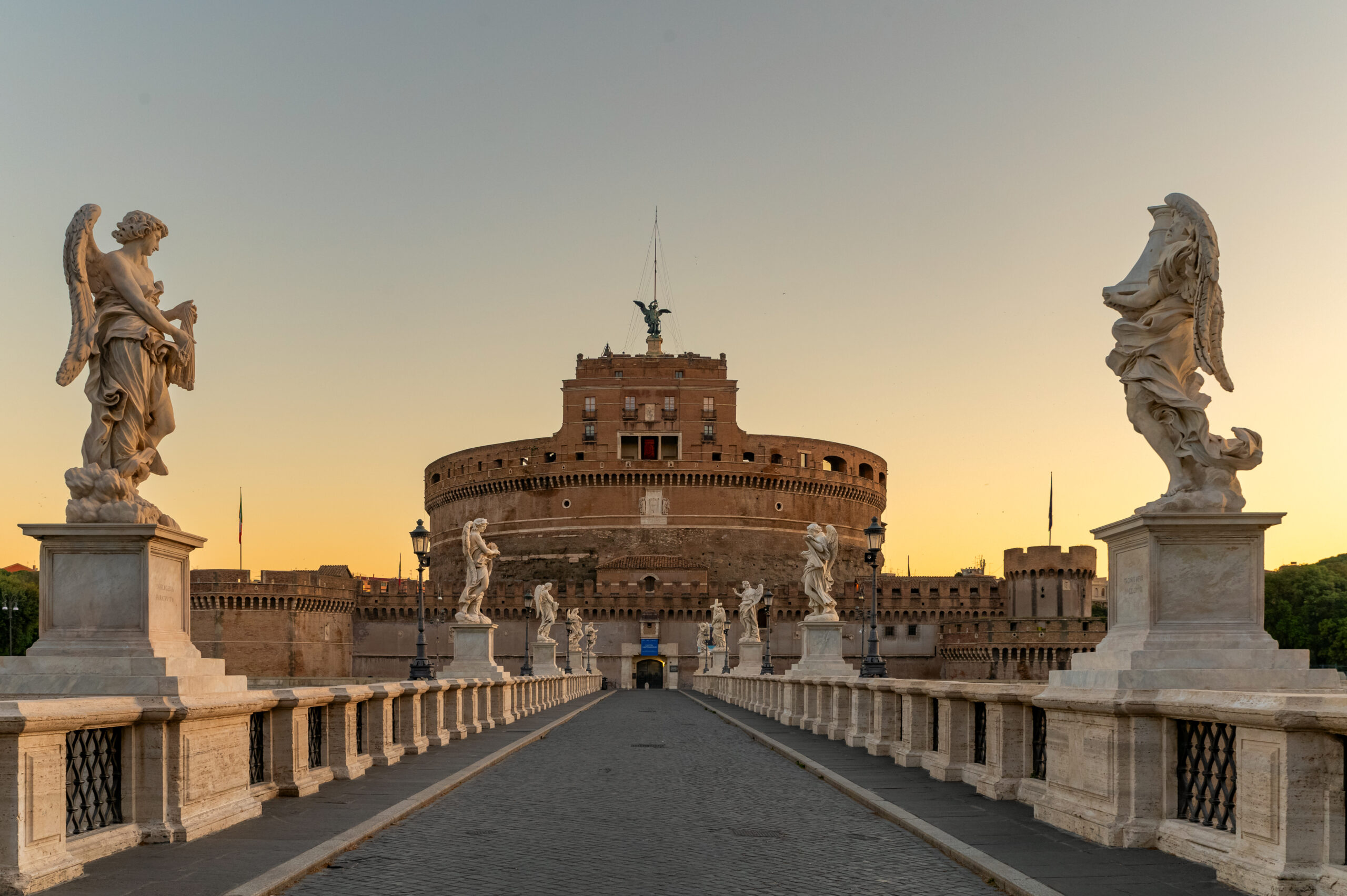
It’s hard to be the prettiest girl at the dance. At least, it seems that way. I wouldn’t know, personally. But I think I speak for many Catholics when I say that I’m still coming to terms with Catholicism’s sudden cultural cachet. In a religiously pluralistic society, Catholicism’s dance card is filling up with converts and the conversion-curious. Cultural commentators—myself included—are pouring out digital and analog ink to figure out and explain just why. Whatever the reason, Zoomers seem distinctly drawn to the Church’s millennia-old aura (as they’d call it): the ritual, the tradition, and, yes, the beauty. It should come as little surprise, then, that Catholic art inspired a July fashion show in Rome, right outside the Castel Sant’Angelo, from Dolce & Gabbana.
The reaction to the show among Catholics appears to have been mixed. The Catholic News Agency reported on the varied responses, including a young Italian priest and social media influencer who said he was in favor. But he said his 250,000 followers largely came out against it when he asked for their reactions. In an opinion piece for Australian outlet The Catholic Weekly, Ohanna McDonald took a more nuanced view. “It would be hard to prosecute the case that the church has nothing in common with luxury, especially as it pertains to vestments, clothing and aesthetics,” McDonald writes, noting that the eras of Church history that most heavily influenced the show were the Renaissance and Baroque periods, “periods of the Church which are hardly synonymous with temperance or humility.” And after all, McDonald asks, “If sacred art has always required flawed artists, can we afford to reject beauty when it appears, even in the most unexpected places?”
I’d say my own view more closely mirrors hers. Honestly, even though some of the Dolce & Gabbana show did veer a little more toward camp—the opening procession appears to have included actors dressed as cardinals and altar servers, which, yes, I’d definitely put on the “cringe” side of the ledger—I’d say the fashion house’s intentions were genuine. They describe the show on their website as a “celebration of sacred iconography.” Why not take them at their word? Whoever is not against us, Jesus reminded his apostles, is for us.
Of course, Jesus also told us not to worry about what we are to wear, so others may be wondering whether it’s a little silly for Catholics to get worked up about fashion in the first place. But I’d like to direct your attention to a particular fashion icon who is decidedly not part of the Catholic world to explain why aesthetics matter to us.
The close attention paid to Pope Leo XIV’s vestments after his election reminded me of coverage of the Princess of Wales’ sartorial choices. News outlets issued breakdowns of the significance of what Pope Leo wore for his first appearance after his election, explainers about how his choices differed from what Pope Francis wore, and speculation over which shoes he would favor (would he bring back the iconic red leather ones?). Online, Catholics scoured his vestments for clues on the approach Leo would take to Traditionis Custodes. In many ways, it was very similar to the kind of coverage Princess Catherine’s outfits receive.
A peak example of this coverage is So Many Thoughts, a fashion site run by former journalist Elizabeth Holmes, who looks closely at clothes worn by British royal women (and increasingly, US first ladies and women in public office) to explain their symbolism and significance. For example, it might seem frivolous to note that Kate Middleton is wearing vintage Chanel to visit a particular charity, but it matters when you know ecological responsibility is an important cause that her husband champions. Kate clearly knows that people like Holmes will look closely at what she’s wearing. When her staff puts out the information that she is wearing vintage, she is likely hoping to inspire others to thrift and repurpose clothes. An all-tan ensemble at another royal engagement emphasized Kate’s red poppy pin, worn to honor fallen service members on Remembrance Day, and Holmes duly draws attention to the fact in her Instagram write-up on the outfit.
The princess “wants the focus to be on the really important issues, the people and the causes she is spotlighting.”
So Many Thoughts sometimes goes a little far for me. Holmes sometimes lays out Instagram stories that argue in painstaking detail how, for example, a series of polka dot ensembles and a certain style of dress worn in the months and days leading up to Royal Ascot were all signaling that the princess would debut a new lewk at the high-viz horse race.
But whether or not Kate has been leaving Taylor Swift–style clues for fans with her outfits, after her cancer scare last year, she seems to understand better than ever that what she wears clearly matters to people. In February, a royal spokesperson told The Sunday Times that the princess “wants the focus to be on the really important issues, the people and the causes she is spotlighting.”
The statement caused a small controversy. The Sunday Times, which carried the quote, titled the story “Princess of Wales: Focus on my work not my wardrobe,” and said that Kensington Palace no longer intended to put out information about what designers she was wearing.
But the same spokesperson later clarified that no changes would be made in that regard.
That’s likely because the Princess of Wales, of all people, realizes that when she shows up, she does so as more than a celebrity or fashion plate. Her outfits aren’t meant to highlight her as an individual. Her clothes are beautiful, and they definitely attract attention. But when she shows up at a children’s hospital or an event honoring veterans, she is there less as “Kate Middleton” than as the embodiment of centuries of tradition for an entire nation of people. The eyes of millions are on her. To show respect for her people, the cause she is championing, and for her historic role as a national symbol, shouldn’t she be dressed to the nines? Shouldn’t she pay careful attention to what she wears and the message it could send?
Since her reemergence in public life, Princess Catherine has clearly leaned toward a more serious and subdued personal style. She re-wears more outfits now, opts for business attire, and goes with a lot of monochrome. But the information about who she’s wearing still gets out, as when she wore Dior to greet the president of France on his official state visit—a look, People magazine noted, “packed with hidden meaning.” At the end of the article detailing the ensemble, People explained that Kate often makes statements with her wardrobe, like highlighting local designers when she’s on a foreign tour, or dressing in the colors of the flag of a country she is visiting. The French design paid homage to the country of France and one of its major industries in a way she was uniquely poised to do.
Like the British royal family, the Catholic Church sometimes comes under fire when its clergy wear lavish vestments. But this criticism misses the fact that liturgical vestments, which cover the entirety of the priest’s person, are in fact meant to de-emphasize his individuality and draw attention instead to his participation in the Body of Christ in the impersonal roles of minister and pastor.
When he’s celebrating Mass, the priest has the eyes of the congregation on him, but the Mass isn’t about him.
I’ve seen some on social media compare and contrast what Pope Francis and Pope Leo wore for their respective meetings with the same dignitary, trying to read into it clues about the direction of Leo’s papacy. But like the teams who lose to the Yankees, I worry that these people are getting distracted by the pinstripes.
It isn’t necessarily frivolous to pay attention to which vestments the pope is wearing, however.
The pontiff, like the princess, knows that the eyes of the world are on him and understands that what he chooses to wear carries symbolic meaning (although he is probably not leaving coded messages for the fans like Taylor Swift, either). And the clothes make the priest as well as the Princess of Wales. When he’s celebrating Mass, the priest has the eyes of the congregation on him, but the Mass isn’t about him. As Catholics, we belong to a sacramental faith. We believe that the physical world and the way we experience it through our senses are all capable of pointing us toward God. That’s why we’re a “smells and bells” people. It’s why the Mass is the source and summit of our religion.
When we see father wearing red, we’re invited to contemplate the Holy Spirit on Pentecost, or the martyrdom of those who have gone before us. When we see the celebrant wearing purple, we know we are being called to penance and the eschatological anticipation of Lent and Advent. It turns out that priests change their color palates for the seasons just like any fashionista—they’re just changing them for liturgical seasons rather than for fall, winter, spring, and summer.
There’s nothing wrong with beauty drawing the eye if it also elevates the mind, heart, and soul. Like the Princess of Wales, Pope Leo is the latest occupant of a historic office that predates him and will be filled by someone after him. And as a priest, he celebrates Mass not as himself, in his own everyday clothes, but in persona Christi. As in every other part of the Mass, what he wears is intended to point toward a bigger truth.
Dolce & Gabbana both compliment and challenge Catholics when they liken the construction of their Rome show to “a sacred ritual.” They say that their artisanal craftsmanship “dictates that every thread must follow a precise path, and each stone must be set with a gesture that is slow, exact, and reverent.” Do we approach the eternal realities that lie behind the external physical ones at the Mass—the vestments, the sights, the sounds, the touch, the taste—the same way as these elite craftsmen approach their craft?
The Catholic Church’s millennia of art and beauty invite us into solemn, exact reverence. Dolce & Gabbana appreciate that. Do we?