
Karl Marx famously described religion as the opiate for the masses, a kind of consolation prize for those whose lives are full of empty harvests, the fruit of their labors continually taken from them by capitalists. With hands empty, they pin all their hope on some heavenly reward.
But what of those whose hearts are full? Have they then no need of religion?
Of American holidays, surely the best is Thanksgiving, that wonderful time of gathering with family and friends and being grateful for the goods we have together. God has blessed the harvest of our year, and we are grateful, celebrating with delicious food and lively conversation.
In his volume on St. Francis, G. K. Chesterton astutely observes regarding the challenge of those we today call nones, “Rossetti makes the remark somewhere, bitterly but with great truth, that the worst moment for the atheist is when he is really thankful and has nobody to thank.”
For Chesterton, religion is not the opiate of the masses but the song of the great-souled and grateful.
Is Chesterton too severe with the nones? What, after all, is burdensome about wanting to sing but having no one to sing to? We could say that it belongs to the very logic of the experience of gratitude, that it involves being grateful to someone. As a priest put it in one particularly memorable Thanksgiving homily, there is no being thankful for if there’s no being thankful to. It belongs to the very grammar of the word “thanks.”
“The worst moment for the atheist is when he is really thankful and has nobody to thank.”
We need only think of Dorothy Day for an example of someone whose heart, full of gratitude for the gift of her child, led her to leave behind “none” and talk of religion as “opiate” and instead acknowledge the existence of God the creator, the giver of this gift.
The experience of fundamental goods as great gifts urges us to want to give thanks, but if the nones have no one to thank, their hearts ache, feeling frustratingly unfulfilled.
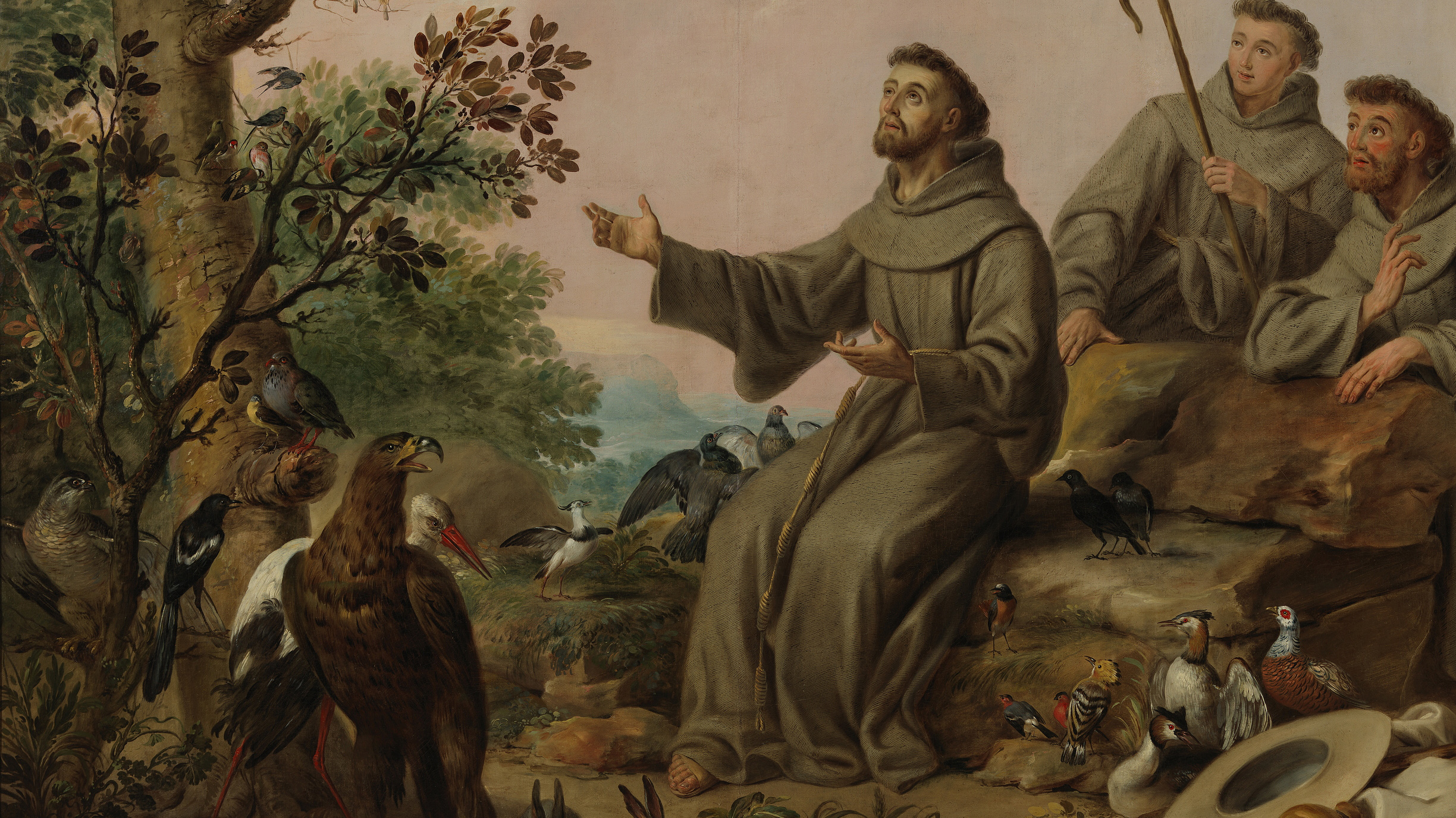
It is here that the life of St. Francis takes on such importance eight centuries after his death.
Chesterton reads Francis as a master of giving thanks, someone who lived out this essential spirit by properly fathoming creation as a gift. To this end, Chesterton formulated one of those great Chestertonian lines, the sort of which we would do well to commit to memory and drill daily into our children: “All goods look better when they look like gifts.”
Why might that be? Why might a good look better when it looks like a gift? The answer is seen most transparently when the gift is of little worth. So, for example, the little child takes a flower from her parents’ yard and gifts it to her mother, who receives it with joy. The value of the gift is the intention the child invests with the flower. Giving enhances goods by bathing them in love.
We can take any creature as a good, but to take it as a gift is even better. That’s what Nietzsche misses when he says positing God as the creator drains the world of its goodness. It is not just that God is better than creation: it’s that creation is better than cosmos.
Think about it. The Greek world rested in itself; there were goods, but they were there not as gifts but instead as givens. In the Christian understanding, those self-same givens are now gifts, which enhances them, for being itself is better when it looks like a gift.
The gift, invested with such an intention, calls for reciprocity; it calls for a response. Not a reciprocal gift that turns the gift into an exchange of presents but the act of acceptance that brings the giving to its proper fulfillment.
It is here again that St. Francis excelled. He shows us the face of the Christian troubadour who sees the world marked with the gratuity of love. At the close of the volume, Chesterton writes,
He was above all things a great giver; and he cared chiefly for the best kind of giving which is called thanksgiving. If another great man wrote a grammar of assent, he may well be said to have written a grammar of acceptance; a grammar of gratitude. He understood down to its very depths the theory of thanks; and its depths are a bottomless abyss. He knew that the praise of God stands on its strongest ground when it stands on nothing. He knew that we can best measure the towering miracle of the mere fact of existence if we realise that but for some strange mercy we should not even exist.
God the creator had mercy on us by snatching us from nothing and loving us into being. The fundamental duty and glory of life is to practice the grammar of gratitude, to see fellow creatures as ontological siblings, to see mother earth as our common sister before God the Father, and to praise the giver of every good and perfect gift.
If every good is better when it is seen as a gift, then Francis—as good as he is—appears even better when we see him as God’s gift to us.
Indeed, even after 800 years, the world still has something to learn from this master of thanksgiving who shows us the faith enhances our perception of the goodness of things.