
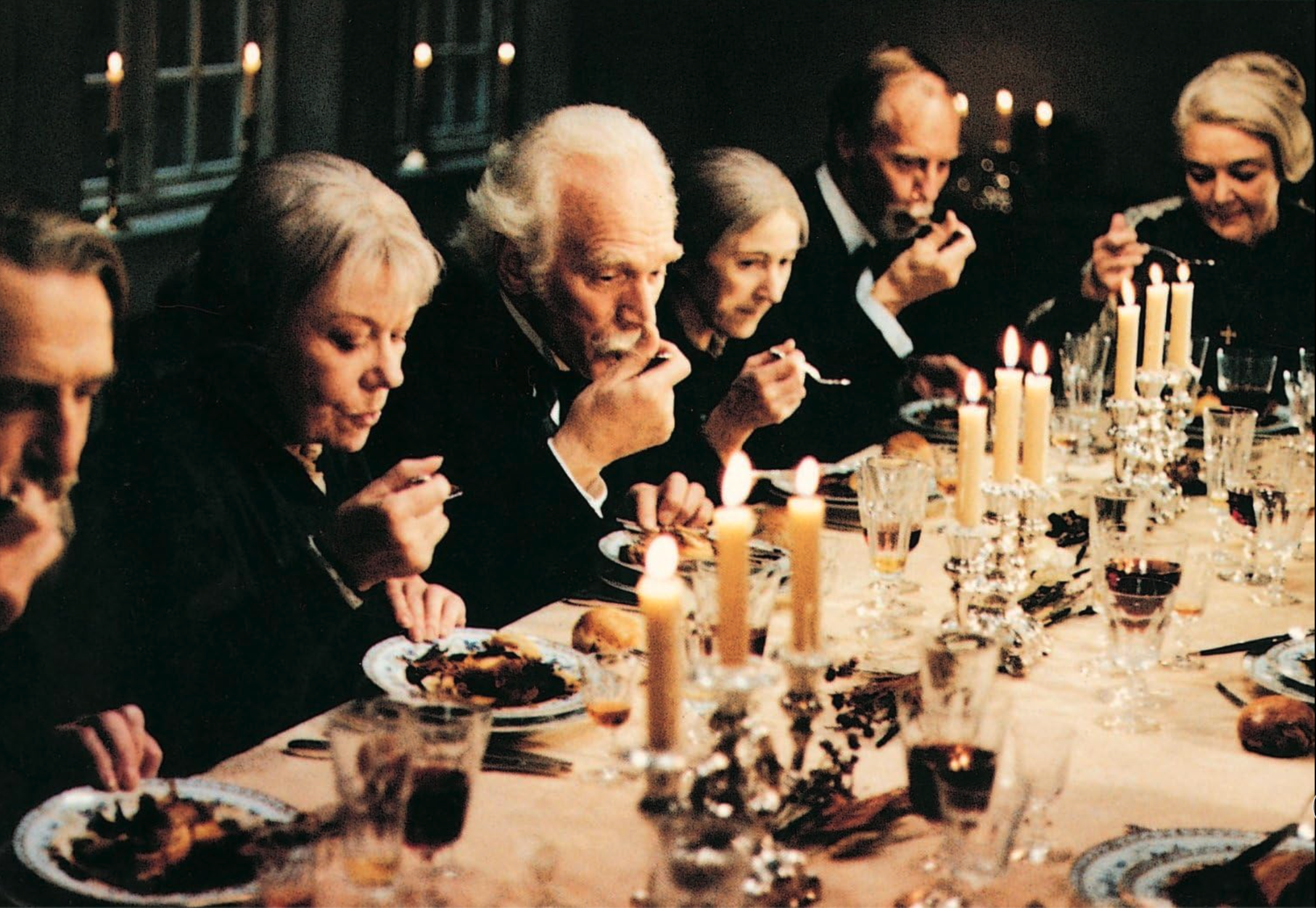
In a remote village on the windswept coast of Jutland, there lived the pious spinster sisters, Martine and Filippa. Thus begins the 1987 Academy Award-winning film Babette’s Feast, a film in which very little happens on the surface—people eat soup, sing hymns, and occasionally glare at one another—yet beneath that rolls an emotional and spiritual tidal wave.
In this little corner of the world, one of the four loves, eros, has been systematically repressed by the sisters’ father, the Dean, in his pietistic congregation. But eros, classically understood, is not mere sexual appetite. It is a life force: the passionate longing to be satiated in beauty, connection, creativity, sensual fulfillment, and perfect happiness. Rather than being a flaw in our fallen nature, it is part of God’s design to bring us to himself. In Babette’s Feast, this love is briefly awakened (though misdirected) in the sisters’ youth until it is finally fulfilled when joined to Babette’s total self-gift. Through her feast, the villagers—long stunted, resentful, and suspicious in their limited understanding of Christian love—discover the healing power of eros.
Martine and Filippa, named for Martin Luther and Philip Melanchthon, live their days doing good deeds and presiding over the congregation left by their late father. The villagers are tightly knit, and the sisters’ love for those around them is genuinely charitable and dutiful. Yet theirs is an incomplete love, carefully scrubbed of anything that might be mistaken for pleasure: the villagers wear drab gray and black clothing, their daily fare consists of salted fish and boiled ale-bread soup, and they gather every Sunday in a plain white chapel in a bare service of hymn singing and a simple sermon. The village essentially operates under a perpetual fast, starving the senses in order to feed the spirit. Any divergence from this fast is treated as tantamount to apostasy. Yet when God saw his creation, he declared it very good. Our bodies and senses are the sacramental pathways of his grace.
Forty-nine years before the opening of the film, the sisters had suitors in the dashing leonine cavalry officer Lorens Löwenhielm and the renowned Parisian baritone Achille Papin. Following the storytelling law that “nomen est omen,” their names carry suggestive layers of meaning. Lorens, whose name literally means “a crowned lion in armor,” is struck by Martine’s “almost supernatural fairness” and hopes she might tame his hunger for gambling and drink. A shared life with her might have led him to greatness of soul. But a lion’s appetite for vainglory and greatness cannot be satiated in the quiet humble life in the village. He flees back to the city to hunt for status, eventually marrying into the royal court and rising to the rank of general. Lorens’s hunger for greatness is legitimate, yet he abandons the path that might have purified it. Martine, whose soul is briefly stirred by attraction, counts his departure a blessing that preserves their careful control of the passions.
The village essentially operates under a perpetual fast, starving the senses in order to feed the spirit.
Achille Papin’s name is an echo of the great Greek warrior Achilles, while his surname, Papin, historically implies “soft nursery food”—an ironic “soft Achilles.” He arrives on a sort of sabbatical after the Parisian life of glory and artistic passion has left him feeling empty. The glittering lights of the stage and adoring audiences, directed inward instead of upward toward the Artist himself, prove hollow. Hearing Filippa’s angelic singing in the Dean’s church, he obtains permission to tutor her in opera. Achille’s artistic passion rekindles, and it seems as though there might be a flame between himself and Filippa. Alas, while practicing Don Giovanni, Achille succumbs to the emotion of the scene and kisses Filippa. His eros has not been disciplined. For Filippa, the awakened passions are too awful, and she breaks off their tutelage. She is startled less by Achille’s actions than her own latent response. Both men sought eros, but failed to direct it toward its proper end. The sisters, lacking the language to discuss such desires, simply suppress them.
Thirty-five years later, in blows the refugee Babette, soaked to the bone by a squalling tempest. Her name, the French diminutive of Barbara, derives from the Greek barbaros, meaning foreign, strange. In mythology, the “stranger” who asks for refuge is often a disguised divine messenger who tests the hospitality of those he visits. Babette carries a letter from the aged Achille Papin explaining that she has just escaped persecution by the Paris Commune and recommending her as a housekeeper. In a line of hilarious understatement, he notes that she “can cook.”
The sisters have nothing to give in compensation, but Babette insists that she work for free or will die if turned away. Over the next fourteen years, Babette wins her way into the villagers’ grudging hearts. She produces improved ale-bread soup and cleverly manages the sisters’ finances so they have more to give in charity to the community. Because Babette brings into the village neither Lorens’s restless ambition nor Papin’s emotional excess but an eros already disciplined by love, she gains their trust. But as the years slip by and their austere band dwindles, the community shows growing fractures. Love, when reduced down to service, has become sterile.

All that changes as the centenary of the late Dean’s birth approaches. Babette learns she has won a lottery of 10,000 francs. To the sisters’ shock and unease, Babette begs them to allow her to use her new fortune to cook an authentic Parisian feast for the centenary celebration. Out of love and respect for Babette, they nervously agree.
Over the next few weeks, Babette imports everything from France. This time, eros arrives not in the overt sensuality of Papin but in wheelbarrows of sea turtle, cow’s head, and cages of quails. Such exotic preparations horrify the sisters and other villagers. Their resolution is the most entertaining irony of the film: They will eat the food served to them, but will make no comment about its pleasures, essentially receiving a gift while refusing to delight in it. It shall be to them as all their daily fare: simply nourishment for the body, nothing more.
The dinner party numbers twelve, including Lorens Löwenhielm. From a worldly perspective, he has achieved impressive success, yet he admits to himself that he feels empty. During the feast, Babette herself remains in the kitchen, overseeing her great masterpiece. As dish after dish of exquisite food is laid before them, Lorens offers educated commentary while the congregants smile and act as if he were discussing the weather. Despite themselves, however, the congregants have begun to lower their defenses. Spontaneously, forgiveness for past foibles and resentments flows as freely as the wine. Over the many courses, decades-old quarrels are reconciled, and the meal ends in laughter. Outside under the stars, they join hands and circle the village well.
When the sisters return to Babette, they are shocked to learn she spent her entire 10,000-franc fortune on that one meal for them. But in Babette’s words, “An artist is never poor.” Babette’s secret is that she possesses erotic love in its full artistic sense, that passionate longing to create a beauty that does not terminate in itself. She elevates her eros and unites it to agape precisely because she spends everything to give that beauty to others. Her self-gift is simultaneously extravagant and disciplined, sensual and spiritual, personally fulfilling and wholly generous. Babette’s feast becomes an anticipation of the beatific vision, the heavenly banquet of the Lamb, because material abundance serves as a direct channel of forgiveness and communion. This union of loves finally breaks open the hearts of the late Dean’s congregation to divine mercy and the life of grace.
Babette’s feast becomes an anticipation of the beatific vision, the heavenly banquet of the Lamb, because material abundance serves as a direct channel of forgiveness and communion.
Although the villagers had the right instinct to place love of God above all other goods, their mistake was to fall into a quasi-Gnostic error that treats material goods as treacherous to salvation. Earthly joys become illusions at best, and at worst, dangers to be renounced for the sake of the purely heavenly Jerusalem. The perpetual fast that resulted is unbiblical and diminishes Christian life, hence the dwindling community, unresolved grudges, culture of suspicion, and a loss of joy. The answer is neither indulgence nor suppression but conversion. How can we believe in an incarnate Christ and deny the goodness of his creation? We ought to recognize created beauty as a gift and ascend through that beauty to its source. Even the most austere, monastic communities acknowledge the importance of the feast after the fast. As twentieth-century German Catholic philosopher Josef Pieper explains in both In Tune with the World: A Theory of Festivity and Leisure: The Basis of Culture, true feasting is not a profane indulgence of the senses, but a cosmological affirmation: The world is good, and it is good that I exist in it.
True, the human act of feasting as an overflow of existential richness requires a structural relationship with fasting to avoid degrading into mere consumption. Because human desire is wounded by concupiscence, the physical pleasures of food, wine, marital intimacy, and art easily become idols when not guided by the virtues of temperance and wisdom. True asceticism denies the body temporarily in order to strengthen the soul, while never denying the goodness of the body or other earthly goods. The conscious practice of saying no on occasion leads to a deeper yes to God.
The infinite hunger of eros for particular earthly pleasures is meant to lead beyond them. Physical joys are a sensory foretaste of the ultimate human end: the beatific vision. Like the angel in St. Teresa of Avila’s ecstasy, Babette’s feast pierces the dinner guests with an arrow that reconciles body and spirit. Eros is generative, leading to wisdom, honor, children (in the natural order), and spiritual fruit. Disordered desire isolates or destroys; ordered desire integrates body and soul, individual and community. The ascent becomes a real sharing in God’s beauty and love. Eros is purified and fulfilled in self-gift; agape is passionate and attractive through eros.