
Last week, my daughter and I went to the Museum of Russian Art in Minneapolis. Once home from college on fall break, we like to take a day to enjoy brunch and then saunter our way through a local art museum or antique store. While the museum’s exhibit The Northern Palette: Winter in Russian Art and Tradition chilled us to our bones (slow down, MRA, it’s still autumn in Minnesota!), the Russian nesting dolls were what really caught our eyes. Expertly crafted and intricately painted, one doll opens, shell-like, to reveal another smaller version inside which, when opened, reveals another. And another. And another. As we left the museum, though my bag was heavy with books, my daughter’s was filled with gifts for her younger sister and dear friend: nesting dolls.
We also went to see the surprise box office sensation, You Can See Everything. It’s a three-hour documentary in which filmmaker (and deadpan comedian) Nathan Fielder spends time with Elizabeth Holmes, the founder and CEO of medical device company Theranos. Holmes was convicted of one count of conspiracy and three counts of wire fraud surrounding a revolutionary laboratory device that simply didn’t work. Fielder was invited to live with and film Holmes and her family during the last thirty-four days prior to her imprisonment.
Okay, first of all, that’s weird. You are living with the father of your children, your toddler, and your newborn, and you are spending the last moments of your freedom with a documentary producer charged with constantly asking uncomfortable questions, showing you a Hulu program that destroys your reputation, and filming your every move. Ostensibly, Holmes and her boyfriend have a twofold strategy: first, to rehabilitate her reputation, and second, to make some money.
To get into the details of the Theranos scandal, it is safe to say that Elizabeth Holmes—a young, brilliant woman who curated an image as the Steve Jobs of the medical device world—was ushering into the marketplace a small device that could run a massive number of lab tests with a minuscule drop of blood. Copious money poured in. Trusted figures signed on. Lucrative deals were made. The medical world hoped and trembled.
And then, nothing.
The machine simply didn’t work. Before long, whistleblowers emerged with stories of draconian non-disclosure agreements and chilling workplace threats. Numbers were fudged and stats were massaged. The lying became brazen and pervasive. What ensued was a criminal investigation with subsequent layoffs, a high-profile suicide, and an epic collapse. Just fifteen years after Theranos launched, it ceased to exist.
How can someone tell investors that something works when it simply doesn’t and claim that “something works” really means “something could work but not yet”?
The documentary hinges on the question, “Couldn’t this just be one big misunderstanding?” Nathan Fielder is a soft-spoken, no-nonsense interviewer adept at asking, in his classic deadpan fashion, astute questions with chasms of silence afterward. He reminds me of Robert Caro, author of Pulitzer Prize-winning books on Robert Moses and Lyndon B. Johnson, who interviews exhaustively and confesses that he scrawls “SU! SU! SU!” all over his notebooks during his conversations. “SU,” Caro tells us, is his curt self-reminder to “shut up” and listen.
During his many conversations with Holmes and her boyfriend Billy Evans (who strikes one as an incorrigible narcissist), Nathan Fielder’s expressions are worth a thousand words. In an otherwise expressionless face, Fielder’s raised eyebrow, intensified squint, furrowed brow, or sideways glance speak on our behalf. How can someone tell investors that something works when it simply doesn’t and claim that “something works” really means “something could work but not yet”? How can someone say they have never lied—even a white lie—in their entire life? How could someone create a multibillion-dollar endeavor and not understand the nuance of Abbott and Costello’s “Who’s on First?” routine? Over and over, Fielder’s expressions say solitary questioning words loudly: “Huh?” “What?” “Seriously?” They’re our words too.
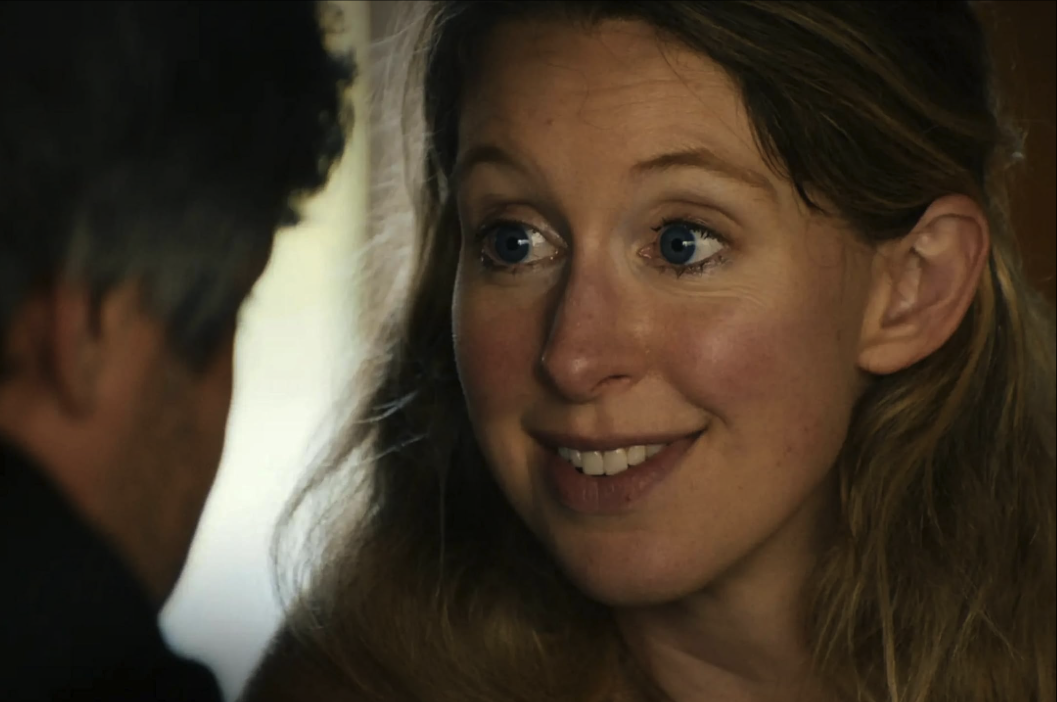
But You Can See Everything does throw some curve balls. As the clock winds down in the days before prison, we do see a very human side to Elizabeth Holmes. She seems to be a good mother. She seems to be kind. As viewers, we want to believe that it is hard to sustain cold-blooded fakery hour after hour and day after day in front of family, friends, and a very skeptical filmmaker. Her boyfriend Billy seems to have enormous secondary gain in this relationship. To be sure, they have children together, but he appears to spend all his time controlling the narrative, working on a Theranos-esque relaunch, and cutting a deal to make money from Fielder’s documentary. Could Elizabeth Holmes truly be a doe-eyed dreamer destined to find her way into relationships with controlling, manipulative men?
In the beginning of the movie, there is a dispute as to whether New York Times reporter Amy Chozick misquoted Elizabeth Holmes in describing actresses that portray her in movies and television shows. Chozick wrote, “They’re not playing me. They’re playing a character I created.” Holmes insists she said, “They’re playing a character they created.” Is it possible Chozick misheard and chose a word, unconsciously, that tilted toward her preferred narrative?

Likewise, at the end of the movie, Fielder debates a word that Holmes used in answering if she knew Billy Evans had negotiated financial compensation for her involvement in the documentary (a negotiation that occurred while Holmes left the room to attend to her child). By this time, Fielder had spent weeks with Holmes and, seemingly, came to be on friendly terms. Did Elizabeth say she knew, “Billy was discussing it” or “Billy was discussing something”? Uncertain, Fielder decides it was “something,” which clearly changes the implications as to whether Holmes had secondary gain in the documentary or was innocent of it. Is it possible that Fielder misheard and chose a word unconsciously that tilted toward his preferred narrative?
In the end, actress Amanda Seyfried watches Fielder think out loud and come to this conclusion. How objective is Fielder? How objective are any of us? Just when we think we know, we find ourselves unsure.
Is Elizabeth Holmes a visionary dreamer who was duped by Machiavellian lovers and invincible self-deception? Is Elizabeth Holmes a canny, sociopathic manipulator intent on maintaining a cynical fiction to manage her image and elude punishment?
What is the truth about Elizabeth Holmes?
“It’s complicated,” Seyfried muses.
When my daughter and I returned from the Museum of Russian Art, she gave the nesting dolls to her younger sister. My older daughter had cracked the doll, pulled out the smaller, and subsequently found her way to the smallest doll. My younger daughter, unsatisfied, took the smallest doll and twisted it. Unexpectedly, a hidden doll came out. Just when we thought we knew, we found that we didn’t.
Perhaps like Elizabeth Holmes.
Perhaps like you and me.