
“Every society is a theocracy. Figure out what people have made into God, and their society snaps into focus.”
This line comes from Mr. Humberstone, a character in Lucas Smith’s 2025 short-story collection, Spare Us Yet and Other Stories (Wiseblood Books). Mr. Humberstone, a young academic and journalist, stands accused by an online mob of raping his ex-“girlfriend” (with girlfriend serving perhaps as too concrete a term; “They liked to keep it vague,” the narrator explains).
In light of the controversy, Mr. Humberstone’s editor asks him to take leave from work, and he returns to his mother’s house, presumably to stew over the injustice he’s been dealt. In that way, the story offers a sort of behind-the-scenes of modern-day “cancel culture.” However, instead of actually fixating on the concept of “guilty until proven innocent,” Mr. Humberstone prays—for his ex-girlfriend, for her mother, and for the people accusing him.
“He was pursuing a subjective state of well-being through the feeling of faith,” the narrator explains. “The important thing was to know that God was real no matter what he thought.” Yet he still reaches a human limit: “Knowing this did not make him feel better.”
This story, “Mr. Humberstone’s Trial,” finds the character at the end of a reluctant Christian conversion. “He passed what he thought was his excusable Marxist phase and his liberal humanist phase,” the narrator explains, only to find himself drawn, as if by an “irresistible force” to “eternal Christendom.” “Oh shit,” he thinks to himself. “I’m a Christian. Oh shit, oh shit, shit, shit, shit.” He writes a letter to his girlfriend explaining his conversion: “In a way, I can. In a way, I can’t.” Ultimately, words fail, and his endless reasoning is reduced to the virtue of faith.
Mr. Humberstone has changed his stance on premarital sex, for example, as a result of his conversion, and he expresses his wish to abstain—a desire that sits in stark contrast with the accusation against him. The “trial” mentioned in the title therefore refers not so much to a literal trial in court as to a trial of penitential suffering—the trial of a new Christian whose faith is being tested.
This is the strange moral territory Smith explores in Spare Us Yet. His characters are confused, compromised, and often wrong. They live in a world shaped by bureaucracies, online mobs, lockdowns, broken families, and political resentment. But, interestingly, Smith is not especially concerned with settling ideological arguments or telling us which side is right. He is more interested in how imperfect people reach for God.
Instead of actually fixating on the concept of “guilty until proven innocent,” Mr. Humberstone prays—for his ex-girlfriend, for her mother, and for the people accusing him.
On that score, the title Spare Us Yet recalls the Parce Domine of the Latin liturgy, “Spare, O Lord, spare thy people.” It is a plea to God to spare his people according to his mercy rather than punish them according to their offenses, and to deliver them in times of spiritual trial. These references do not exist within Smith’s stories simply to announce that the author is Catholic; Catholicism, for Smith, is not wallpaper. Instead, they provide windows into the interior lives of the characters, giving them a vocabulary for experiences that modern political language cannot adequately describe.
Likewise, the characters are not saints, and Catholicism is not a shallow evangelization device. Instead, faith sits quietly within each story, shaping how the characters confront their moral predicaments without necessarily resolving them. Each character reaches for it imperfectly in the search for truth.
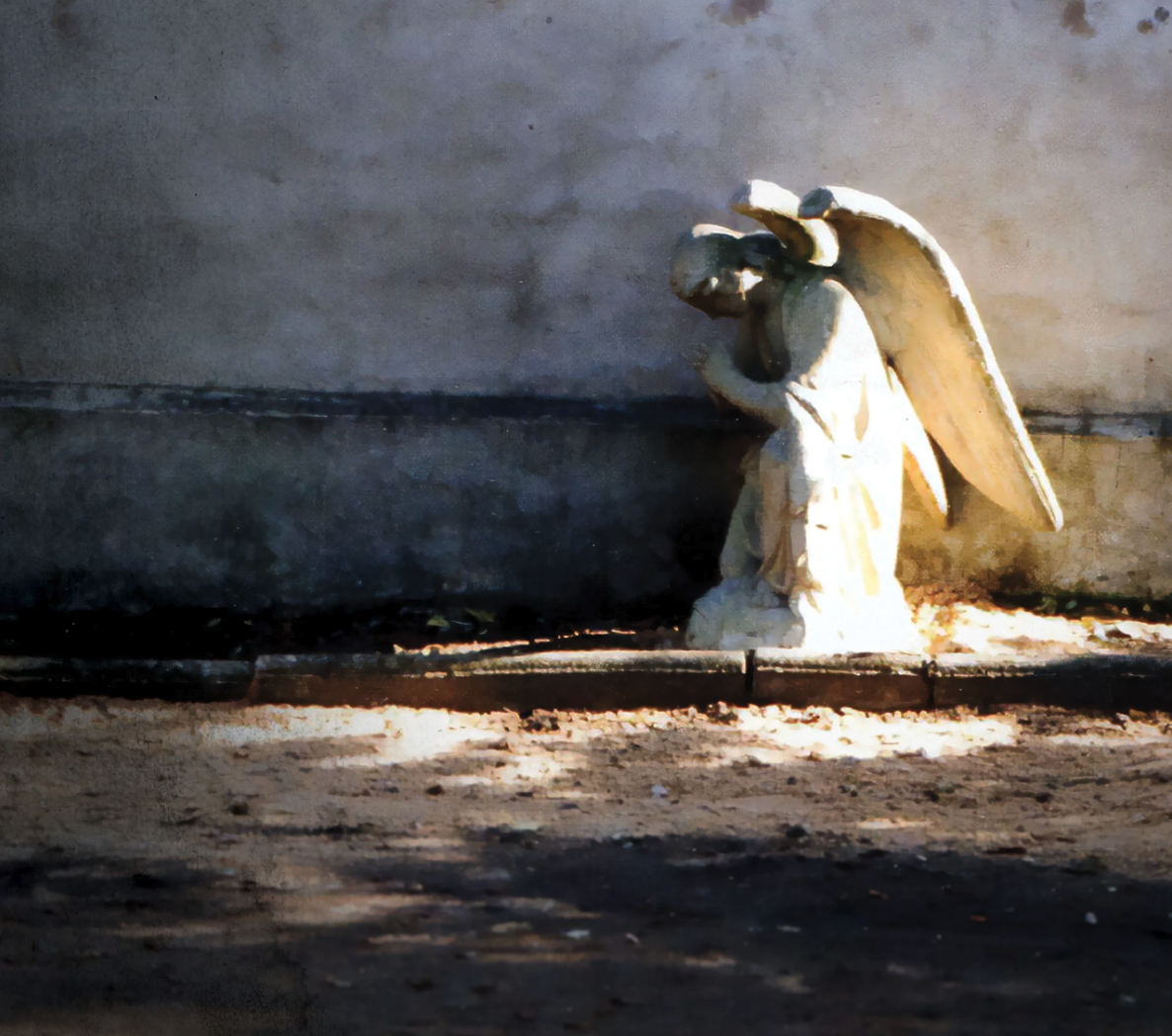
In making sense of this dynamic, it’s helpful to think of the collection’s preface, “Prelude: Unit 1002,” as a frame for the stories that follow. In “Prelude: Unit 1002,” a nameless angel is called down with great fanfare to protect Christ’s altar. But this occurs in 1858, and the novel takes place during COVID. In the years that follow, the church is slowly abandoned—yet bureaucratic rules keep the angel from being released despite the abandonment, and he finds himself in the same storage unit into which the altar is placed. Eventually, he is released when the storage unit itself is abandoned and then sold to the highest bidder. Upon the sale, the altar is fed into a woodchipper, finally freeing the beleaguered angel from his earthly duties. Thus, the altar meets a darkly comic end. “Lord, have mercy on them!” the angel says as he ascends back to heaven.
It is a strange and funny story but also a sad one—and it captures a paradox of the period Smith documents. Despite trending urban parishes and occasional sexy optics, the Church Militant—the living body of believers on earth fighting against sin, temptation, and the devil—has long been shrinking in cultural influence. Yet even as churches closed during COVID, Catholicism was acquiring a certain cultural cachet, particularly among young writers, artists, and intellectuals. Its institutional presence was appearing diminished at precisely the moment its aesthetics, traditions, and moral vocabulary were becoming newly fashionable.
Smith is not especially concerned with settling ideological arguments or telling us which side is right. He is more interested in how imperfect people reach for God.
During the COVID lockdowns, this institutional decline became literal: Churches closed, public worship was restricted, and religious life was treated by governments as one more activity eligible for suspension—even as liquor stores remained open for business. COVID was topical when Smith’s stories were written, but, unfortunately, it remains relevant to understanding the current state of the church in larger culture today as well.
Amid the lockdowns, the question of vaccination mandates in particular divided society: Should individuals be free to decline vaccination, or should governments be able to require it? This is another lens through which Smith investigates moral dilemmas.
In “Lions Over the Bridge,” Smith follows a homeless man whose situation stems from his COVID-vaccine refusal. It would be easy to turn this character into a political martyr: an innocent man destroyed by an unjust system. But Smith refuses to make things that simple. The man is troubled in his own right. “HOMELESS DUE TO JAB,” he writes on a cardboard box as he begs on the street, even as he refuses his brother’s offer of a room. His suffering may be real, as may the forces acting against him, but this does not mean every decision he makes is reasonable. Yet he still reaches for truth, even using a quote he attributes to St. Isaac the Syrian: “Be like the bees and go where the good stuff is.”
In his homeless, jobless wanderings, he casts judgement. He presses his diocese’s archbishop for forcing priests “to take the jab.” His mind is addled with diversions, and he pontificates, “You can’t pray ironically, and you can’t pray as if you are right. Prayer must always leave open the possibility you are wrong.”
Smith’s characters are three-dimensional, and each of them—whether chasing after atheist graffiti artists, planning illicit Shrove Tuesday gatherings, or altar-serving at empty funeral Masses at the height of “stop the spread”—retains the possibility of an act of grace. Flannery O’Connor once described her own subject in fiction as “the action of grace in territory largely held by the devil.” Smith works in similar territory. His characters are never beyond the reach of mercy. And whereas O’Connor often ushers in grace through grotesque comedy, violence, or a sudden reversal, “Lions Over the Bridge” arrives at its own strange reversal.
The COVID years have been “memory-holed,” and when recalled, they are remembered differently by opposing political factions with conveniently alternative memories. Smith remembers something strange that he illustrates through his fiction: human beings trying to remain human while isolation, bureaucracy, and ideology reshape their society and their lives.
Vitriol and pedantic moralization do not spew from these stories. There is no long anti-vaccine tract disguised as dialogue, nor are the characters merely puppets Smith uses to convert readers to Catholicism. Instead, Catholicism provides a language for sin, suffering, forgiveness, and grace without making any of those virtues easy. A challenging collection, Spare Us Yet rewards close rereading, with each story rich enough to warrant a review of its own.
Still, complications linger. Even though much of its subject matter will resonate with those who lived through the COVID years, readers may not always know immediately what Smith wants them to make of a story. A few stories require a rereading before they can be fully absorbed. Individual lines can carry an unusual amount of weight, and, for better or worse, Smith often refuses to provide the moral conclusion that a less confident writer might underline at the end.
This density works better in some stories than in others. There were moments that demanded slightly more clarity. But the difficulty also seems inseparable from what Smith is doing. These are stories about people who cannot fully decipher the moral situations they themselves inhabit. Why should the reader be allowed to stand comfortably above them?
Spare Us Yet is not a demand that God punish our enemies. It is not even a confident
declaration that “we were right.” It is a prayer uttered by people who know the world is
disordered, who suspect that they are disordered too, and who can only beg for mercy over judgment. As we emerge from the COVID era and its consequences, Smith offers an important documentation of what occurred, the aftermath we’re still experiencing, the way Catholicism interplays with American life throughout the most unusual seasons, and the way art can still make us human after all.