
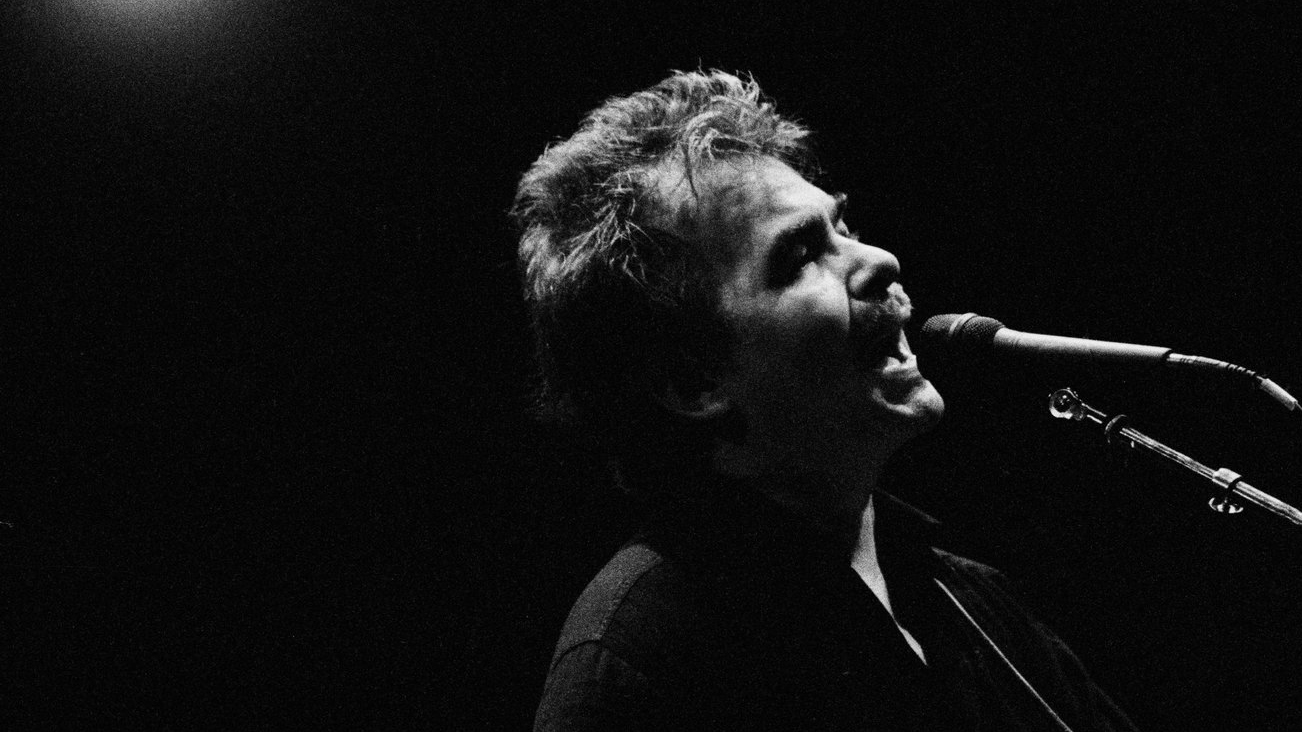
October 10 this year marks the 80th birthday of one of America’s greatest wordsmiths, the late John Prine. When Prine came to Duluth, Minnesota, in the summer of 2019, I almost didn’t go to see him. I had listened to him a little bit in the past on my dad’s cassette of Prime Prine and once or twice to the 2018 album The Tree of Forgiveness that he was touring behind, but I had never gotten too deep into his music and was on the fence about buying tickets. But sometimes you can encounter the same thing a half dozen times without being moved, and then the seventh time through, for whatever reason, you’re prepared to receive it for the first time. In the months preceding the concert, I gave Prine’s music a closer listen and realized what I had been missing out on; I got my tickets and went with my dad. Now, especially after Prine’s untimely death in 2020, going to that show remains one of my biggest near misses—an event I know I was this close to missing out on and am so grateful to have experienced.
Many books and analyses could be written about Prine and his songs, and I’m sure many have been, but I want to focus on one song on that 2018 album where Prine gives his dream of the afterlife. The song “When I Get to Heaven” is the last track on the album, and you can watch and listen to an especially moving live performance recorded at the House of Strombo.
To preface, any theology that comes up in Prine’s work has never been strong, in any orthodox or even consistently thought-through sense. I don’t know that he ever gave theology as a field of knowledge or truth much thought. And while his album The Missing Years earned him a Grammy in 1991, Prine’s account of Jesus’s “missing years” leaves much historically and theologically to be desired. Still, writer Andrew Tolkmith has pointed out that in spite of Prine being no theologian or proponent of the Church, his music points toward a longing for redemption and hope. And, despite his depiction of heaven looking very different on the surface from biblical or theological descriptions, some beautiful truths that lie at the heart of all human longing break through in Prine’s “vision” of heaven.
After a flourish of strings that sounds like cartoon angels plucking their golden harps, Prine begins by speaking,
When I get to heaven, I’m gonna shake God’s hand
And thank Him for more blessings than one man can stand.
In this opening line, Prine emphasizes the incredible blessings of life. He expresses thanks for the particular blessings of his own life, but we know that each one of us has also received our own blessings and the pure gift that is life itself. It would be easy for Prine or any of us to complain about all the things that are wrong in the world, all the things that have not gone the way we wanted, all the things we haven’t received or that we think are unfair. The grotesque pleasure of complaint is an all too human tendency. But all is a gift, and Prine acknowledges that we ought first to recognize the gift and blessings that precede and overpower anything we could complain about.
Despite his depiction of heaven looking very different on the surface from biblical or theological descriptions, some beautiful truths that lie at the heart of all human longing break through in Prine’s “vision” of heaven.
Each verse of “When I Get to Heaven” is spoken instead of sung by Prine, with soft guitar chords underneath. Bare and stripped down, the verses give us the simplified music of the earthly pilgrim in exile, looking and longing heavenward. As the song shifts into the chorus, the music and lyrics complete the movement toward heaven, from the sojourn to the destination. Prine sings accompanied by a chorus of voices, jangling piano, and buzzing kazoos in a joyful outburst. Here, Prine sings,
And then I’m gonna get a cocktail, vodka and ginger ale
Yeah, I’m gonna smoke a cigarette that’s nine miles long
I’m gonna kiss that pretty girl on the Tilt-A-Whirl
’Cause this old man is goin’ to town.
As I mentioned earlier, this is not the description of the heavenly Jerusalem you will find in your Bible, and it is, admittedly, open to critique. For instance, is heaven really no more than a place where we can do the things that are bad for us and “sin taxed” on earth? But I don’t think that is fair to Prine’s intent, and the lyrics go beyond that surface-level criticism.
For one, we do experience a sense of longing on earth that is only fulfilled in heaven that Prine expresses here in his own way. In the performance at the House of Strombo, Prine says he smoked a pack a day for thirty-five years until he got cancer and his doctor convinced him to quit. For him, smoking a cigarette was a pleasure on earth that also carried with it (as it does for anyone) a cost and a risk. Forgive me if this is taking a leap too far, but all pleasures on earth are imperfect; they carry with them the risk of overindulgence, intemperance, and some kind of earthly price. Prine, in his own way, describes the desire to eat without cost and to be filled without price. At the heart of this heavenly vision is the desire to be fulfilled. Certainly the things he pictures himself being fulfilled by are not the highest goods or the goods we imagine will be in heaven, but the heart of his vision speaks to that longing which cannot be fulfilled on earth.
The same can be said in a different sense about the third line of the chorus. On earth, human and specifically romantic relationships are a great good—an important way we are called to imitate God and a preparation for the union of heaven. Yet we so often distort and pervert what that relationship is supposed to be. The innocent, nostalgic image of kissing “that pretty girl on the Tilt-A-Whirl” speaks to a desire for the redemption of romantic relationships, a rectifying of distorted lust back to a chastened love. In Prine’s vision, things that are fallen on earth are turned to a perfected version in heaven. Again, some listeners could hear this as a problem—heaven as the bad things on earth being made not bad anymore, heaven as sin without the consequences. But that doesn’t feel like Prine’s point for several reasons, in part because we know that God really does turn all things to the good. Vodka, cigarettes, kissing a pretty girl: none of these are evil or immoral in themselves, and there’s a recognition that what we overindulge in or twist into sin in our fallen state on earth are meant for good, for blessing, which God can redeem in the end.
Both lyrically and musically, the aspect of “When I Get to Heaven” that I find most moving is the shift from the sincere longing of the verse, of the earthly pilgrim, to the overwhelming sense of joy in the chorus. We feel this most strongly in the third verse, where Prine says,
And then I’m gonna go find my mom and dad and good old brother Doug
Why, I bet him and cousin Jackie are still cuttin’ up a rug
I wanna see all my mama’s sisters ’cause that’s where all the love starts
I miss them all like crazy, bless their little hearts.
The sense of longing for union and communion is so strong here, and Prine’s gravel, world-worn voice gives a sense that he knows he’s nearly there, that his heart is halfway to this reunion. After these lines, the song breaks into its final raucous chorus and emphasizes what I think is most powerful in Prine’s image of heaven: the joyful sense of play.
What does Prine lean into when he thinks about heaven? Communion, laughter, the voice of a child, a chorus of voices singing in harmony, buzzing kazoos, fun—this sense of play is something that isn’t always emphasized when we think about heaven but is something that I think helps us in a more complete vision of heaven. In God, we find peace and communion but also ebullience, laughter, joy, and play; when we think of heaven as only somber, our human experience of somberness is disloyal to the actual promise of heaven. I don’t mean to say that heaven is supercilious or frivolous, but play and fun are good and therefore belong as part of the fullness of heaven in some way that we don’t yet fully comprehend. In spite of himself, Prine reminds us that there is joy in the heavenly kingdom, joy that fulfills beyond what we can imagine or try to substitute on earth, joy in the fullness of reunion and communion with God. And I pray wholeheartedly that when (and if) I get to heaven, I’ll be able to sing a joyful chorus with John Prine.