
The College Beat: Article XVII
. . .
Picture with me, if you will, a society fragmented by political division and polarization, violence, secularism, decline in religious affiliation, and economic uncertainty. A society in which people still yearn for meaning, purpose, and connection with one another and something greater than themselves but find it difficult to achieve. A society in which recent political and social unrest have raised pressing questions around access to education, healthcare, and community. A society that encourages a misguided search for identity, meaning, purpose, and connection primarily in one’s political affiliation, one’s individual achievements, or in the more superficial offerings of the world. This situation should not be too difficult to imagine.
And yet, this was what Bl. Basil Moreau, a nineteenth-century French priest and Scripture scholar, found himself responding to when he set out to found a new religious community—the Congregation of Holy Cross—in the years following the French Revolution. Moreau established Holy Cross to minister to a society that was, in many ways, suffering, broken, and alienated. He saw people who were separated from one another due to the political environment, an over-emphasis on the individual, and the decimation of many social institutions in the years following the French Revolution. He also saw people who were separated from God due to the Revolution’s enshrining of reason alone and the gutting of the Catholic Church in France, which left an entire generation largely illiterate and without access to sacraments. Moreau’s solution was simple: He gathered a group of priests, brothers, and sisters from the local town of Sainte-Croix (“Holy Cross”), and invited them into a shared mission, identity, and common life that would allow them to care for the spiritual and educational needs around them while providing a powerful witness for what true unity grounded in Christ could look like. And as he wrote to his community to encourage them in their educational ministry, he reminded them that theirs was a “work of the resurrection.” He saw the educational process as a kind of dying to old ways of being and knowing in order to give way to the new, the transformed. Education, for Moreau, had a mystical, spiritual, and almost liturgical quality, as it invited the individual and community as a whole to participate in the death and resurrection of Jesus Christ. And this transformation was twofold, having profound implications for the individual student who was being formed as well as society as a whole.
He saw the educational process as a kind of dying to old ways of being and knowing in order to give way to the new, the transformed.
As a Holy Cross priest who has served for nearly two decades in Holy Cross universities, I have returned to Bl. Moreau’s words often for inspiration. When I returned to my alma mater, the University of Notre Dame, in 2018 to serve as vice president for Mission Engagement and Church Affairs, I began my role just one week before the release of the Pennsylvania Grand Jury report, which detailed a painful scandal of sex abuse by priests across the state of Pennsylvania. At the time, the university was also beginning to grapple with the phenomenon of disaffiliation among young people (in 2021, church membership in the United States fell below 50 percent for the first time in our country’s history) and asking serious questions about what this might mean for undergraduate admissions, the ways we form our students, and how Notre Dame might be in service to the Church. The university’s former president, Rev. John Jenkins, C.S.C., thought a great deal about this, as has our current president, Rev. Bob Dowd, C.S.C., and at the former’s request, we dove deeper into these questions, bringing in sociologists and theologians from Notre Dame to assist us in understanding the trends and potential implications for our mission. It was also in the midst of these conversations that the COVID-19 pandemic began, which carried profound implications for our students and community as a whole. At times, it was difficult to see past some of these challenges. And yet, ours is a work of the resurrection.
Listening
In 2021, I was asked to take on a new role as Notre Dame’s vice president for Student Affairs. I entered into this role with great excitement because, as a “triple domer,” I had been deeply formed by Notre Dame as an undergraduate, law, and graduate student. But as much as I recognized many similarities between my own experiences as a student and the student experience today, I was acutely aware of the differences as well. Today’s students have lived through a global pandemic, the effects of which we continue to feel to this day. They have encountered dramatic changes in our national political landscape, including a heightened sense of political polarization and toxic levels of political discourse. They are navigating the emergence of AI, which has quickly and acutely shaped our society, relationships, and ways of working. Amidst all of this, trends toward disaffiliation have continued, with young people expressing increasing distrust in institutions and organizations and finding their sources of meaning and spiritual encounter outside of traditional religious institutions and communities. At Notre Dame, fewer and fewer incoming first-year students have reported that they regularly attend religious services (64 percent of incoming first-year students in the class of 2019 reported attending religious services frequently, which had decreased to 47 percent for the class of 2025).
I hoped to understand how we might meet students where they are, accompany them on their journey of formation, and ultimately invite them into a deeper encounter with the God who first called them.
In light of all of this, my first priority was to listen and to listen deeply and widely. Having grappled with these realities on an institutional and intellectual level for a number of years, I was especially interested in learning how our students—and the staff and faculty who work most closely with them—experienced these contexts in their day-to-day lives. Most importantly, I hoped to understand how we might meet students where they are, accompany them on their journey of formation, and ultimately invite them into a deeper encounter with the God who first called them. This listening also involved a campus synod that our Campus Ministry team led as part of the Universal Church’s Synodal process.
I learned a great deal from these conversations, including the effects of the pandemic on students’ mental health, sense of belonging, and their social and academic development. I also learned about how over-extended students felt—exasperated by a highly competitive college admissions process—and their desire for more opportunities for prayer, reflection, and discernment. Our students often find themselves caught up in a culture of comparison, which can manifest in the frenzied perception that they need to pursue three majors and two minors, found a new club, and chase the most competitive internship they can find as early on as possible. Students tend to perceive that everyone else is doing well, often seeing themselves as alone in their struggles—a perception that is only exacerbated by social media.
If there is one thing I have learned through my work with students, it is that even amidst declines in religious practice, they continue to ponder and wrestle—as does every human heart—with deep questions about God, life, life after death, suffering, purpose, faith, and ultimate meaning. The beauty of what we offer at Notre Dame is that we are intentionally set up to prompt these questions of discernment, to encourage relationships that foster deeper reflection on vocation and purpose, and to invite students to consider and take seriously the possibilities of a life of faith. Even today, as I begin my sixth year as vice president for Student Affairs, it is not uncommon to find myself in a conversation with a student about faith. I am often sought out by students wishing to discuss their faith in part because I am a priest and in part because, as a priest-in-residence, I live in an undergraduate residence hall. Sometimes their intent is clear: “Father, can we talk about spiritual direction?” “Father, I have a question on something we discussed in my theology class that I wanted your take on.” “Father, could I talk with you about how you knew God was calling you to become a priest?”
Other times, we reach the topic through a more roundabout path. A conversation about something mundane gives way to a more serious topic that I can tell is the real reason the student stopped by. A death in a student’s family leads to a conversation about suffering and why bad things happen to good people. A casual question about how a girlfriend or boyfriend is doing back home opens up a deeper conversation around vocation, happiness, and discernment. I’ve learned through these many interactions that faith is often on students’ minds, ever relevant to the many facets of their lives even when they don’t necessarily realize it. This springs from the charism, tradition, and original vision that Bl. Basil Moreau had for Holy Cross schools, which emphasizes the importance of a holistic and rigorous formation of mind and heart; of strong mentors and exemplars (both in terms of peer mentors and mentoring relationships between students and their professors or staff members who accompany them); and of formation in the context of a community that fosters familial bonds. Or as Notre Dame’s mission statement puts it, we endeavor to develop “that sense of community and of responsibility that prepares students for subsequent leadership in building a society that is at once more human and more divine. . . . Notre Dame pursues its objectives through the formation of an authentic human community graced by the Spirit of Christ.”

The Response
These early conversations with students—particularly as they related to students’ lives of faith—led us to articulate what we call Four Pillars for Reaffiliation. While not intended to be all‑encompassing, these pillars represent a strategy for inviting students to consider the relevance of faith for all aspects of their lives. Simply put, these pillars represent “what seems to work”—what do we see as drawing young people in, having an impact, and helping those with very little experience with faith to enter in while also helping those with very deep faith lives to go deeper. These pillars are as follows:
- Authentic Encounter: Students are drawn to experiences that invite them to bring their whole selves, to pause and reflect, and deepen their communion with God and those around them. This might include retreats and pilgrimages, faith-sharing opportunities, Bible studies, and opportunities to deepen their sense of belonging in community with others.
- Mentorship: We take seriously the role that adult mentors (professors, residence hall rectors, etc.) play in students’ faith lives but also the sometimes greater impact that peer mentoring can often have. Our efforts in this space have included a full reimagining of Notre Dame’s Moreau Program and placing a premium on the mentoring relationship of the seminar instructors as well as peer leaders. We have also developed peer mentoring opportunities across students’ experiences (whether through residence halls, campus ministry, health and wellness, or student leadership opportunities), while also continuing to invest in spiritual direction and vocational discernment initiatives.
- Faith Through Justice and Service: Studies of disaffiliation have underscored the ways in which service and social justice speak in particular ways to young people, and a number of opportunities exist to pair service engagements with theological reflection. The university’s Mercy Works program, launched just a few years ago, connects students with direct service opportunities in the local community, followed by prayer, theological reflection, and faith sharing in small groups. This program has grown immensely in popularity over the past few years, now numbering approximately 400 students each semester.
- Faith Through Beauty: The Catholic faith has long held up beauty as a reflection of God and an invitation to encounter God and our faith through art and architecture. We are blessed at Notre Dame to have a very beautiful campus that does just this, whether it is the Basilica of the Sacred Heart (and its beautiful choirs!), the grotto, the buildings and statues that adorn campus, or the beautiful path that lines our lakes. We have also taken steps to enhance campus beauty by creating new artwork that invites students to contemplate the mystery of our faith, the diversity of vocations within the global Catholic Church, and the particular ways that God might be speaking to them.
Undergirding all of these and other efforts has been an increased emphasis on a truly holistic and more integrated approach to student formation both inside and outside of the classroom, which has led to a number of innovative collaborations across students’ academic experiences and their lives outside of the classroom.
The Impact
Our hypothesis has been that by focusing our time, energy, and resources in these areas, we could “move the needle” on reaffiliation on our campus. Five years later, we are beginning to reflect back on these initiatives to begin to assess whether or not we have done so, and the early results are striking.
While only 37 percent of seniors graduating from Notre Dame in 2019 reported attending religious services frequently, this number has climbed to 49 percent as of 2025. 46 percent of the class of 2021 reported that Notre Dame has helped them view the world informed by Catholic teaching, but as of 2025 this percentage is now 64 percent. Reflecting more national trends, participation in the Order of Christian Initiation for Adults (OCIA) has increased an unbelievable percentage, jumping from 42 participants in 2021 to 165 students this past year.
More graduating seniors are reporting that their religious beliefs are central to their life (from 56 percent in 2021 to 62 percent today), more are reporting that prayer is important to them (from 82 percent in 2021 to 94 percent today), and more are reporting that witnessing their faith to others is important (from 68 percent in 2021 to 73 percent today).
There is, of course, much work to be done. For example, only 53 percent of students believe that their identity as a member in God’s beloved community is more important than their accomplishments. 70 percent indicate that the university’s Catholic, Holy Cross mission inspires them to live a life of faith and engage in ongoing personal development. I would like these numbers to be higher. However, as I noted above, I am very encouraged by the early indicators we are beginning to observe on campus and hope to see this continue.
Conclusion
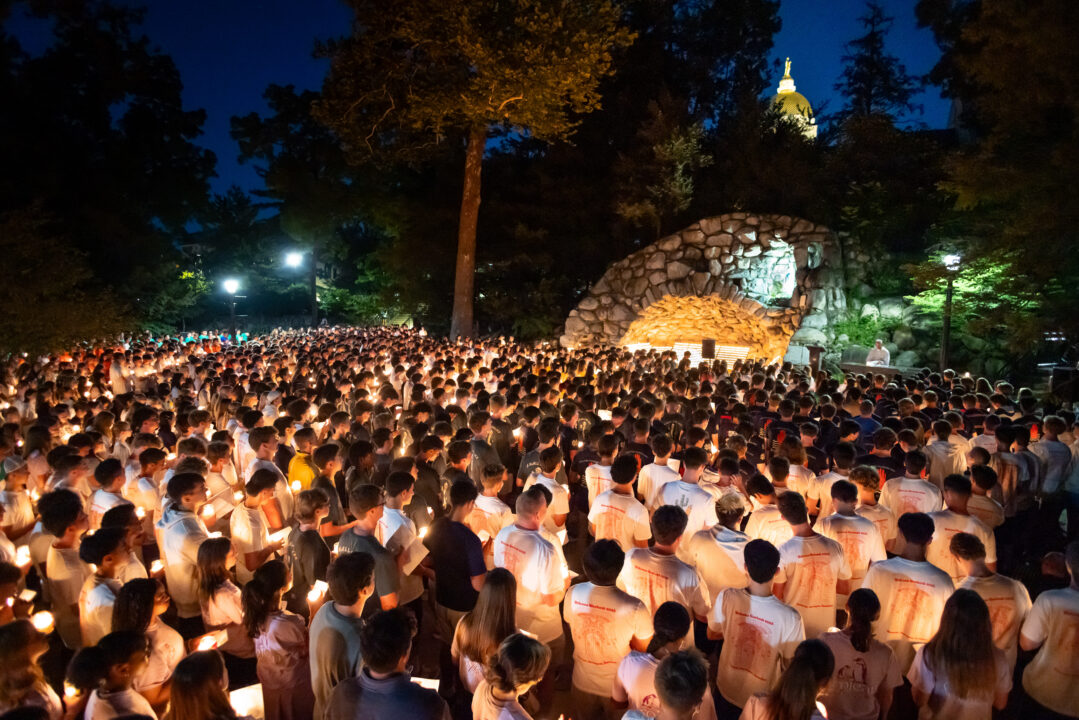
These broader trends give me great hope. But metrics and programs are only part of the equation. Perhaps even more compelling are the stories of the Holy Spirit at work in students’ lives and those that have been transformed by the ways we seek to help students engage their faith in the context of authentic connection and community. A few years ago, a very recent alumnus tragically drowned in a swimming accident while on vacation. This alumnus was part of a tight-knit group of friends who met in their residence hall at Notre Dame and remained close after graduation. When the alumnus’s friends learned of the accident and prepared to travel together from across the country for his funeral in another state, they first made a stop at Notre Dame. They came to the grotto and lit candles and prayed for the friend they had lost. Then they returned to their former residence hall, where the current hall community gathered with them for Mass. Current members of the hall raised their hands in blessing over the group of friends, offering their prayers, support, and consolation as they mourned the unexpected and tragic loss. The group then departed Notre Dame and traveled together to their friend’s funeral, where they grieved with his family, shared stories about their time together as students, and helped one another to find the strength to continue forward.
This story is a profound illustration of the “work of resurrection” that we are privileged to take part in at Notre Dame. The Constitutions for the Congregation of Holy Cross remind us as followers of Christ that resurrection is a “daily event.” I have certainly found this to be true. Often we find ourselves facing circumstances that we wish had not fallen on us and that can be incredibly difficult to see beyond. Whether it is the loss of a loved one, a serious trauma, separation from a significant other, a difficult class, or any number of factors, there are crosses we carry and dying that we do on the way to the Father. And yet, by inviting students into the mystery of Jesus’s own passion, death, and resurrection, by drawing them into deeper communion with the Catholic Church and by walking intentionally with them on this journey, we have the opportunity to form people of hope who will leave this place as signs for an alienated world. And we can say, with Bl. Basil Moreau, Ave crux, spes unica, “Hail the cross, our only hope.”