
They say that everyone’s favorite subject is themselves. People are endlessly skilled in discussing themselves, their thoughts and feelings, their ideas for the way the world should be. Take any contemporary American and place them in a coffee shop, on a podcast, or in a therapist’s office, and they can produce a forty-five-minute dissertation on their childhood and all those assorted things that punctuate life. In the last quarter-century in particular, we have become connoisseurs of our own interiority. The language of psychology, once reserved for the consultation room, has puzzlingly entered into common usage. We know our attachment styles, our personality types, our love languages, our trauma responses, and perhaps even the unconscious motives that prevent us from finishing tasks. If self-knowledge alone could save us, ours would be the most pristine, most devout generation since the apostles walked in Galilee. However, perhaps self-knowledge alone is an incomplete discipline.
Something curious has happened in the wake of all this psychological banter. In short, the more fluent we have become in the language of psychological introspection—in the act of explaining ourselves—the less certain we seem about changing ourselves. This is by no means an indictment of psychotherapy or a claim against its efficaciousness. Good counseling has aided countless people from the personal trials of depression, addiction, anxiety, grief, and despair. It has given us the verbiage to rebuild communication and offered us recognition of our own need for boundaries and personal limitations. It would be foolish to deny the value of this in the face of overwhelming results.
However, there is some confusion relating to what psychotherapy is and what it can do. In the Catholic world, it is more apparent—and it needs to be stated—that therapy and confession are not the same enterprise. They are relatives, not twins. For the unfamiliar, there has been speculation that Freud got the idea for his “talking cure” in his own Viennese childhood. His Austrian Catholic nanny would often take him to church, and he would observe firsthand the affective changes that took place before and after the sacrament of auricular confession. Taking this account at face value, this would make confession something akin to psychotherapy’s great-grandfather. However, with this, as with most relations, there are considerably different qualities to both of these crafts. The first of which is an orientation to the subject. That is to say, psychotherapy ordinarily asks, What happened to you? while confession asks, What have you done? The difference here is not trivial, albeit subtle. One question seeks understanding. The other is seeking something alien to the realm of psychology: the idea of repentance.
The more fluent we have become in the language of psychological introspection—in the act of explaining ourselves—the less certain we seem about changing ourselves.
Suffice it to say that modern people greatly prefer the first because it allows us to remain self‑preoccupied. Psychotherapy is built on the premise of constructivism, that you are the authority on your own life, happiness, and the pursuit of the good in the world. The second is considerably less flattering. It insists that after every generous allowance has been made for our upbringing, there still remains one stubborn fact: We are responsible for ourselves. We possess the free will capable of making the decisions that ultimately plague us. In the words of the late Edwin Arnold, “Ye suffer from yourselves, none else compels.”
To be frank, there is no market for that kind of observation. As a rule latent found across our civilization, human beings have always preferred complicated explanations to simple confessions. It is comforting and perhaps self-aggrandizing to imagine ourselves as elaborate machines requiring expert technical calibration. Every age invents new vocabularies for old vices, as though a change in terminology amounted to a change in human nature. It is rather less pleasant to admit the obvious fact that pride, vanity, and selfishness have survived through every century without requiring much in terms of innovation. The old hypocrites of yesteryear at least paid virtue the compliment of imitation.
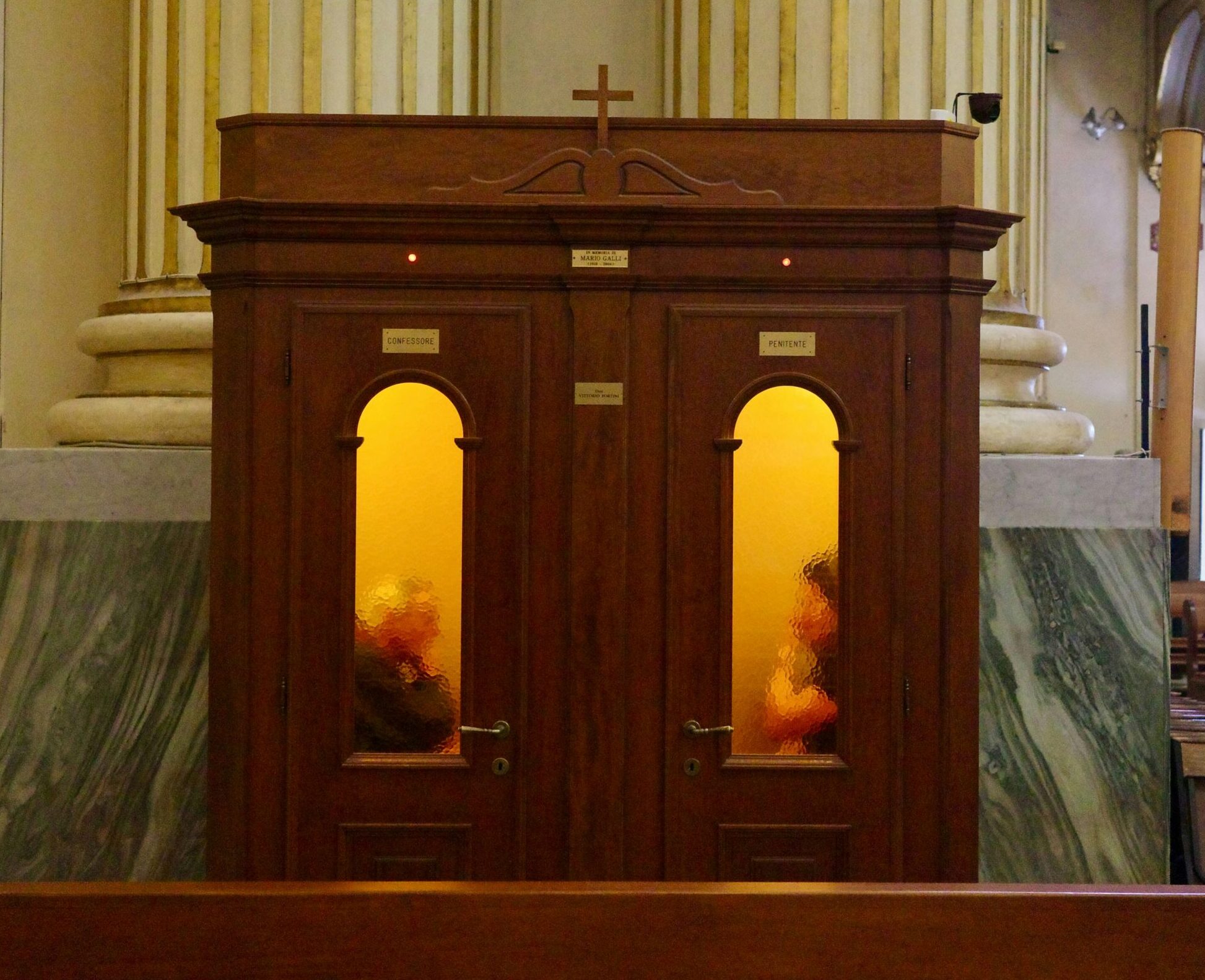
The sacrament of confession is radical precisely because it refuses to let us be passive in our actions, to become spectators of our own moral lives. It does not permit the participant to be detached. It invites us to analyze our misgivings and personal failings from a safe academic distance. It requires us to stand inside the moral wreckage of our own actions and admit, without annotation or legal counsel, “I am the one accountable.” In the era that we live in, that sentence has become unambiguously countercultural. We are inhabitants of an age that is remarkably proficient at distributing blame—or rather finding absolution for ourselves and condemnation for others. Our vices are accompanied by a long personal genealogy of behavior. Every one of our failings has a context, and every one of our cruelties possesses a reasonable explanatory framework. While some of those explanations are in fact valid and deserve thoughtful consideration, explanation and absolution are very different things.
To explain why a bridge collapsed is not the same as rebuilding it. Likewise, understanding why we sin, why we have transgressed the natural moral order of the world, does not reconcile us with God or with our neighbor. It only provides the prologue, the route by which we brought ourselves there. The act of any confession begins where explanation ends.
It is comforting and perhaps self-aggrandizing to imagine ourselves as elaborate machines requiring expert technical calibration.
The state of our culture has become emotionally allergic to any sense of judgment. For the lay person, the idea of judgment is akin to moral violence. Perversely, our culture has imagined freedom as the absence of any kind of judgment, and in doing so, has created a landscape of perpetual and inexhaustible nihilism. Christianity proposes something altogether stranger. Our freedom begins not with moral judgment but with truthful judgment. I help no one by condemning them, but I also cannot help them if I deny them the truth that they need. A person who cannot admit to their own sin, who is not responsible for themselves, is not liberated from sin but a slave to their own insanity.
The confessional performs a remarkable act, something which has little parallel in the course of Western civilization. It removes every respectable disguise we all carry. There is no room for temporal authority. There is no room for political opinion or professional accomplishments. In the end, there are no excuses. Inside, there is only the sinner asking for mercy. It is difficult to think of another institution in our civilization that so thoroughly levels any notion of human pride. The Church does not ask whether your failures were sophisticated or what unconscious forces drove you to act. It only asks whether they are yours and you repent of them.
If my deepest problem is only my environment, the society I live in, the friends or family that surround me, then I must wait for the whole rest of the world to improve before I can become better. Obviously, such a proposition is impossible, and it shifts accountability to everyone and anyone. If everything is determined by forces outside my control, then genuine moral transformation becomes exceedingly difficult to imagine. Christianity, with its proposition of sin, redemption, and renewal, proposes a harder diagnosis but a brighter hope.
Sin is real, but so is the presence of grace. The Christian leaves the confessional with something no amount of self-analysis can provide: not insight into the nebulous past but reconciliation for the future. Psychotherapy may help us understand why we fell and offer us the natural comfort of connecting with another human being. However, confession assures us that, by God’s grace, we need not remain on the ground. In an age devoted to explaining ourselves, that may be the most subversive idea of all.