
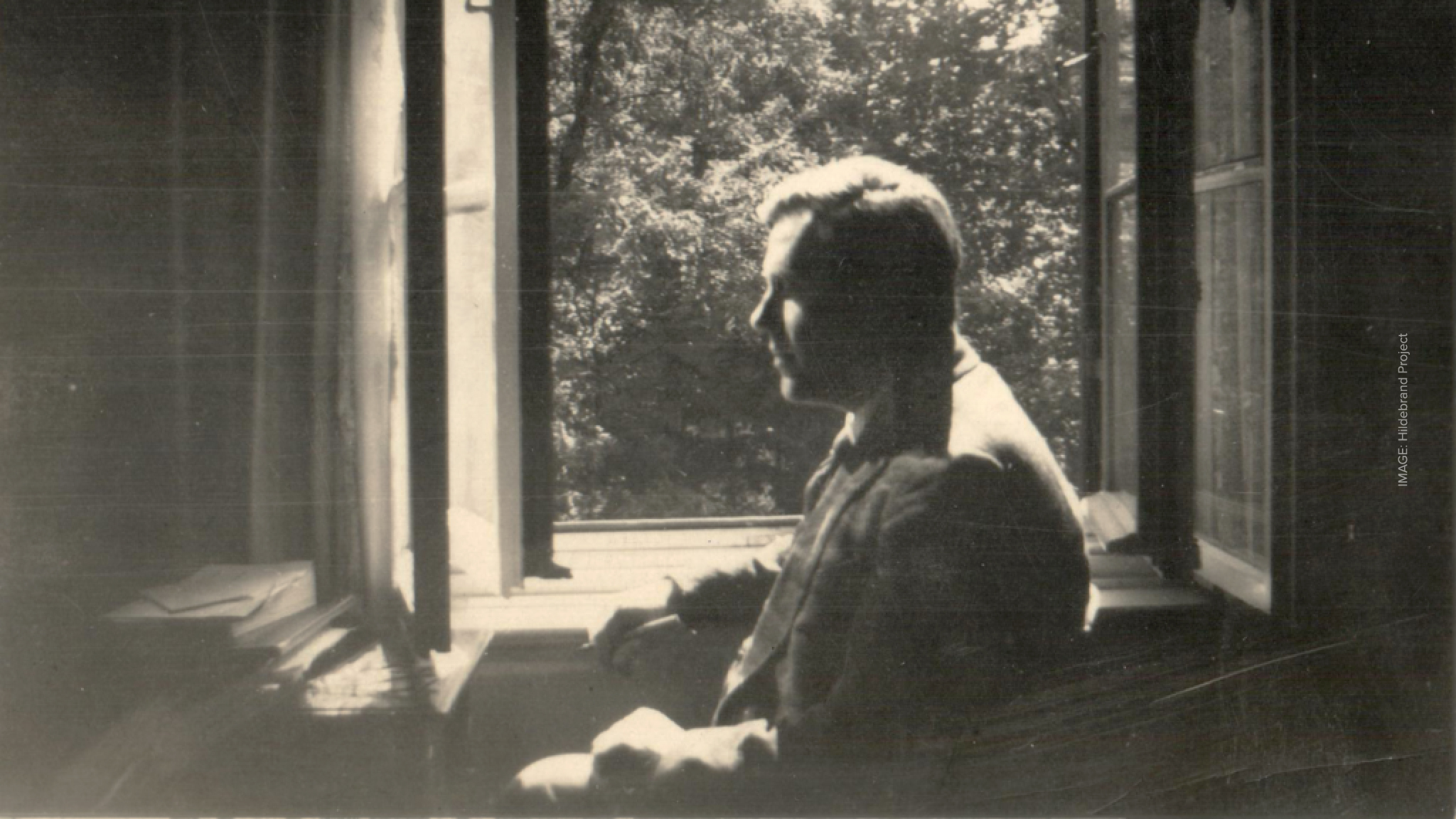
Dr. John Crosby joined me to discuss his new course set to launch in the Word on Fire Institute on August 24, 2026, The Christian Philosophy of Dietrich von Hildebrand.
***
Joshua Bitting: Dr. John Crosby, you have recorded a new course about one of the most remarkable philosophers in the last century and certainly a man of great consequence for Catholic thought today: Dietrich von Hildebrand. Your work on this German philosopher is also deeply personal. Would you mind sharing your relationship with Dietrich von Hildebrand and his late wife, Alice (called Lily by her personal friends)?
Dr. John Crosby: I met Dietrich von Hildebrand (DvH) when I was twenty-one and he was seventy-six. In February 1966, he came to Georgetown University where I was a senior, to deliver a lecture on the true meaning of Vatican II. The lecture made a great impression on me; never had I experienced a Catholic intellectual speaking with such depth of intelligence and at the same time with such ardor of faith. The voice I heard in that lecture was not just the voice of an outstanding professor but the voice of a true confessor. I wanted to get to know him better, and to my great surprise, he welcomed me into his circle of friends. I was able to spend much time with him in the remaining eleven years of his life. He showered his genius on me and introduced me to many of his closest friends. He became my primary teacher in philosophy. Through that first encounter with him at Georgetown, my life took a new direction. And in getting to know him I also got to know his wife, Alice, who was also a philosopher. In being drawn into deep friendship with her husband, I was drawn into deep friendship with her as well.
Your son, John Henry Crosby, is the founder and president of the Hildebrand Project, “the world’s leading organization dedicated to the presentation and exploration of the thought and witness of Dietrich von Hildebrand.” Clearly the impact of his work has rippled out to your own family and their passionate pursuit of exploring the age-old questions surrounding human dignity, the fullness of love, and the transforming power of beauty through the Catholic philosophical lens. Would you speak to why von Hildebrand’s work matters to a 2026 audience?
The thought of DvH has a freshness and originality that makes him appealing to people in any era. But he also appeals in a special way to modern thinkers. His thought has deep roots in the modern philosophy known as phenomenology, which he studied before his conversion to Catholicism at age twenty-four. He was well aware that many currents of modern philosophy are infected with subjectivism and relativism and represent a danger to the Catholic faith, but he was also convinced that some modern currents, though they may at first seem subjectivistic, are in fact deeply congenial with Christianity and enable Christian thinkers to break new ground in philosophy. Thus the so-called turn to the subject, which is said to be the signature of modern thought, offers Christian thinkers some new resources for developing a Christian understanding of the human person. St. John Paul II frequently pointed this out. One can detect here in DvH a point of kinship with Bishop Barron. Both of them concur in thinking that Christians should not only denounce what is wrong in modern thought but also retrieve and appropriate for Christian self-understanding all that is right in modern thought.
It is Hildebrandian reverence that enables us to adjust our vision and to learn to see not just the surface of things but also the depth and mystery of things.
Your course—The Christian Philosophy of Dietrich von Hildebrand—was filmed at the Word on Fire Institute’s studio and offers seven lessons that are approximately twenty-minutes each. They range from the nature of love to beauty to von Hildebrand’s life as a witness. How have you approached teaching this course in order for it to be accessible for our members with no background in philosophy?
It is true that many of DvH’s philosophical works are not easily accessible to people who have never studied philosophy. But it is possible to reduce these works to their simplest terms and to illustrate their meaning by means of well-chosen examples so that they become accessible to thoughtful non-philosophers. This is what I have tried to do in my lectures on DvH’s philosophy. Take, for instance, the Hildebrandian concept of value, which is central to his philosophy; I have tried to give revealing examples of value, to point out value in the basic human experience that we all share, and to contrast value with its opposites. I have attempted just what experts in the thought of St. Thomas Aquinas have attempted: Starting with passages in St. Thomas that are forbidding for people with no training in Thomistic thought, they distill the basic intuitions of St. Thomas in a way that lets these intuitions enrich the thought and the faith of non-experts. Josef Pieper is a good example of a philosopher who has made the thought of St. Thomas available to a broad audience, and I have attempted something similar in my Word on Fire Institute lectures on DvH.
The Word on Fire Institute exists to equip evangelists to proclaim Christ in the culture. Your course provides an examination of the nature of love, in particular. You teach, “In loving a person, we encounter the person as this unrepeatable person.” What does it mean to encounter the other as unrepeatable in a world of filters, cosmetic procedures, “looksmaxxing,” and the desire to blend in? How can we adjust our vision to receive each other as a gift?
DvH distinguishes between the shallow surface of things and the deepest depth of things. For example, we can look at persons in a superficial, transactional way, noticing in them only what makes them useful to us, or we can take our heavy hands off them and release them into their own being, getting caught up in what they are in their own right. DvH is a master at leading us into the depths, of helping us to make the transition from seeing the usefulness of other persons to seeing the inner splendor of other persons. We can also put it this way: DvH teaches us reverence, which he calls the mother of all virtues. The person who approaches others only with pragmatic concerns lacks reverence, but a person shows reverence by being awakened to the preciousness that being has in its own right. Your question asks how we can adjust our vision to receive each other as a gift; it is Hildebrandian reverence that enables us to adjust our vision and to learn to see not just the surface of things but also the depth and mystery of things.
Evangelization in a world hostile to Christian values and Catholic social teaching can look like an impossible task. And yet this is what we are called to. Would you share about how von Hildebrand’s staunch witness in the face of Hitler and the rise of facism can inspire us today to stay hopeful in God’s promise of pouring out the Holy Spirit to renew the face of the earth?
One way in which DvH helps us is by pointing out the danger of being infected by anti-Christian ideas. What does he mean by “being infected”? He means something more than simply being influenced by anti-Christian ideas that you find in books or hear from teachers. Anti-Christian ideas can enter into the spirit of our age, into the temper of our times, into the spiritual atmosphere that we breathe; in doing so, they take on an interpersonal reality that seduces us into thinking that they are true and valid ideas. When German Catholics heard the boisterous Nazi propaganda all around them, many mistook it for a divine voice that had a claim on their obedience. DvH gave a memorable witness to the truth by distinguishing between the deep appeal of the truth, on the one hand, and the strong but shallow dynamism exercised for a time by the Nazi ideology on the other. The example of DvH can help us to draw similar distinctions in our time so as to remain invulnerable to the siren song of evil ideologies.
Thank you, Dr. Crosby, for introducing our members to the life and thought of this incredible Christian witness, Dietrich von Hildebrand!
To learn more about the Institute and join this course, visit https://institute.wordonfire.org/von-hildebrand.