
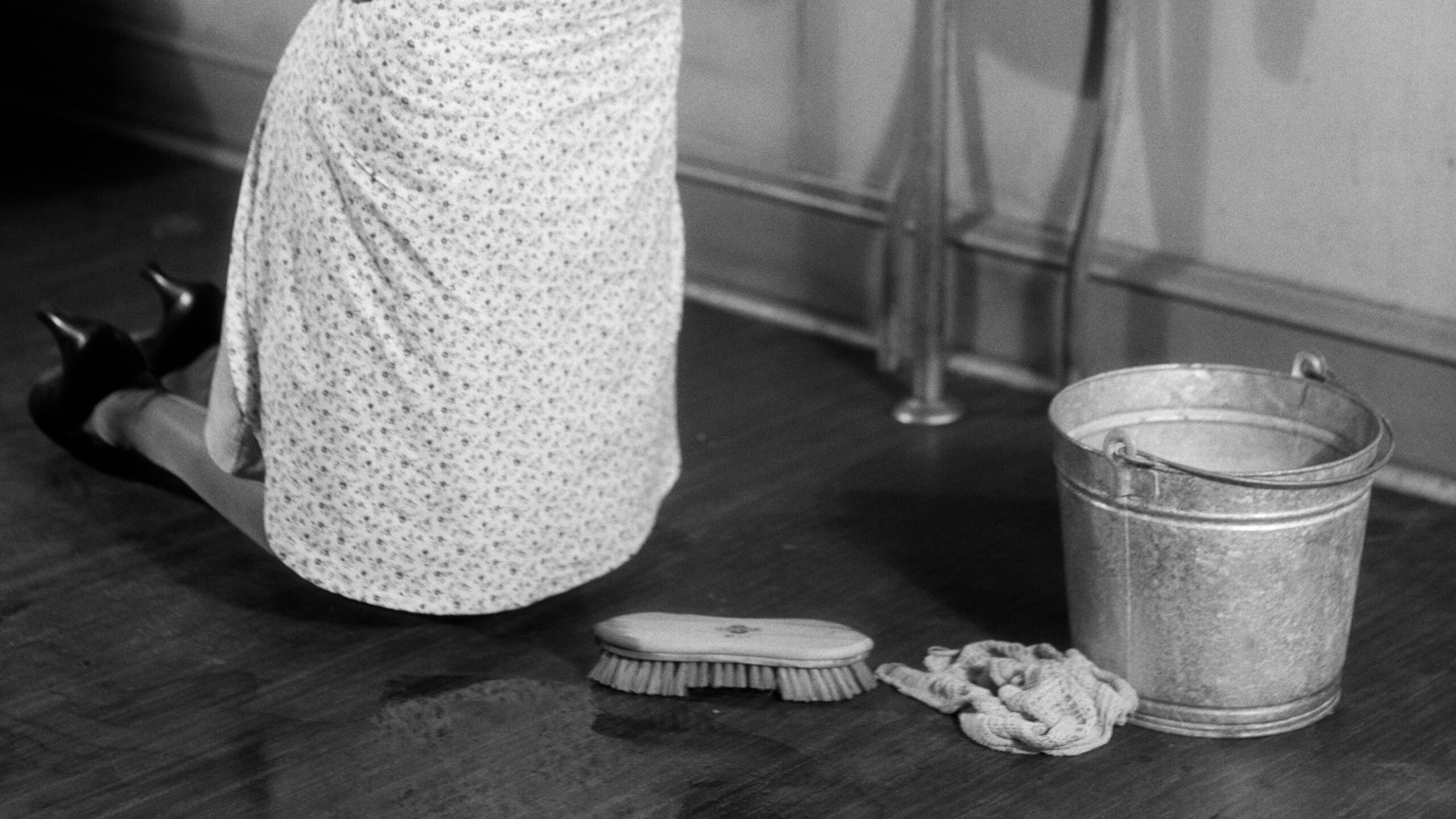
“You would make a very valuable slave,” I told my mom when I was little. I was trying to express admiration for how much she did. The humor of the compliment comes from its grain of truth: Mothers and slaves do many of the same things. This tempts us full-time homemakers to throw a pity party.
It’s somewhat comforting to remember that all vocations involve some level of drudgery. But the housewife’s primary commitment is to the mundane. A nun prays seven times a day, and she also cleans the abbey’s restrooms. The housewife’s first calling is to clean the toilet and do a thousand other housekeeping tasks. Then she gratefully receives an hour of peace and quiet in which to pray, if it ever comes.
When we housewives do manage some spiritual exercise, it’s not even impressive. We’re too tired and hungry to do anything much. History is filled with saints who accomplished great feats of fasting, penance, and care for the poor. And here I am trying my darndest to fast from carbohydrates for three hours.
The real problem is not the fact that someone has to clean the toilet; the problem is classical liberalism, which threatens to demoralize housewives and everyone who has an active vocation. Liberalism emphasizes the importance of a person’s individuality. Follow your dreams and develop your personality, liberalism says, and you will discover that you are something special.
And so people say as a matter of course, “I want to spend my time doing what I’m uniquely good at.” Come again? Not to be harsh, but unless you’re Elon Musk or an Olympic athlete, you’re probably not the best person in the world at anything. Even if you were the best, someone else could do a satisfactory job in your place, given a little time to learn the ropes.
When we housewives adorn our houses, we show the world an attribute of God that no one else can capture as well as we do.
And yet people are truly irreplaceable, and you are uniquely good at what you do. Just not for the reasons that classical liberalism offers.
It’s the relational context that makes an action unique, not the action itself. For example, anyone can have sex, but a happily married man and his wife provide each other with a sense of intimacy that no one else could give them. Many people can write a legal brief, but that work becomes unique when my husband does it as an expression of care and love for our family. Most people can change a diaper, but my toddler only likes me to do it; for him, it’s different when his mama does it.
Love dignifies toilets—not to insult the toilets. They’re important in their own right.
My favorite provision in the law of Moses is, oddly enough, about waste disposal. It was illegal for Israelites to leave their waste out in the open, so that God “may not see anything indecent among you and turn away from you” (Deut 23:13-14).
This suggests that God is interested in the cleanliness of our living spaces. I suspect that we feel better in well kept homes partly because they’re more humane and partly because they’re more welcoming to the Holy Spirit. Perhaps toilet cleaning helps us experience God’s presence more fully.
The Bible also hints that God is interested in other mundane matters. He feeds the birds and lion cubs (Matt 6:26; Job 38:39-41). God made the livestock and other animals, and he “saw that it was good” (Gen 1:25). So God likes livestock. Livestock! Those smelly creatures. What a strange and wonderful God we worship.
No one sees as much mundaneness as God does. Since God is outside time and space, he always sees all coffee mugs from all angles. I can only look at a coffee mug for a few seconds before I want to see something new. God will never see anything new, nor does he want to.
G. K. Chesterton said that “perhaps God is strong enough to exult in monotony. It is possible that God says every morning, ‘Do it again’ to the sun; and every evening, ‘Do it again’ to the moon. It may not be automatic necessity that makes all daisies alike; it may be that God makes every daisy separately, but has never got tired of making them.”

No one is interested in mundane matters like God is. And no one keeps house like he does.
Have you ever noticed how clean and neat nature is? People generally don’t think that way, but a kid can play on grass, dirt, rocks, sand, and other natural surfaces without getting sick. It’s the manmade places that will get you. But a walk through the forest is normally quite pleasant. The plants and earth smell good. Everything is somehow adorned, and yet all the wildness and variety of beauty forms a harmonious whole.
When we housewives adorn our houses, we show the world an attribute of God that no one else can capture as well as we do. Mother Teresa showed God’s love for the poor, Justin Martyr showed God’s love for the truth, and St. Francis of Assisi showed God’s love for animals. Housewives are an image of God’s love for the mundane.
When we arrange our living room furniture, we imitate God who calls the earth his footstool and yet takes the trouble to make it beautiful (Is 66:1). When we step back and enjoy the wildflowers we have arranged, we are like God who is always watching the meadows he made. When we exclaim over our children who are learning to crawl, we are like God who delights in the children of man (Prov 8:31).
We send little children to pick up their toys like God sends the monkeys to clean up fallen fruit. We garden and compost (or at least we aspire to) like our God who set up a complex energy recycling system. We feed and feed and feed our families like the Father who feeds us all.
Of course, the pain and difficulty of our daily work is a result of the fall (Gen 3:17-19). This is an uplifting thought, because it means we will not always find suffering in housework. I hope that, when I enter eternity, I’ll finally have time to actually get all the housework done. But meanwhile, it may be encouraging to remember that Jesus chose to live most of his adult life on earth as a poor carpenter. Sweat and toil can’t be so bad if God chose them.
I daresay that Jesus has even emptied chamber pots. And if he loved his fellow man enough to do it, maybe I should stop writing this now and go clean that toilet.