
When St. Thérèse boldly wrote of her Little Way, she heralded it as a “new way”—something distinct from the arduous paths of old. Her doctrine of spiritual childhood is indeed fresh in its inspiration and expression, springing forth from the unrepeatable soul of one who carved out her spirituality against the tides of Jansenism threatening France. Her writings also represent an uncommon synthesis of spiritual childhood in light of grace. Nevertheless, when her teachings are understood apart from Christian history and thought altogether novel, one misinterprets both.
In reality, the Little Way is a spirituality that summarily expresses the Catholic doctrine of “salvation by grace.” Its roots are found in the Gospel, and its fruits are perennially expressed in the lives and teachings of the saints. It provides the practical means of living out that doctrine Christ alluded to when he said, “Unless you turn and become like children, you will never enter the kingdom of heaven” (Matt 18:3).
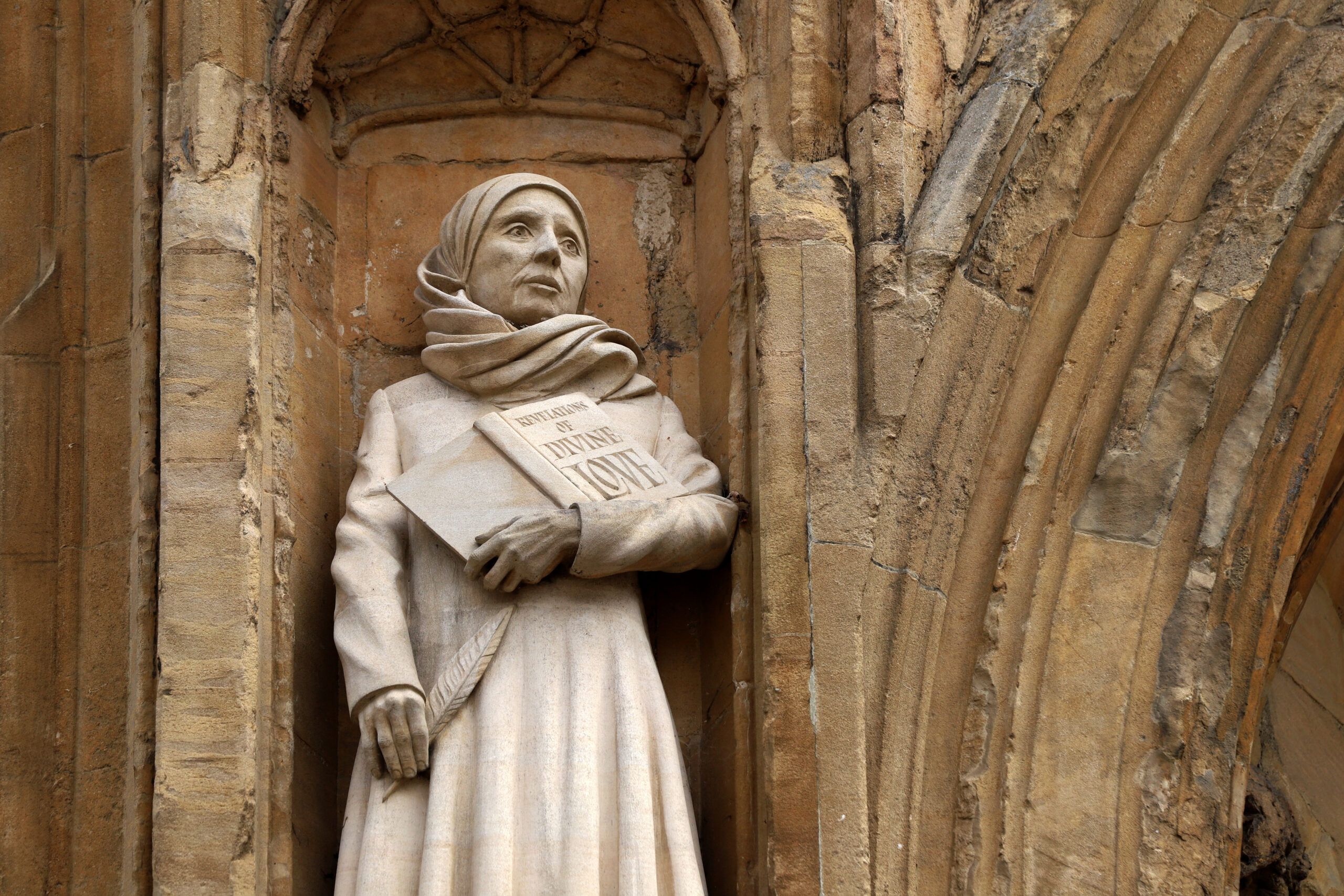
Inasmuch as the Little Way demands its followers surrender to the action of grace, we might cite as many forerunners to its doctrine as there are saints. And though we could adduce influences on Thérèse’s thought, our concern is not to name her inspirations but to highlight the historical unity of thought on spiritual childhood. By taking the extended example of Julian of Norwich (1343–1416) and her mystical work, Revelations of Divine Love, we may discover the principles of spiritual childhood enunciated in the Middle Ages, confirming the unity of Christian spirituality. Separated by half a millennium, language, and culture, Julian’s writings have no known connection to St. Thérèse, even as they agree on the way of spiritual childhood.
Toward the climactic end of Julian’s revelations, she compares Christ to a mother, much as Thérèse would in her own works. By establishing Christ as the figure of motherly love, constant and providing, Julian is enabled to form an extended spirituality of the child, who realizes his utter dependance on that love (see Isa 66:13; Matt 23:37). Reflecting on the natural virtues of children, she outlines the basic principles of spiritual childhood, writing:
For of nature the Child despairs not of the Mother’s love; of nature the Child presumes not of itself; of nature the Child loves the Mother and each one of the other [children]. These are the fair virtues, with all other that be like, wherewith our Heavenly Mother is served and pleased.
These three virtues—complete trust in God, mistrust of oneself, and unwavering love—are the recommended means of living out spiritual childhood. The first of these virtues, trust in God, is described by St. Thérèse in terms of the confidence and love of a repentant child who tenderly casts himself into his Father’s arms, knowing that self-entrustment, not cowardly retreat, will win pardon. Julian powerfully depicts this same reality in negative terms, ruling out all doubts of God’s mercy. She reasons that the Christian cannot despair of God’s love, as children simply do not doubt their mother’s love. Both represent a spirituality of radical confidence based upon the unshakable security of parental love.
By establishing Christ as the figure of motherly love, constant and providing, Julian is enabled to form an extended spirituality of the child, who realizes his utter dependance on that love.
The second virtue—mistrust of oneself—speaks of that humble realism whereby children rely not upon their own meager strength. Thérèse memorably illustrated this virtue in the parable of the child who, knowing his inability to climb the steep staircase, contented himself with goodwilled attempts, knowing his father would soon lift him on high, carrying him up the stairs. For Julian, this reality is simply acknowledged in light of nature, which is to say that children reflexively live in reference to their parent’s strength, knowing their own weakness. The child’s aims are achieved not by holding fast to their limited abilities but by anchoring their trust in their parent’s care.
Finally, the third virtue—resolute love of God and Christians—is the core of the Little Way, which Thérèse variously calls the “way of love.” Linking the first virtue to the third, Thérèse famously wrote: “Confidence alone must lead us to Love. . . . Does not fear lead to the thought of the strict justice that is threatened to sinners? But that is not the justice Jesus will show to such as love Him.” For her, trust opens the door to love, and love leads to union. Servile fear, by contrast, tends to breed distance. For this reason, we find innumerable counsels in Thérèse’s writings for souls of every condition to throw themselves as children into the Father’s arms.
By framing this virtue in terms of nature, Julian awakens us to the reality that children naturally commend themselves to their parents in love, precisely because man was made for love. As the fulfillment of the law, love is the summary of Christian living and the bond of perfection that unites us to Christ and to his mystical body. To act against this holy impulse, this desire for relationship and communion, is contrary to our very nature.
These three dispositions prove to be the dispositions of salvation. They represent the elevation of grace, whereby man relies entirely upon God and his merciful love rather than his own finite powers. Though popularizations of the Little Way sometimes emphasize its secondary qualities, stressing action over being, Julian focuses on the interior life. In this way, she points to the heart of the Little Way, describing the inner exchange that takes place between God and man. Rather than highlight works—that is, doing everyday actions with great love—Julian encourages the exchange of man’s mortal frailty for Christ’s divine strength. Indeed, the heart of the Little Way consists in this Pauline paradigm in which we live no longer in ourselves, but in Christ: trading our poverty for his riches, our misery for his mercy, and our weakness for his strength.
It is in this spirit that Julian declares childhood to be the highest stature in the spiritual life, as such souls as these are intrinsically receptive to grace. Man, finite and fallen, requires the gift of grace to be raised up. Connecting these realities, Julian writes:
And I understood none higher stature in this life than Childhood, in feebleness and failing of might and of wit, unto the time that our Gracious Mother hath brought us up to our Father’s Bliss. . . . Thus I understood that all His blessed children which be come out of Him by Nature shall be brought again into Him by Grace.
Overturning the pride and vanity of man, childhood is paradoxically praised as paramount in the spiritual life. This is because the child’s heart is open to instruction and grace, allowing it to be transformed by God’s omnipotent love. If ever we believe that we can merit heaven by our own efforts, we have strayed from the Little Way and from the gospel. Furthermore, this Pelagian notion contains a hidden trap—namely, that if we believe our salvation primarily flows from our own works, then our faults and failures make us prone to discouragement and despair. Nevertheless, the spiritual life is largely a work of surrender: surrender to the Spirit who sanctifies us and makes us participate in his salvation.
Justified by grace, we may work out our salvation through everyday actions, which are not simply carried out with great love but in the Spirit. In this sense does the New Commandment encapsulate the active dimensions of the Little Way. Living in the Spirit, and allowing Christ to act in and through us, our everyday works may be divinized as we build up the kingdom of heaven on earth. Faithfulness to this Spirit preserves us in grace, fulfilling the law.
Julian of Norwich and St. Thérèse arrived at the same conclusions on spiritual childhood not because of any personal connection but because their lives were grounded in the same gospel and in the same one person of Christ. We may choose to be imitators of Thérèse in her practice of the Little Way or follow Lady Julian’s model of spiritual childhood. Yet another saint who lived in the shadow of the Middle Ages, St. Charles Borromeo (1538–1584), taught that Christ himself was the forerunner and exemplar of this way, writing:
There ought surely to be for little ones a way to Christ the Little One; for the humble to Christ the Meek and Humble of Heart. For Christ was little in His Nativity; born very lowly in a little city by the wayside . . . in the little manger at Bethlehem. Nazareth, His own home, was little; He was little because of His reputed father: ‘Is not this the Son of the carpenter . . .’ Little because of His disciples—He chose fishermen; little because of the doctrine of humility, which He preached; little as long as He lived. ‘. . . the Son of Man has not where to lay his head.’ Little in His death. Let us then allow the little ones to come to Him who was in every way little, for the like will mingle easily with the like.”
Following after the Little Jesus, patterning ourselves after the sublime humility of him who fell from heaven to earth, we must indeed fall from the precipice of our own ego, casting ourselves upon the receiving heart of him who can do all things and without whom we can do nothing. If Christ has affirmed spiritual childhood as a necessity for salvation—“unless you turn and become like children, you will never enter the kingdom of heaven” (Matt 18:3)—it is because it indicates the condition of humility, without which we cannot be saved.
Christ assuredly calls the little ones unto him (Matt 19:14) and to them alone does he reveal the mysteries of the kingdom of heaven (Matt 11:25). Conscious of our frailty but moreover convinced of his all-embracing mercy, we must surrender ourselves to the action of grace that God may become all in all. This is the spirit of the Little Way in which Christians trust not in themselves but in God, humbly receiving his grace in faithful love.