
I confess I knew absolutely nothing about Wilkie Collins’s book The Woman in White when I recently agreed to read it. The first clue that I was in for a challenge revealed itself in the dusty fiction stacks of my local county library. My fingers absently grazed the books of shelf COA–CON until they recoiled at the surprisingly thick tome I was seeking. An incongruously cartoonish purple sticker with too many multicolored question marks whispered Mystery from the base of its spine. I picked the book up and quickly ascertained the following facts: The novel was 672 pages long, it was originally published in 1860, and it was, as I quickly feared, presented in an unusually small font. Not for the last time, I pulled the book to my chest and grinned as a thrilling sense of foreboding washed over me. Reading this chunk of a nineteenth-century novel by the deadline I had agreed to would perhaps be more of an adventure than I had expected.
The adventure did not disappoint. The Woman in White is more than just a heart-pounding page-turner; it’s a much-needed exercise in seeking truth.
It is safe to say that The Woman in White was a cultural phenomenon.
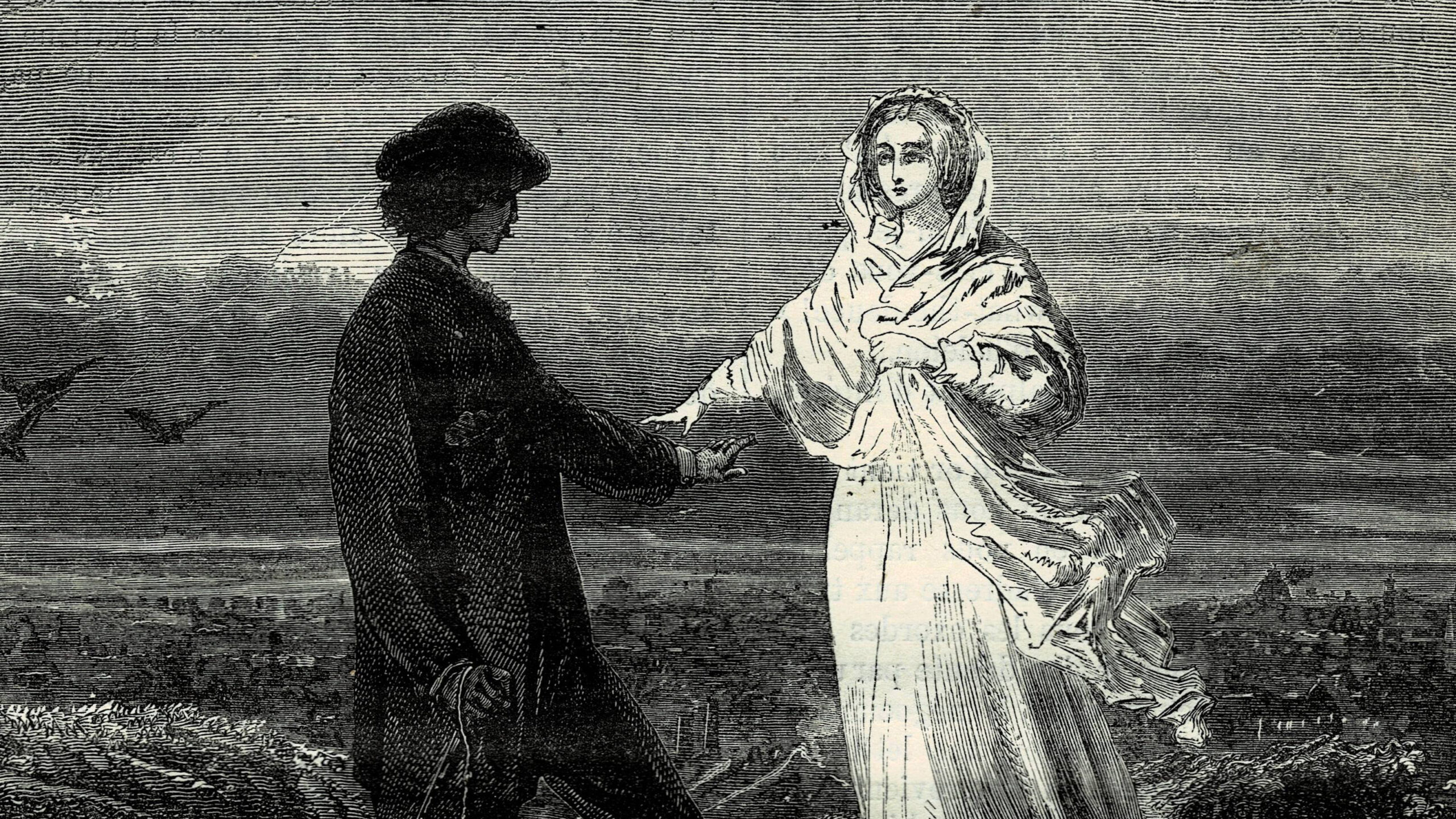
Before I explain why, allow me to share a bit of what the book’s introduction tells those of us who are unfamiliar with Collins’s work. The Woman in White is “generally regarded as the first sensation novel, an enormously influential branch of Victorian fiction which fused the apprehensive thrills of Gothic literature with the psychological realism of the domestic novel.” It was first published in weekly installments from November 1859 until August 1860 in Charles Dickens’s weekly literary magazine, All the Year Round. The plot so captivated Victorian society that people gathered on sidewalks to purchase each installment as it was released; bets on its outcome were won and lost; princes, politicians, and celebrities canceled engagements to read it; scores of London’s baby boys suddenly bore the name of the story’s hero, Walter; scores of British cats suddenly shared the name of the story’s villain, Fosco. With theater adaptations, perfumes, toys, bonnets, and songs inspired by the tale, it is safe to say that The Woman in White was a cultural phenomenon.
More than a century and a half later, the plot still sucks readers into the page-turning twists and turns of what feels like a dark, creepy Victorian telenovela. It employs startling cliff-hangers and unnerving changes in narrators. It sets scenes in dark wooded roads, cemeteries, and dank old houses. It stars damsels in distress, dastardly villains, a lovestruck hero, and crawling white mice. As I read of heartache and espionage, madness and flames, wealth and poverty, and life and death, my family endured me slamming the thing shut on more than one occasion to exclaim, “This book is bonkers!”
And it is bonkers. But, as I previously mentioned, The Woman in White is more than just a heart-stopping thriller.
Readers of the novel will recall that Collins does not present his tale in one continuous narrative but in a series of first-person accounts. These varying perspectives put the audience into delightfully direct contact with the story’s characters, but with this direct contact comes an added element of confusion and suspense. Like discerning jurists in a legal case, readers cannot take events at face value and must determine for themselves each narrator’s motivations, biases, and credibility.
The story’s hero, Walter Hartright, perhaps most alarmingly alerts us to wrestle with the question of narrative reliability. He admits that “the best men are not consistent in good,” then asks, “Why should the worst men be consistent in evil?” In Walter’s case, we can take for granted that he is pursuing the truth of the novel’s mysteries in a noble quest of honor, but what if he is sometimes just as self-interested as the story’s villains? And what if those villains are also victims? With themes of madness and delusion echoing throughout the plot, readers can easily begin to stumble over the question of what is true and what is self-serving spin.
All of us, when we pause in silence, need to feel . . . the presence of Christ, the heart of the world.
It’s a question, of course, that goes beyond the scope of reading a fun old mystery. None of us need reminding that our modern perceptions of truth can be shaped by algorithms that stoke anger, media outlets that foment division, and a lurking sense that artificial intelligence is soon going to make it nearly impossible for any of us to know what is real and what is not. The Woman in White can be, on its surface, an entertaining escape from these dreadful thoughts into a tale that has captivated audiences for over a dozen decades. But it also demands we give much needed practice to the muscles that help us to discern fact from fabrication.
Not long after I settled for myself which of Collins’s narrative voices is to be trusted (for the record: Marian, of course), I encountered some comforting words from Pope Benedict XVI. In one of his oft-quoted Angelus speeches, he said, “Every person needs a ‘centre’ for his or her own life, a source of truth and goodness to draw upon in the events, situations and struggles of daily existence. All of us, when we pause in silence, need to feel not only the beating of our own heart, but deeper still, the beating of a trustworthy presence, perceptible with faith’s senses and yet much more real: the presence of Christ, the heart of the world.” When our reality feels like fiction, and our fiction feels insane, these words are a welcome reminder that the truth, the way, and the life is with us in every silent pause, and with us in every heartbeat.