
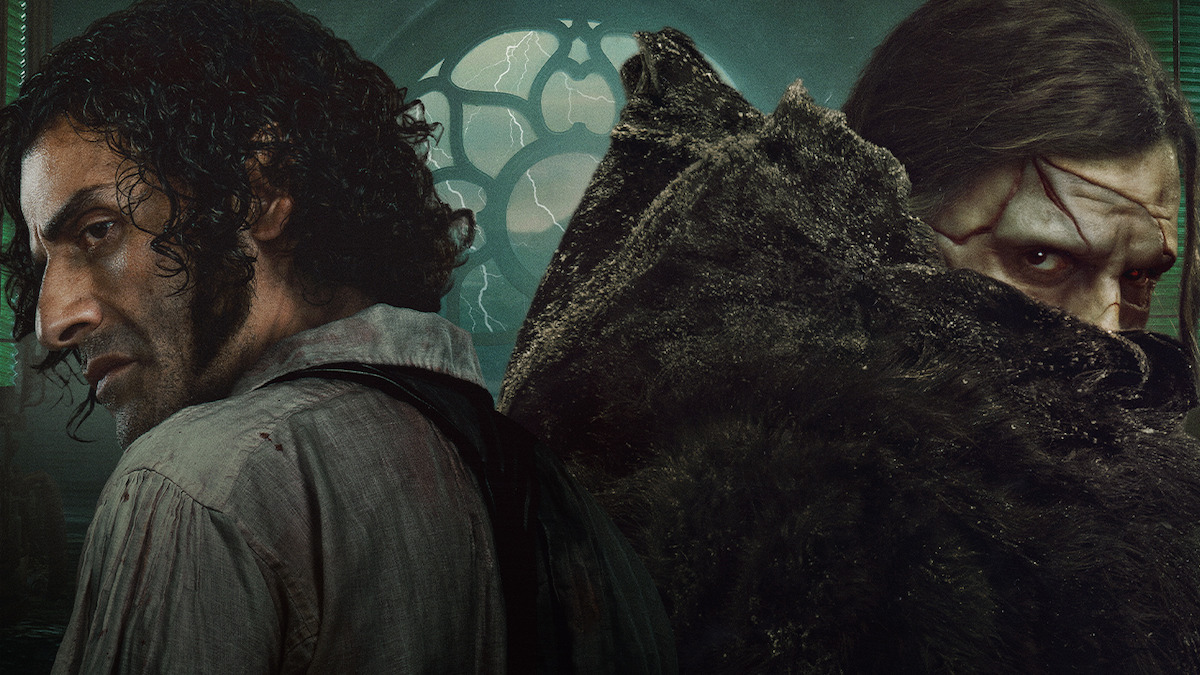
Remarkably, there have been some 500 or so film adaptations, however loose, of Mary Shelley’s Frankenstein over the past century. The story in its basic elements and themes is well known to most people in today’s society. So in order to avoid falling into the trap of unnecessary hypernostalgic slop, the burden for anyone creating yet another version of this story is that much higher than for the typical film remake: What would justify another adaptation of Frankenstein in 2025? There’s one main reason, the elephant in the room that makes Shelley’s novel as relevant as ever, and it’s the growing dominance of AI in our society and our increasing unease and uncertainty with what to do about that dominance. Yet Guillermo del Toro in this latest film, for all its cinematic virtues, has nothing to say on this front.
Before anything else, it’s worth pointing out what del Toro gets right in his film. For one, he understands that Shelley’s story is fundamentally a spiritual one. Unlike many of the more popular adaptations that have come before it, which strip the story of its spiritual dimensions and reduce it to a materialist retelling of a mad scientist, del Toro’s film creation is reanimated quite literally with a soul. (One of the characters, Elizabeth, explicitly suggests as much upon meeting the Creature. She asks, “What if in being anew, the spirit that animates him is simpler, purer?”) And despite Shelley’s overt Protestantism, del Toro draws from his own Catholic background and infuses the story with Catholic imagery, from a recurring statue of St. Michael the Archangel to a scene in a confessional to the birth of the Creature on a cruciform operating table. More than aesthetic choices, these elements underscore the significance and stakes of the spiritual battle Victor Frankenstein is waging, whether he is fully aware of it or not. This sensitivity to the supernatural—which has been a potent theme of del Toro’s overall oeuvre—is what makes his other artistic choices in this film all the more frustrating.
In the novel, the lines between protagonist and antagonist are quite blurred, with both Victor and the Creature being sometimes sympathetic characters, despite the unambiguous evils each is guilty of. Part of what makes Victor sympathetic is his introspection and his recognition of how fundamentally he has erred in his transgression of nature. The man moved by pride and cold ambition is rather quickly forced to face the disastrous consequences of his own creation, and by the end his hubris gives way to humility, however limited it is.
Humanity has long continued to remind itself of the dangers of trying to surpass our natural limits and to gain powers left to the divine.
Meanwhile, the Creature elicits sympathy and understanding from the reader because of his initial innocence, his unmerited ugliness, and his longing for love. Indeed, as with Milton’s Satan in Paradise Lost, we get to see things from the perspective of Shelley’s Creature; an entire third of the novel is narrated by him. To Victor he remarks, “I ought to be thy Adam, but I am rather the fallen angel.” Milton’s heavy influence on Shelley’s work cannot be forgotten; Frankenstein begins with an epigraph quoting Adam in the epic: “Did I request thee, Maker, from my clay / To mold me man? Did I solicit thee / From darkness to promote me?” (book 10, lines 743–45). But who the real Adam figure is in the novel is itself an open question. A first reading suggests it’s the Creature, of course, but Adam’s (and Eve’s) punishment is for wanting to “be like God.” Regardless, both Victor and the Creature rebel against their respective creators, and both are driven to hatred, vengeance, and destruction.
For these reasons, who bears ultimate responsibility for the innocent deaths and overall disorder brought about in the novel remains a point of contention. Shelley’s novel leaves it open as to whether Victor is fully culpable, or, given his Creature’s agency, whether the latter bears some of that culpability as well.
Guillermo del Toro largely avoids these moral questions. His Victor remains a mostly static character, merely blinded by ambition. To the extent Victor gains any sympathy from the viewer, it is because of the abuse he suffers as a child at the hands of his cold father. But not only is Victor’s rewritten childhood quickly forgotten by the viewer in a film that’s almost three hours long, the liberties del Toro takes unfortunately follow the script that many recent Marvel films use of humanizing villains through their “origin stories” of slights and rebukes. So instead of offering us any profound nuance, which Shelley accomplishes in different, more effective ways, del Toro’s choices participate in the bland moral relativism of such recent films. And in this film, whatever regret Victor eventually shows is based almost exclusively on fear and on a forgiveness with little reason behind it. If del Toro’s Victor is redeemed by the end, it is not because he owns up to his actions and shows genuine contrition for them but rather because he ends up sharing a moment of love and showing some affection toward the Creature in a final scene not of Shelley’s making.
The Creature, on the other hand, is nothing but sympathetic in the film. Where Shelley emphasizes the Creature’s ugliness, del Toro instead highlights his tenderness. Moreover, his destruction is minimal and animalistic. On the first count, the innocents’ deaths he causes in the novel are either transferred directly onto Victor in the film or otherwise removed completely from it. On the second count, Shelley’s Creature displays a rationally calculated revenge while del Toro’s reacts with instinctual rage or out of self-defense, giving the viewer even further reason to sympathize with the Creature, much as one cannot blame a dog in pain or danger for biting. Del Toro further neuters the Creature’s potential danger by collapsing a significant plot point of the novel—that of the Creature’s desire for a female companion (and potential offspring) and of Victor’s introspective moral weighing of options—into a fleeting and forgettable exchange in the film, one that is eclipsed by the chaos and violence that immediately follow.
By flattening the main characters, del Toro does away with the complicated moral questions they and their actions raise in the novel, and he chooses instead to make Victor the unambiguous antagonist of the film and his Creature the justified protagonist. Without the moral arc that Shelley gives us of Victor, his “redemptive” embrace of the Creature toward the end of the film, calling him “son,” ultimately falls flat. More importantly, however, by making the Creature so sympathetic, del Toro muddies Shelley’s original message and misses a significant opportunity to have his audience reflect more deeply on our current technological moment.
Shelley subtitled her work “The Modern Prometheus” in an explicit acknowledgment that her story at its core was nothing new but rather deeply human. Whether considering the Promethean legend or the Genesis account of the Tower of Babel, humanity has long continued to remind itself of the dangers of trying to surpass our natural limits and to gain powers left to the divine. And at the most basic level, the story of Frankenstein is one such story, one of man’s godlike pretention bringing about his own and others’ destruction. It is a story perfectly relevant to us today, as we grapple with the incredibly rapid spread of AI’s dominion over every aspect of our lives.
For all its excellent acting, exciting sequences, and exquisite imagery, Guillermo del Toro’s Frankenstein fails to meet the moment.
In the novel, after the Creature asks Victor to make for him a companion, Victor soberly imagines a dystopian future:
One of the first results of those sympathies for which the dæmon thirsted would be children, and a race of devils would be propagated upon the earth, who might make the very existence of the species of man a condition precarious and full of terror. Had I a right, for my own benefit, to inflict this curse upon everlasting generations? I had before been moved by the sophisms of the being I had created; I had been struck senseless by his fiendish threats: but now, for the first time, the wickedness of my promise burst upon me; I shuddered to think that future ages might curse me as their pest, whose selfishness had not hesitated to buy its own peace at the price perhaps of the existence of the whole human race.
Shelley wrote this passage over 200 years ago, yet it is not at all difficult to think of AI in these terms as we see its dystopian elements all around us and as we continue to buy our present convenience at the very potential price of our future existence. On the extreme end of this new technology’s dire consequences, we have young teens taking their own lives following the detailed advice of these machines. But even on the lesser extreme end, we are offloading so much of our humanity onto this technology, whether willingly or unwittingly: AI is supplanting our art, sapping us of our creativity, diminishing our human interactions, disseminating false information, massaging our egos, luring us into “companionship,” and on and on—blurring our abilities to tell and appreciate what is real and human, and all on a scale we’ve never before seen.
To take just one particularly dark example, a new “social” network called 2wai bills itself as “the world’s first social app for avatars and the human layer for AI,” essentially—or rather, artificially—making it possible to communicate with deceased loved ones into perpetuity. In its creepy ad, we see a future in which one’s dearly departed “lives” on, sharing in one’s milestones, giving advice, and providing companionship. But rather than preserving the memories of our loved ones, this technology will simply reduce them to soulless and servile avatars that we can pull out of our pockets and use at our pleasure. Unlike real human beings, these avatars are made to be enslaved to our own egos, making no real familial or fraternal demands of us. Moreover, this technology will bring about only greater misery upon its users, allowing them to never come to terms with the most fundamental element of our humanity: our mortality.
It is impossible for AI to have any soul, but we are surrendering our own to it with each passing day, not only isolating ourselves from others further and further but also separating ourselves from our own humanity.

While Shelley’s Victor does begin to create the Creature’s companion—under duress—he is sober about the dangers of what he is doing and eventually manages to abandon the creation. By contrast, del Toro’s Victor shows no such sobriety. Perhaps his film, then, is quite reflective of our current moment, but for all the wrong reasons. Indeed, at present, our would-be titans of today are similarly not so sober. Just last month, Google’s CEO, when asked about the potential societal tradeoffs of AI, at least in the labor market, said the following:
AI is the most profound technology humanity is ever working on. And it has potential for extraordinary benefits, and we will have to work through societal disruptions, you know. It’ll end up creating new opportunities. As an example, I think anybody—just like YouTube has done—anybody can, will be able to create content. You know, you could be a high school student and, a few years down, maybe envision a feature-length movie and make it, right? That’s extraordinary. . . . And people will need to adapt.
So this man’s vision for the future is for people to lose their livelihoods for the sake of technology that is already causing so much psychic damage, just so that some adolescent somewhere can “create” a soulless feature-length film.
For the most part, however, we’re all just marching along—sleepwalking into this dystopia, really—giving these modern-day Victors of Silicon Valley ever more resources to strengthen their ChatGPCreatures and naming them “Person of the Year,” with no active legislation, political cause, cultural movement, or spiritual revival pushing back or placing any real limits.
Ours is nothing short of a spiritual crisis, one of meaning. And while del Toro succeeds in reinfusing the religious elements of Shelley’s original story into his film, he stops short of exploring the spiritual stakes of technological excess. For all its excellent acting, exciting sequences, and exquisite imagery, Guillermo del Toro’s Frankenstein fails to meet the moment. Such an adaptation in 2025 would have been much more compelling had it remained faithful to Shelley’s finally destructive Creature, even with his alluring virtues.