
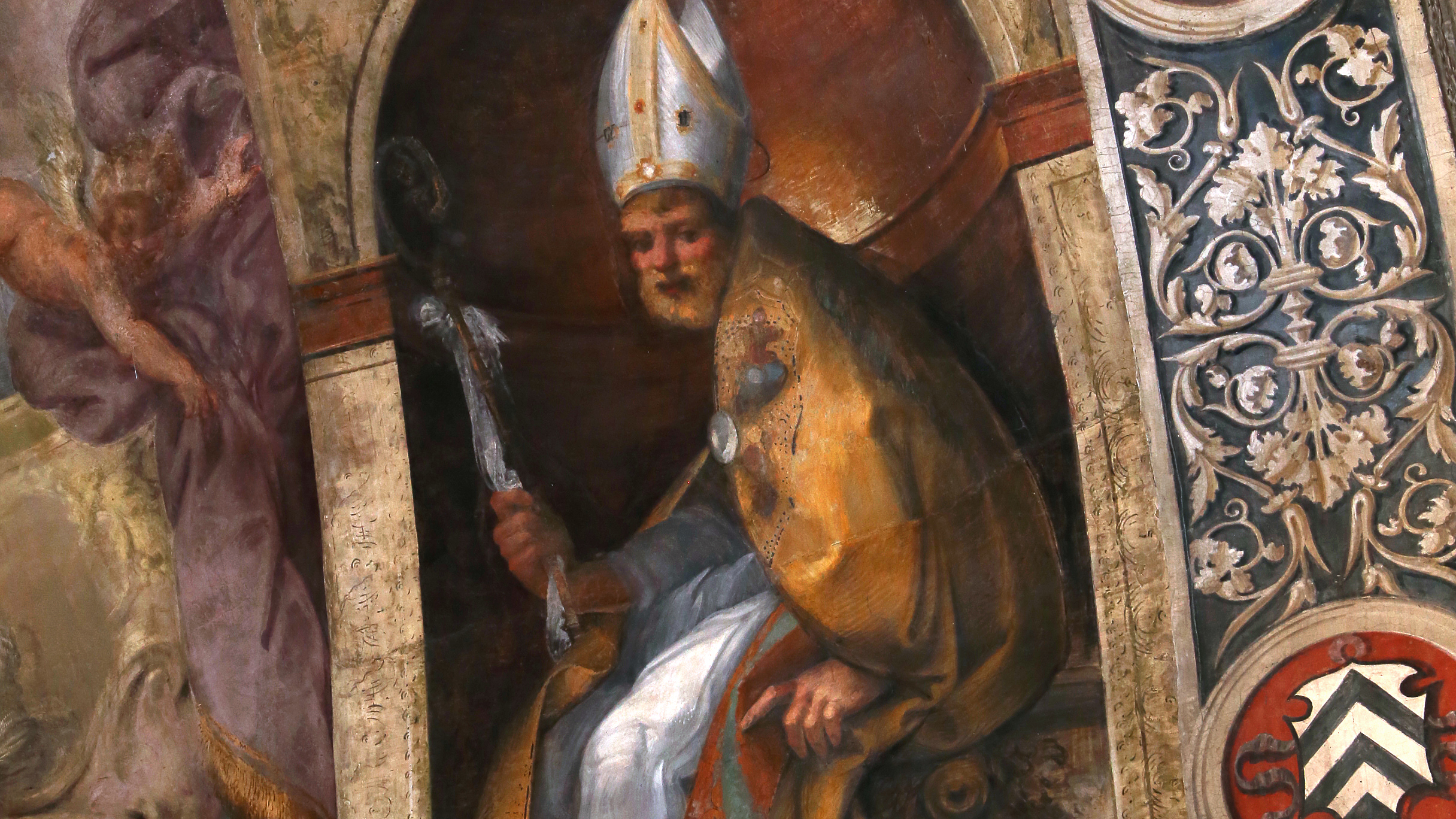
I doubt if many of us have a devotion to St. Hilary of Poitiers, whose feast day we celebrate today. Yet, our being Christian is indebted to him. Here’s why.
Hilary was born in France at the beginning of the fourth century and was elected bishop of Poitiers in AD 350. His time as bishop was marked by controversy and division as he sought to repel the ongoing spread of the Arian heresy, which claimed Jesus Christ was like a super-saint but created by the Father and certainly not divine in the same degree as God. Hilary saw this heresy for what it was, for if Jesus was just a creature like us, then he couldn’t save or redeem us. This was not about splitting theological hairs. Hilary and others knew that the whole of Christianity was at stake if this heresy took hold.
In the battle to preserve Christ’s identity as Son of God, Hilary did for the West what St. Athanasius did in the East: insist that at the heart of the incarnation of Jesus Christ, “God became human so that we could become divine” (St. Athanasius, De incarnatione). In opposition to the Arians, who believed of Christ that “there was a time when he was not,” Hilary insisted that Christ’s appearance on earth was a revelation of his existence that had always been with the Father, whose love generated him from eternity.
While Athanasius in the East was instrumental in formulating the Nicene Creed of 325, Hilary defended the creed in France and devoted his whole life to proclaiming faith in Jesus’s identity as consubstantial in divinity with the Father. Many credit Hilary with the preservation of the orthodox faith in France at the early stage of its development—efforts that led to his suffering exile many times. A synod celebrated in Paris in 360 or 361 borrows the language of the Council of Nicaea; several ancient authors believe that this anti-Arian turning point of the French Church was largely due to Hilary’s fortitude and leadership. The Church recognized this contribution in 1851 when Pope Pius IX proclaimed him a Doctor of the Church.
Hilary and others knew that the whole of Christianity was at stake if this heresy took hold.
Despite the best efforts of Athanasius and Hilary, Arianism hasn’t gone away. Like other heresies, it tends to reinvent itself under different guises over the course of history and reappear in subtle ways in different cultures. Modern-day expressions of Arianism include any attempt to present Jesus Christ as one god among many or as merely human but not divine.
That’s why the recent celebration of the 1,700th anniversary of the Nicene Creed gives us fresh impetus to defend the uniqueness and divinity of Christ in our day, as St. Hilary did in his time.
During a visit to Turkey in November 2025, Pope Leo XIV warned against a “new Arianism” in today’s culture and sometimes even among believers. The Holy Father spoke about modern tendencies that “admire Jesus on a merely human level, perhaps even with religious respect, yet not truly regarding him as the living and true God among us. . . . His divinity, his lordship over history, is overshadowed, and he is reduced to a great historical figure, a wise teacher, or a prophet who fought for justice—but nothing more.” Like St. Hilary, Pope Leo takes us back to the orthodox faith of the Council of Nicaea, which “reminds us that Jesus Christ is not a figure of the past; he is the Son of God present among us, guiding history toward the future promised by God.”
Pope Leo’s warning is timely. This error accepts Jesus of Nazareth as one of the greatest ethical leaders and figures of history, but it holds him as one among many human beings who lived, made an impact, and died. We remember him and his legacy in history but nothing more.
Jesus certainly did show us how to live ethical lives, but he did far more. As God, Jesus became human and became the Savior we needed to save us from sin, death, and every form of dysfunction. If Jesus was only human and merely an external example to be imitated, he could not do this as God. But by the power of his Holy Spirit, the saving power of God has been offered to us through faith in Jesus Christ and the sacraments of the Church. And by the power of that same Spirit, Jesus penetrates our humanity as Savior, uniting himself to our nature, in order to conform our nature to his.
Before his visit to Turkey to celebrate the anniversary of the Nicene Creed, Pope Leo published an apostolic letter called In Unitate Fidei (In the Unity of Faith). In this letter, he anticipated many of the themes he would speak of in Turkey, especially the Nicene Creed as a reference and meeting point of unity. He rightly implies that our unity as Christians is compromised if some of us believe in Christ as divine and others don’t. The fundamental issue here is Christ’s divinity and subsequent ability to divinize us through faith and the sacraments. If Jesus isn’t God, then this is impossible. In the words of In Unitate Fidei:
Divinization in no way implies the self-deification of man. On the contrary, divinization protects us from the primordial temptation to want to be like God (cf. Gen 3:5). What Christ is by nature, we become by grace. Through the work of redemption, God not only restored our human dignity in his image, but the One who created us in a wondrous way, has now made us partakers in his divine nature in an even more wondrous way (cf. 2 Pet 1:4).
This is why the divinity of Jesus that St. Hilary insisted on is so important today: For to admit that Jesus is divine is to admit his absolute authority over our lives, both private and public. It is the human Christ that identifies himself with our fragile nature. It is the divine Christ that has come to kill in us what is selfish, to heal what is wounded, and to change us into people of greater love who resemble himself.
These insights, clarified and distilled through the Church for centuries, began with people like St. Athanasius in the East and St. Hilary in the West who defended the divinity of Jesus while holding onto the fullness of his humanity. History shows that the Church in France influenced that of Britain, which influenced that of Ireland. From these countries, thousands of missionaries brought the faith to the New World. Therefore, without Hilary’s leadership, faith, and courage, we might all be Arian today, or have drifted into a vague admiration of Jesus but nothing more. For this reason, we owe St. Hilary a debt of gratitude and we thank God for this fearless defender of the truth of our faith.
May God raise up many more believers today with the spirit of St. Hilary to spread the faith and work for unity.