
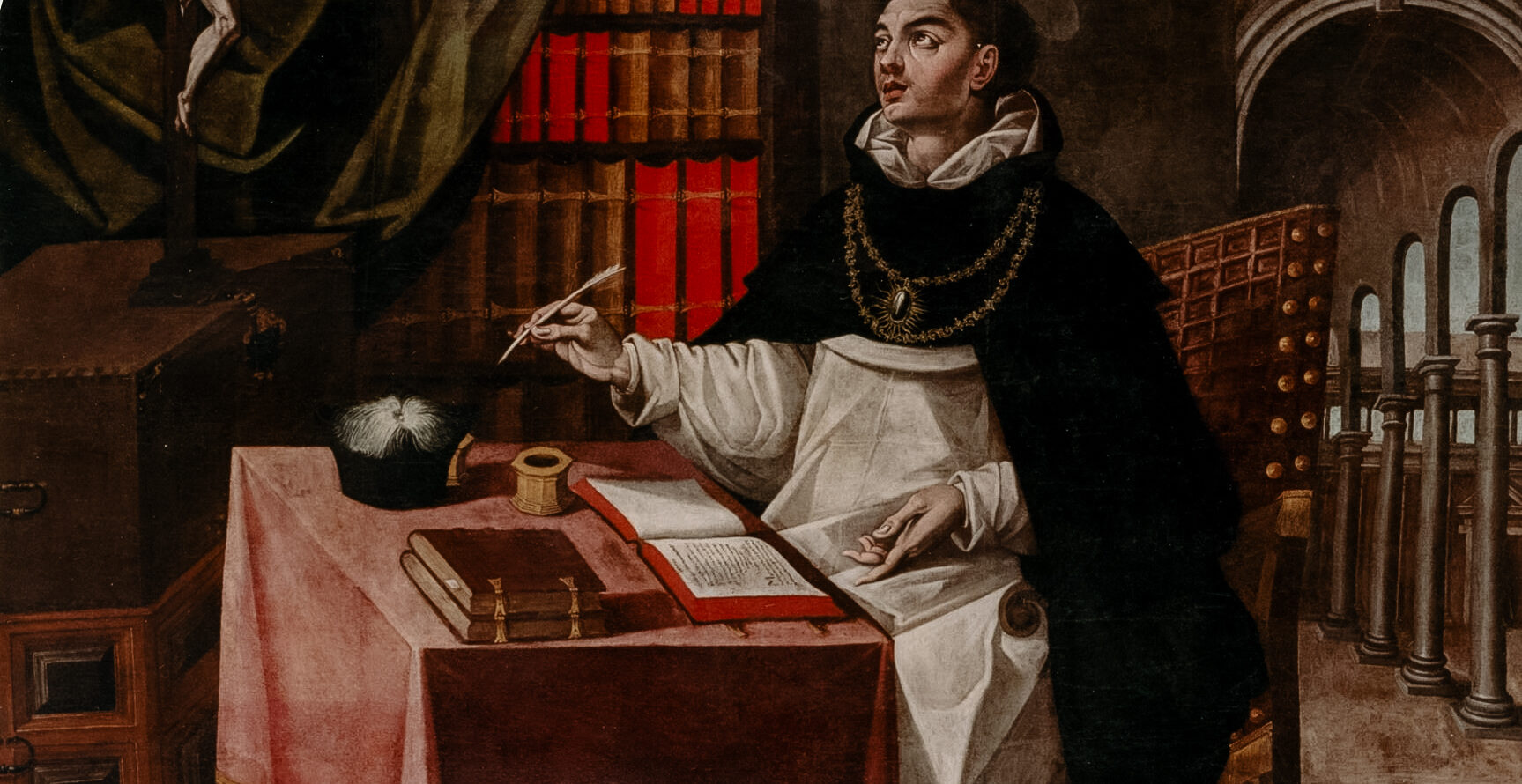
The first question of St. Thomas Aquinas’s Summa Theologiae states that sacra doctrina—sacred teaching—is about God. Aquinas needs to make this point because the scientific status of sacra doctrina depends on the existence of an object that unifies the science. If physics is one by virtue of what it is about—mobile being—then sacra doctrina must be one by virtue of what it is about: God. What exactly Aquinas means by sacra doctrina is debated, but at the very least, theology is related to it. Aquinas is therefore committed to the proposition that theology is about God.
So far, so uncontroversial. The very etymology of theology reveals its God-centered nature: theo + logia can be translated to “words about God.” Where is the profundity in Aquinas’s claim? The profundity lies here: Theology’s God-centered nature can be subtly replaced by a theologian-centered nature. Instead of studying God (i.e., doing theology), we may become content to merely study theologians (i.e., doing theologianology). This subtle change is a tragic problem. Whatever merit there is to studying theologians, it is not what will ultimately make us happy, flourishing human persons.
Reality, Theology, and Theologians
Reality—that which is—can be known by the human person. Our faith teaches us this (see Rom 1:20) and so does human reason: Any attempt to deny the knowability of reality will presuppose some knowledge of reality, resulting in a contradiction.
Our happiness depends on our ability to know and love reality. Only a real meal, a real spouse, or a real job can satisfy our desires. Simulacra fail to do the trick in the final analysis. Reality, however, comes in gradations. There simply is more being to a human person than a piece of meat. This truth is why a real spouse is more satisfying to possess than a real hamburger. It follows that the most satisfying of all reality will be that which possesses the most being: God. God, as Aquinas teaches, not only causes all being but is himself pure subsistent being, ipsum esse subsistens. To know and to love God are therefore the greatest and most satisfying activities human beings can undertake.
The theologianologist is like the astronomer who, instead of learning from the master and pointing his telescope into the night sky, points his telescope at the master astronomer.
We come to know God in this life first and foremost by means of Sacred Scripture and sacred tradition. Posteriorly, it is the task of theology to proceed from revealed principles and deepen our knowledge of God, his creation, and his redemption. Theology is faith seeking understanding, fides quarens intellectum.
Throughout the centuries, God has blessed the Church by raising up illustrious theologians. Gregory of Nazianzus, Augustine, Thomas Aquinas, and Pope John Paul II all readily come to mind. These theologians knew God in a profound way and shared their knowledge with the Church and the world by writing extensive and impressive works. Still, these works of theology, qua works of men and women, should never become the ultimate object of our study. That would be to commit ourselves to theologianology.
Theologianology and Fr. Cajetan Cuddy, O.P.
In our day, the chief forewarner of the dangers of theologianology is Fr. Cajetan Cuddy, a Dominican priest of the province of St. Joseph, author, and assistant professor of Moral and Dogmatic Theology at the Dominican House of Studies. Fr. Cuddy has articulated the perils of theologianology at various conferences and on podcasts. His critique is captured by his analogy of the theologian and the astronomer.
The true theologian is like an astronomer. As a master astronomer calibrates his telescope to achieve the best view of the stars, so does the master theologian calibrate his mind to achieve the best cognition of God. And as we might learn from the master astronomer, in order to calibrate our own telescope, so too might we learn from the master theologian in order to calibrate our own minds.
The theologianologist is a different story. The theologianologist is like the astronomer who, instead of learning from the master and pointing his telescope into the night sky, points his telescope at the master astronomer. He obsesses over the master’s instruments, customs, and appearance, but sadly never gazes upon the beauty of the stars for himself. Such a sorry confusion mirrors the essence of theologianology. The theologianologist pores over the texts, sources, and styles of theologians, but ultimately never raises his gaze to God himself, his creation, or his saving plan. For any given theological question, the theologianologist is most concerned with “who said what?”
(I note here the essential problem of theologianology can plague subjects like philosophy as well. I chose to focus on theology because it is the highest science in which things matter most. And “philosopherology” simply does not have a ring to it, does it?)
Theologianology can turn into a game of compare and contrast: “Augustine and Balthazar on hell,” “Bonaventure and Aquinas on the angelic will,” or questions of hermeneutics: “The Franciscan influence on Dei Verbum,” “Examining the twentieth-century Christian philosophy debates through a Neo-Suarezian lens.” Works like these (the above mentioned are fictitious—at least I did not look them up) are important but must always remain subordinated to actually making true claims about God, the world, and the human person.
Not even the Holy Scriptures should become the ultimate object of our study. The Church teaches us this fact when she states that “the Christian faith is not a ‘religion of the book.’ Christianity is the religion of the ‘Word’ of God, a word which is ‘not a written and mute word, but the Word which is incarnate and living’” (CCC 108).
Keep in mind, our happiness consists in knowing and loving reality, not what others have said about reality. The true end of theology is God himself. To be satisfied with anything less is a pusillanimous rejection of God’s gift. Even if, after careful study, we err in our assent to the truth, this error can become an occasion for repentance, rectification, and correction. Making a false truth claim is missing a shot, but theologianology is refusing to shoot.
The recognition of the dangers of theologianology nevertheless leaves untouched the absolute importance of tradition, deference to authority, and historical study. We stand in grave need for the Church and her saints to teach us how to see God correctly. I myself appeal to the authority of Aquinas and Fr. Cuddy! But my appeal to authority is in the hope that the reader will walk away thinking “Theologianology is dangerous,” not “Jack Trent and Fr. Cuddy think theologianology is dangerous.”
It may be safer, in some sense, to talk, write, and publish solely about theologians than it is to talk, write, and publish about God, but we simply cannot afford such a trade-off. Caution in study is needed, but God does not want us to be timid skeptics. We will find ourselves sealed off from the Lord of all reality if we contracept our minds from assent to the truth.