
Guy Consolmagno, SJ, is a Jesuit brother and planetary scientist whose research focuses on meteorites, asteroids, and the evolution of small solar system bodies. In 2015, Pope Francis appointed him director of the Vatican Observatory.
Br. Guy is the author of numerous popular books about astronomy and faith, including his latest, A Jesuit’s Guide to the Stars: Exploring Wonder, Beauty, and Science, from Loyola Press. In this wide-ranging discussion, Br. Guy explores his Jesuit vocation, the Ignatian approach to faith and science, his work studying meteorites, and much more.
Note: This interview has been edited for length and clarity.
Thomas Salerno: You’ve written several books about the crossroads of astronomy and the Catholic faith. What makes A Jesuit’s Guide to the Stars special or unique compared to your other work?
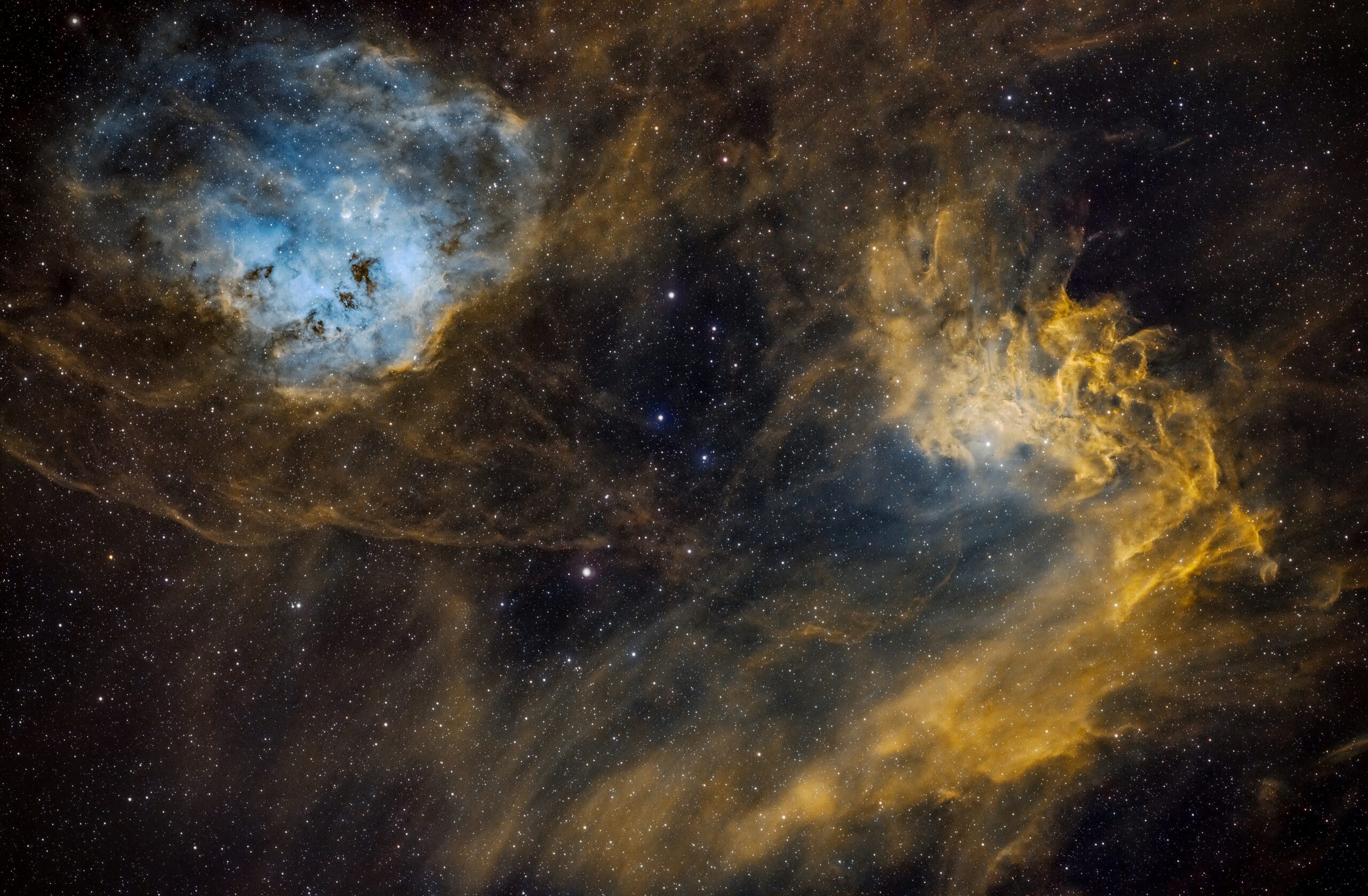
Br. Guy Consolmagno, SJ: Well, it’s really remarkable that Loyola Press has been able to put together a book with so many color images and sell it at the price they’ve gone with. Let’s face it: Pictures are what draw people into astronomy, so to be able to show some of these images from the Vatican Observatory is really important.
Science has this tendency to be perceived by people as “over my head.” Well, the stars are over your head, but anybody can look up at the stars. That appeals to people who just want to be able to go outside, look up, and say, “Oh, wow!” And that’s what I think the pictures do for this book. It’s a way to lead people into wonder. It’s all about wonder. That’s why I talk about history. I talk about poetry. I talk about all the other things that make up the stars and that influence how human beings interact with the stars. This isn’t just a book about astronomy.
One thing that grabbed my attention very early in the book is that your path to astronomy (and also your path to the Jesuits) was not a straight line. Are there any particular providential moments that stick out most to you in your vocation journey?
Oh my goodness, it’s really hard to even limit myself to a few of them. In the original draft of the book, I went on at great length about my discernment. Eventually, I cut it down a little bit. Part of it was me being a stupid eighteen-year-old. I decided to join the Jesuits to become a priest in order to get out of the freshmen dorms. But God woke me up and showed that that was not a good reason to be a priest. In fact, I did not have a vocation to the priesthood. God kicked me in the right direction. And, you know, I wouldn’t be here if it wasn’t for that.
Another moment was when I was in Africa during my Peace Corps training. I was homesick. I thought, “I’m not cut out for this. I’m going to go home.” But I went outside and saw the constellation called the Southern Cross and recognized all the other stars overhead—that moment was so incredibly powerful, and sent me in an entirely new direction, because not only did I wind up staying in the Peace Corps but I also learned that I love to teach. And eventually I got a teaching job, which led me at last to the Jesuits. That moment really changed who I was.
Neither faith nor reason is the goal. Truth is the goal. Science is not the truth. Science is the tool to bring us to the truth.
After my two years in Africa, nothing will scare me again. The things I thought were going to be terrifying turned out to be things I could handle easily. Things like being alone, being by myself in a little village in a country where most people didn’t speak my language, where—because of my race—I stood out as being different, and all of the things that for an introvert like me would be terrifying. But I learned to live with it.
One of the important things that experience did is make me realize my way of doing things isn’t the only possible way. It was often something as simple as being in a country where you turn on the lights by flipping the switch down rather than up. It makes you recognize how many things are just cultural “tag ons” that don’t matter versus the things that are actually essential. And I think it’s important for a Catholic to be able to know which parts of our religion are essential.
The Society of Jesus has been instrumental in science, particularly in astronomy, for centuries. A number of asteroids and lunar craters bear the names of Jesuits. How does it feel to be part of this legacy of Jesuits in science and part of this spiritual family?
It’s both humbling and reassuring, because you look up to the people who went ahead of you but, as you dig more deeply into them, you realize they weren’t perfect and yet they did great things. I have a whole chapter in A Jesuit’s Guide to the Stars about Angelo Secchi, who is probably one of the greatest scientists you’ve never heard of. He was a priest and a scientist who essentially invented astrophysics. But the one thing that he fell down on was that he really had a very poor understanding of the relationship between faith and science. And that’s okay. It’s okay to ask the right questions, even if you come up with the wrong answers.
And yet, in the end, you also realize the goal of being a philosopher or scientist isn’t to come up with the right answer. Because a scientific paper that has never been superseded is a paper nobody has ever read. It takes a love of the truth rather than a love of my own reputation to be able to say, “I was wrong.”
As a Jesuit, you’re grounded in the spirituality of St. Ignatius of Loyola. And the Ignatian way emphasizes engagement with the world, famously finding God in all things. How does this perspective shape your work as a scientist?
Well, first of all, it means that things are worth studying because they were created by God. There are people who will look to find God in meditation by trying to reject the world. That’s not what Jesuits do. That’s not what I do. I love the physical universe, and I’m not embarrassed to be in love with the physical universe—being in love with something as simple as a good cup of coffee or being in love with the stars! Creation is the place where we find God.
And you know, of course, St. Paul in his letter to the Romans starts by pointing out that God reveals himself in the things that are made. Jesus is the incarnation of God. Jesus became a part of the universe, because God so loved the world that he sent his Son. Being a member of the Society of Jesus means being engaged in the physical universe.
That gave me the courage, and the motivation, to be a scientist; it also allowed me to recognize that the science I do is sacred if it is in pursuit of the truth, because the truth is also where you find God. There’s a wonderful encyclical that Pope John Paul II wrote on faith and reason that begins with this famous image: Faith and reason are the twin wings that bring us to the truth. And there’s two important links in that image. First of all, faith and reason are equal. You can’t have one wing overbalancing the other. The second is that neither faith nor reason is the goal. Truth is the goal. Science is not the truth. Science is the tool to bring us to the truth.
There’s a common trope in science fiction that a greater understanding of the universe will lead to a revelation of how petty and horribly insignificant human beings are on the scale of the cosmos. You even see some astronomers and popular science gurus take up this idea. How can we, as Christians, respond to this bleak cosmology?
The first thing is to recognize there’s nothing new there: Psalm 8 makes the same point. You can either look at the universe and say, “It’s so big and I’m so small. How could God ever see me? I should despair.” Or you can say, “It’s so big and I’m so small. The fact that God, nonetheless, has his full attention on me tells me how great God is!” Our tendency is to always make God too small. We make God into something small enough for us to be able to fit our head around. But that, of course, gets it exactly backwards.
Another question I’d like to ask is about the role of science. Science and spirituality are not opposed to one another, and nature can lead us to the supernatural. So, how should these ideas inform the way a scientist should approach a phenomenon like miracles?
The key word there is “supernatural,” because in our popular culture “supernatural” has come to mean anything that’s not described by the current science textbooks. But that’s wrong. Casper the Friendly Ghost may not fit our current science, but even if there were ghosts like him, that doesn’t make him supernatural. He would just be a part of nature that we haven’t gotten around to doing science on yet. Supernatural has to mean that which is outside of nature.
God is already there in the beginning of Genesis to say, “Let there be light,” so God is not part of the universe. God is not part of space and time. God was there before there was nature. In that way, God is supernatural. Only a supernatural God can give meaning to the universe; the universe cannot give meaning to itself.
Things are worth studying because they were created by God.
So, when we are doing science, we start with the assumption that there is a universe, it’s worth studying, and it follows rules. All of these assumptions are well grounded in Genesis. It’s not that religion and science are separate and non-overlapping magisteria. They’re doing different jobs but working toward the same goal of bringing humanity closer to the truth. Religion gives me the courage to do science. Science gives me a tool to be able to say what parts of religion are superstition and what parts of religion are true.
Finally, there is an idea about the nature of miracles I actually got from my coauthor, Paul Mueller, when we were writing our book, Would You Baptize an Extraterrestrial? Miracles existed before there were laws of science. Miracles existed before the scientific method did. Therefore, a miracle is not a violation of the laws of science. You can’t define it that way, because that definition wouldn’t have any meaning. And yet there are miracles anyway. A miracle is a highly unusual event in your life that concentrates your attention on God. It could be just a very, very rare, unexpected but not totally impossible event. It could be something that, according to our laws, is impossible, merely because our laws only describe the most likely way the universe works. But a miracle has got to be something drawing you to God.
A foundational Ignatian principle is that we’re placed here on earth to serve God and save our souls. So, everything in life can be a road to sanctity. How can the life of a scientist be a road to sanctity?
Science can be a road to sanctity if it’s a road to truth. It’s that simple. Science is not the same thing as technology. Science is not the same thing as engineering. Science itself has no immediate benefit. Another good person can come along and use the science I’ve come up with to figure out a way of feeding the world better. That’s great. But the science itself is merely and purely the pursuit of truth for its own sake, and the pursuit of truth is the pursuit of God. And we are given license to do that. Indeed, we are given the command to do that: Genesis shows the ultimate goal of creation is the Sabbath, the day of rest, the day we spend contemplating the universe with gratitude, with joy, with amazement, with fun. And part of the fun is seeing the puzzles and figuring out how they work.
Some of the scientific puzzles you figure out in your work have to do with meteorites, the field you specialize in. How have you been able to encounter God in this little corner of his creation? Are there any spiritual lessons you’ve picked up from the study of space rocks?
Well, let me give you three. The first is that meteorites are relics. The relic of a saint is a physical thing you can look at and touch to remind you this person really existed. This thing is real. This person is real. Likewise, a meteorite is the thing in my hand that reminds me there are planets up in the sky. They’re not just lights. They’re real places. Meteorites remind me there is a reality beyond my day-to-day experience.
The second thing is that, when I’m working out the puzzle, I learn about how God has made the universe, and I can discern something of God’s personality—that it’s subtle but also fun. God starts with simple ideas and simple rules that blend together like a piece of music to make something marvelously complex. There was a moment when I found a beautiful correlation between two physical properties of different types of meteorites. There may have been ten people in the world who would get what I was doing, but I had such joy at seeing this pattern in the universe where I didn’t expect to find it. I could almost hear God over my shoulder saying, “Isn’t that cool? Isn’t it so nice that finally somebody came across this thing I had planted there before time began?”
The third thing is the joy of sharing what I’ve discovered. The joy of sharing new data with my colleagues. The joy of showing meteorites to people who come through our visitor center. The joy of reminding people of a universe that is bigger than their daily worries. And this is one of the things I think the Jesuits do well. We don’t just keep these things to ourselves. I’m not Doc Brown building a time machine in my basement that I don’t tell anybody about. Science is about sharing discoveries with a community. And that’s essential to being a person of faith—to be a person of faith in a community of faith.
Why is it important, especially for scientists who are faithful Christians, to be good storytellers?
Well, it’s in the process of telling the story that we ourselves see the greater story we’ve been a part of all along. We are human beings, and human beings are storytellers. Stories are wonderful ways of telling important truths that can be easily remembered, whether it’s the story of the tortoise and the hare or the story of the prodigal son.
We create our own stories. Our lives are the novel we get to create; and it’s a science fiction novel, because most of it takes place in the future, right? The future is the part we’re creating.
That sense of story, whether it’s salvation history or my own personal history, is very important. In A Jesuit’s Guide to the Stars, I start by telling my own story, because it is through that story I can illustrate the ideas I want to get across.