
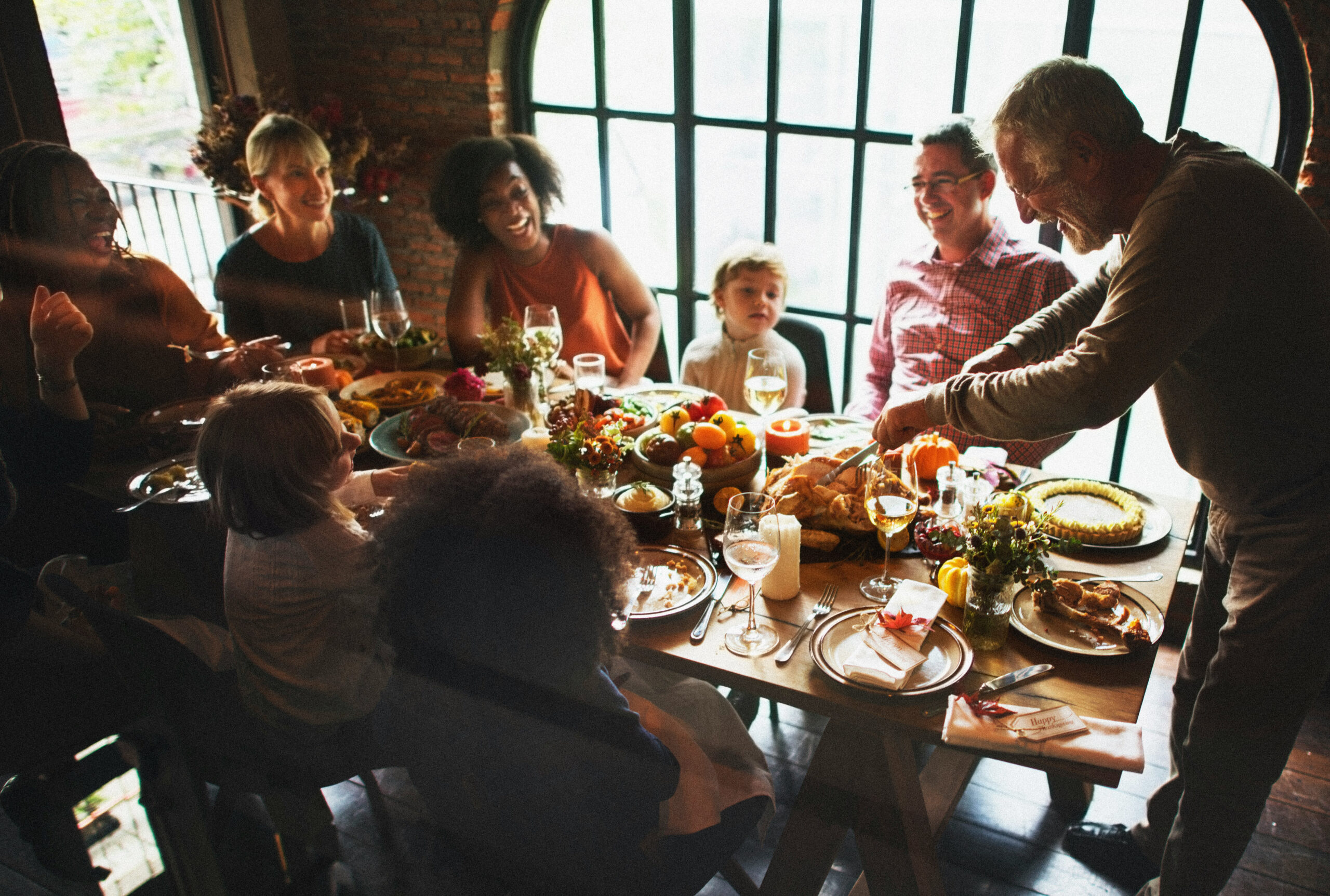
The first year it was just eight of us in a junior’s college apartment. I don’t remember whose idea it was to have a Thanksgiving dinner for our little club of friends (AKA, Friendsgiving), but I quickly took over the project as the most capable cook in the group. On the last weekend before Thanksgiving break, I spent my Saturday prepping pies, cooking sides, and laying the table for a bunch of college students whose typical idea of hosting was buying an extra six-pack for a dorm room party.
Boxed stuffing and frozen dinner rolls notwithstanding, everyone agreed that it was one of their favorite meals in a long time. When dinner was over, I remember sitting there and thinking that I had never felt more accomplished and important than I had in that evening when I fed people I loved and treated them like they mattered. I was nineteen and had academic achievements at that point, but none of them felt as real as this moment did.
We did Friendsgiving for two more years, each year bigger than the last. My sophomore year, I fed just under twenty friends, and that year, I had the help of my roommate and my then-boyfriend, now husband. I built a shopping list and cooking plan weeks in advance, made a variety of pies, and again felt a complete high by the end of it. The final year, I enlisted more girlfriends to help and tried to impart my Friendsgiving-hosting wisdom on them in hopes that the event would continue after I graduated. We fed over thirty people together that day.
A decade after that first Friendsgiving, I have cooked more Thanksgiving meals (the real thing now!) and many other meals besides. I’ve made intricate dinners for my husband and I in our first year of marriage when time abounded, quick and easy meals for our family of four, intimate dinner parties, large-scale events with friends, and everything in between.
There is a lot to be said about the importance of family dinners and sitting down with your immediate family each night around the table, but I fear the act of cooking for other people is quickly fading from our cultural reality. A little more than half of Americans either attended or threw a dinner party in the past year, with just two-thirds having people over in their homes socially at all. These numbers are in a free-fall from the 1990s, and you can guess where all of the extra time is going. We are seeing the death of hosting with no sign of improvement.
We’re swimming in the decadence of rapid availability of every variety and flavor of food unimaginable but drowning in the loss of the community that used to be served alongside.
The loss of authentic community, replaced by digital “leisure,” is a virus that has propagated the loneliness epidemic we are currently experiencing. One of the symptoms of this disease is losing out on one of the most simple yet sublime gifts to humanity: getting to love someone through food. Bringing people together, crafting a meal that makes them feel welcomed and cared for, and enjoying people you love over the dinner table are core parts of what it means to be a person.
Our Lord himself hosted a dinner party with his closest friends on the night before his passion. Don’t you think, on that night, he lovingly chose everything that was to be served and delighted in the company of his friends as they shared in food and wine? Christ chose the setting of a dinner as the place of the institution of the Eucharist to show us that we are not merely animals who have instincts to feed ourselves nor machines who need “food as fuel” like a car needs gas, but that we are fully human, and eating with one another is sacramental in its very nature.
Creating home-cooked food out of real ingredients, laboring over a meal, and giving of our time and talents are not mere chores but a way for us to participate in communion with one another. We commune at the dinner table as a reminder of the heavenly Communion we receive at the Sunday liturgy, where the Church feeds us in her love and compassion.
As modern people, we are struggling with this. This is easily displayed by statistics that show Americans spend well over $3000 annually on eating out, around 40 percent of the total amount we spend on food. Grocery stores have devoted more of their floor space to single-serving, ready-made meals, and most people are eating at least one meal in their car each week, with Gen Z averaging almost four meals consumed in their car weekly—most likely alone. We’re swimming in the decadence of rapid availability of every variety and flavor of food unimaginable but drowning in the loss of the community that used to be served alongside.

Where do we go from here? We again turn to the example Christ sets: a table, laid with food, surrounded by friends. We begin with creating a meal, however imperfect, and inviting others to sit around the table and share in it with us. This may start with instituting regular family mealtimes, but it should not end there. You must reach out into your community and invite others into your home and cook for them. This may be close friends or family members, but ideally, it should extend out to the couple at your church who recently got married, the coworkers you want to get to know better, or even your actual neighbors. You don’t need to be wealthy or own a large home to host; many of our first dinner parties were hosted in a small apartment with simple ingredients.
Once you’ve invited them, lay a feast. This may be an actual feast (lesser-celebrated liturgical holidays like the Nativity of Mary or the Annunciation are a great option for this) or a simple Saturday night dinner with a roasted chicken and salad. Don’t feel the need to attempt something above what you’re capable of, but resist the temptation to just order a pizza. Make something real—labor over the stove and create something with your own two hands that you can stand over with pride as you all sit down to pray. Make enough so everyone can have second helpings, receive compliments with grace, and squeeze in more people than you thought possible around your table.
Last month, my husband and I hosted some of our old college friends (some of whom attended that first Friendsgiving) and their families for breakfast. It was raining, so we couldn’t be outside as we originally planned. Instead, we all squeezed into our relatively small kitchen and living room. Many of us sat on the floor, the older children went outside to play in the rain, and we had four babies total in attendance. We made breakfast tacos with coffee and muffins, which were quickly devoured by all.
In many ways, it was chaos, and nineteen-year-old me wouldn’t have believed that I somehow pulled it off—this time with a toddler and preschooler as my “helpers” rather than a small pack of college girls. But I experienced the exact same feeling of love and accomplishment at the end of the gathering as I did nearly a decade ago. In a small way, I was able to be Christ to those I loved by serving them a warm plate of something homemade, looking at them across the table (or living room floor), and loving them. This means of grace is available to all of us just by opening up our homes and setting the table for communion.