
The College Beat: ARTICLE XXII
. . .
Poland must decide whether to remain a Catholic nation or submit to the secular West.
I am often met with happy faces at school whenever I say I am Polish. Students at Franciscan University of Steubenville admire legendary figures like Pope St. John Paul II and St. Maximilian Kolbe—individuals who dedicated their lives to serving God and their fellow man. Their stories are ingrained into the Polish archetype, defining the country’s rich, religious history.
My parents escaped from Communist Poland shortly before the fall of the Iron Curtain, finding freedom and opportunity in the United States of America. Growing up in a Polish household in the Pacific Northwest, I was raised to love my country while simultaneously embracing my European ancestral roots.
The Catholic faith was a central part of my childhood. I learned about my parents’ homeland and its deep ties to religion, which began more than a thousand years ago when Prince Mieszko I was baptized in an event known as the Baptism of Poland.
Poland remains a stronghold of Catholicism in Europe, especially when compared to other countries like France, Italy, and Spain, which were once visible hearts of the Church. These nations have become shells of their former spiritual selves, lacking the love and respect for religion that once defined their societies. That is not to say Catholicism is no longer present—Pope Leo XIV’s recent trip to Paris proves it is—but it has faded out of the mainstream and is no longer central to the once religiously rich cultures.
However, this secularism has slowly been spreading into Poland, which is experiencing the same spiritual fatigue other nations have already acceded to. The phenomenon is worrying, especially to a Catholic who admires Poland’s historically deep faith.
Poland is adopting secular laws that are fundamentally opposed to Catholic teaching and violate both historical standards and natural law.
On November 7, 2026, a young man killed ten people—three of whom were his family members—and injured fifteen in the Krakow town square, one of the most visited locations in Europe. A mass shooting event like this was thoroughly unprecedented for the country.
School stabbings also rose over the past few months as children have wounded teachers, staff, and fellow classmates with sharp objects, one resulting in the death of a custodian. The Associated Press went so far as to state that “school violence is a new phenomenon” in Poland, suggesting that the country and its younger generations are headed toward a more divisive and hostile society—one antithetical to Christian values.
Moreover, Poland is adopting secular laws that are fundamentally opposed to Catholic teaching and violate both historical standards and natural law.
Last March, the Supreme Administrative Court began recognizing so-called same-sex marriages from other European Union states, a decision corrupting the definition of marriage and permitting sinful relationships.
Additionally, as of 2025, it is legal to change one’s gender in Poland. The Polish Supreme Court ruled that transgender youth no longer need to involve their parents in a case to change their officially recognized gender, showing how far it has shifted towards a secular society. These sorts of changes cannot coexist in a Catholic nation because they represent an ideology fundamentally opposed to Church teachings.
Even more troubling is the incessant demand for increased abortion access. Pro-abortion protestors have been wreaking havoc across the country while Poland barely holds onto its strict guardrails, which allow the procedure only if the mother’s life is in danger or she has been raped. As a result, abortion pills have become the go-to method for killing one’s child as new organizations like Abortion Dream Team are formed to facilitate this life-ending poison.
It is important to note that these social changes are occurring during a time of great economic development. Poland recently entered into the world’s top twenty economies as its national income surpassed $1 trillion, revealing the strides it has made since its time under Communist rule. However, it seems like these improvements have led to a decrease in citizens’ desires for religion and a turn towards secular culture—problems impacting both the short- and long-term future of the nation.
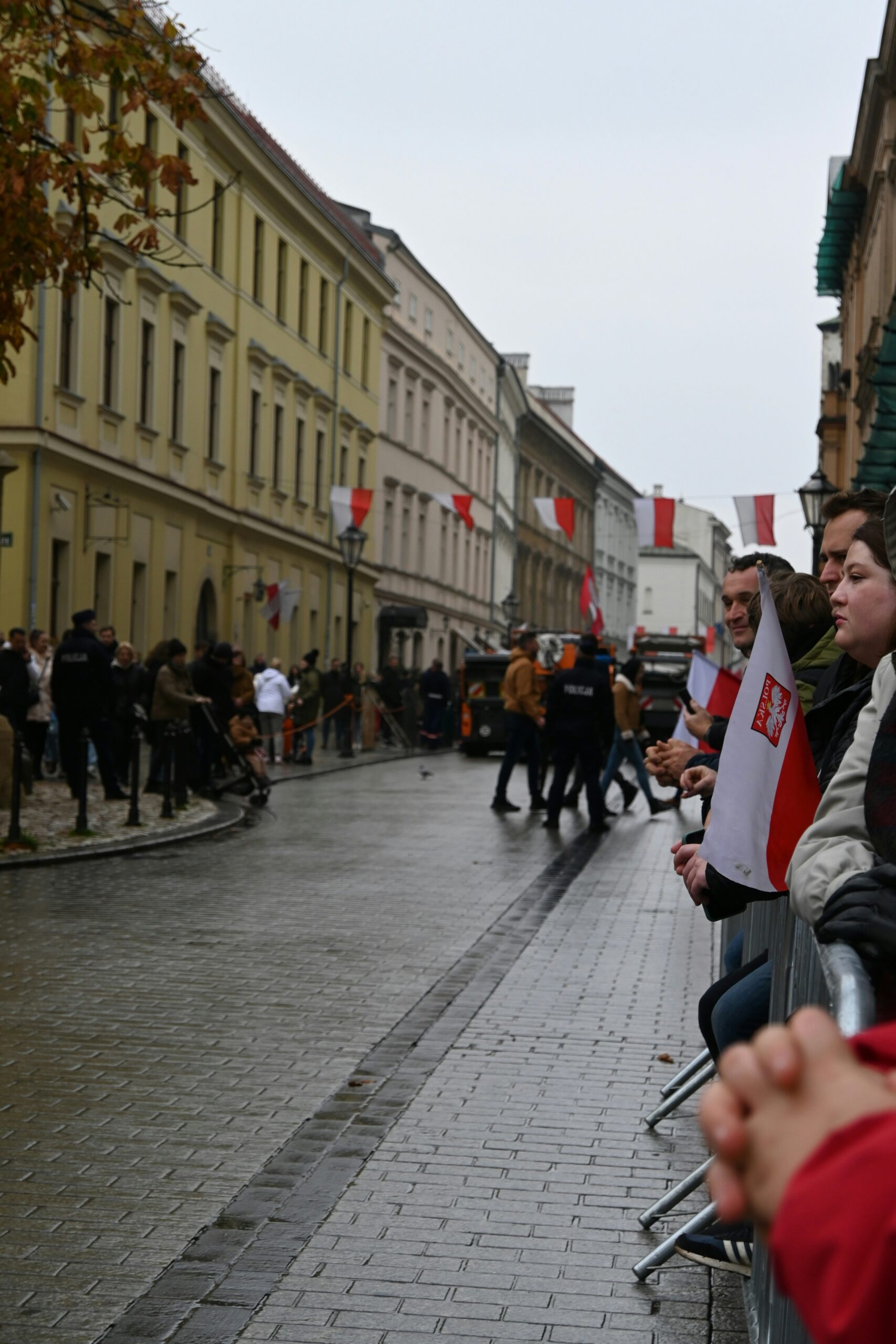
Money corrupts men and can corrupt nations when religion and its guiding principles are swapped out for those of greed and pleasure. Of course, that is not to say that these strides in wealth are bad or that Poland has surrendered to them—quite the opposite. Just look at the Polish Independence Day March, where Poles paraded religious images around the city for hours (while a prominent Western media outlet labeled it “far-right,” as if to dissuade such behavior). Poland has pulled itself out of decades of destruction to become an extremely successful nation, and the country should use its blessings to guide its citizens towards virtue.
With that being said, living with everything one needs makes it easy to abandon prayer, weekly Mass, and the sacraments while pursuing pleasurable activities and crafting a worldly lifestyle. After a while, one may ask: “Why even go to Church?”
Poland cannot remain a Catholic nation while legalizing excessively sinful behavior, embracing those who do not respect nor assimilate to the culture, and breathing the same secular air plaguing much of Western Europe.
Unfortunately, data shows that this is already taking place. Looking at the 2011 census, one will notice that almost 88 percent of the Polish population, numbering 33.7 million people, identified as part of the Roman Catholic Church, a lofty sum compared with other nations. More recently, the 2021 census shows that 27.1 million people, or 71.3 percent of the population, identify as Roman Catholic. Within the span of just ten years, over five million people left the Church.
Living with everything one needs makes it easy to abandon prayer, weekly Mass, and the sacraments while pursuing pleasurable activities and crafting a worldly lifestyle.
Simultaneously, the number of people professing no religious belief almost tripled, hitting 6.9 percent in 2021, while the number who refused to answer grew from 7.1 percent to 20.5 percent. Younger Poles are also no longer willing to go to Church at the same rate as their parents and grandparents, as only 23 percent practiced regularly in 2021 compared with 69 percent in 1992.
This is indicative of a fundamental shift in Poland’s relationship with religion that, if unaddressed and unchanged, will undoubtedly restructure the nation’s identity and relationship with Catholicism.
Looking back at Poland’s rich and fruitful Christian history, one will quickly find examples of overcoming assaults by hostile powers, often turning to Christ and the Blessed Mother for aid. The difference now is that Poland can no longer concretely identify the enemies confronting its traditions and faith because it is slowly reducing its bond with the Church—its most integral institution.
Under Communist rule, the Soviet-backed government distributed anti-Catholic propaganda, burned churches, promoted atheism, and harassed clergy to hollow out the Church from within to make space for a Communist, atheist state, completely contrary to the nation’s acknowledged and protected culture. These abuses formed some of the twentieth century’s greatest heroes, such as Jerzy Popiełuszko, a thirty-seven-year-old martyred priest who continued to voice disapproval of the Communist party despite death threats, and Pope John Paul II, who became instrumental in ending the Cold War.
Today, Poland is experiencing great difficulty recognizing the secularizing effects of their success and is failing to remain steadfast in their traditions and faith. The further entangled they become with the modernist elements of the West, especially those promoting a globalist agenda destined to make every nation homogeneous, the more difficult this will become.
Poland, the country of my forefathers and the millions of US immigrants who contributed to the improvement of this great nation, is in a moment of choosing. It must decide whether it will continue the legacy left by its ancestors and heroes of the faith, or if it will give in to the forces of secularism and modernization that intend to reduce its love of Christ and nation to that of a secularized West. The choice rests in the hearts and hands of the Polish people.
Niech żyje Polska!