
Personally, I was not a “Playstation kid,” but all 90s-era kid video gamers knew about Resident Evil. In an American suburb, Raccoon City, a shadowy pharmaceutical corporation has been experimenting with viruses to create biological weapons, including human mutants. Predictably, there is an outbreak transforming huge swaths of the populace into zombies. It was a groundbreaking survival–horror game in which the player explores eerie mansions and zombie-infested streets, relying on his sidearm and wits. The game spawned one of the most successful and influential video-game franchises of all time. And the films based on it were early examples of successful Hollywood adaptations of video games.
The “reboot” film that recently came out, Resident Evil (rated R for pervasive language and violence), is a noteworthy entry into the franchise not only because it is a well-made thriller–horror film that introduces the franchise to a new generation—but also for its deeply pro-fatherhood and pro-life message hidden under layers of metaphor. Warning: spoilers follow.
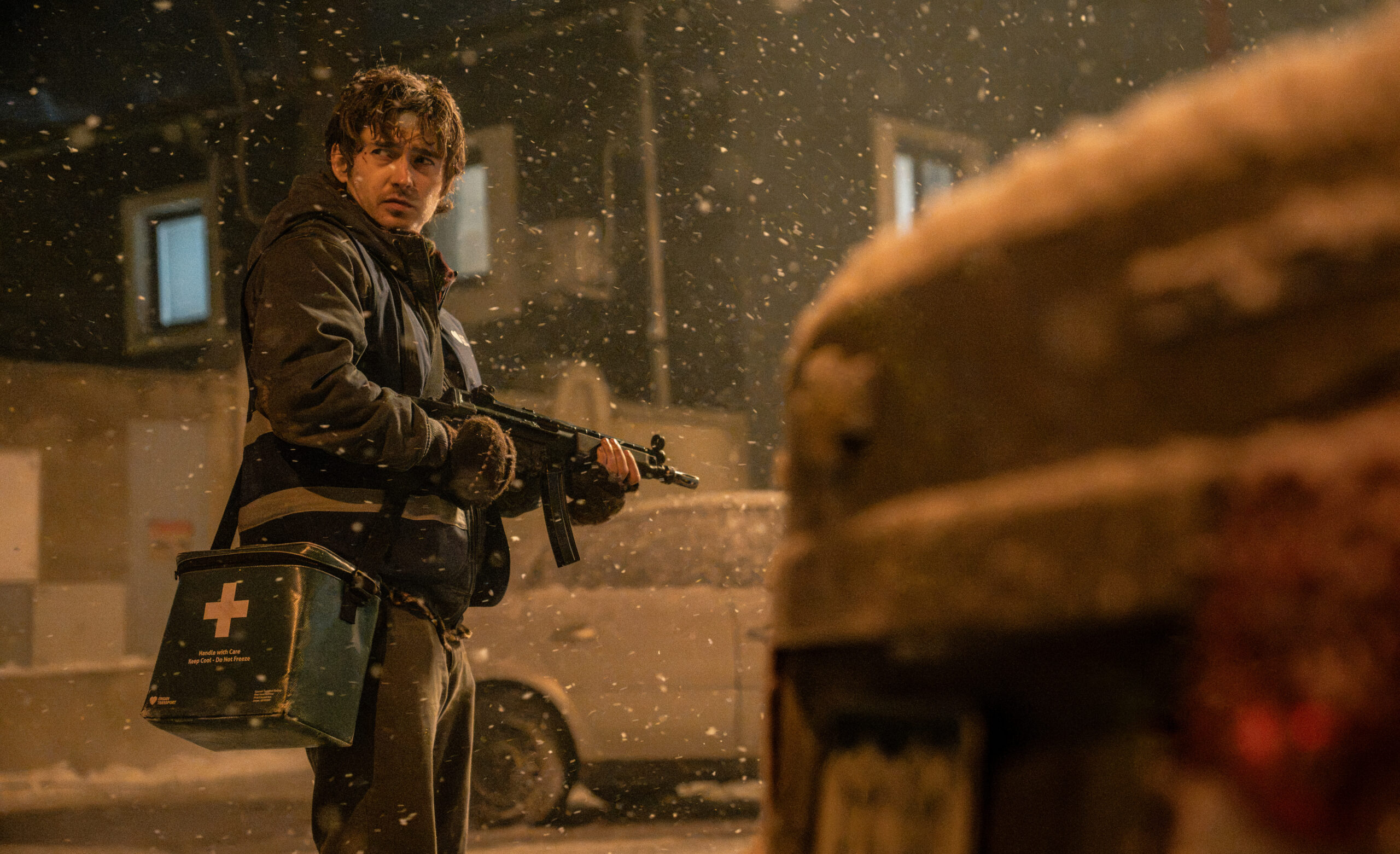
The film is set in Racoon City the same night as the events of the Resident Evil 2 game when the Umbrella Corporation’s bioweapon virus caused a zombie outbreak. But it is reimagined with contemporary technology, like smartphones, and follows a new character, Bryan (played ably by Austin Abrams). The film opens with Bryan taking a mystery medical package to be delivered to Raccoon City, driving through a blizzard. He takes a phone call from his girlfriend Michelle, who wants to continue their discussion of the recent revelation that she is pregnant. Bryan is clearly afraid of becoming a father and exhorts her to take another test. He then expresses indifference about whether Michelle should get an abortion: “It’s your body, your choice,” he lamely says, to which she takes offense. She pleads with him to come home so they can discuss it as he protests that he has an important job to deliver the mystery medical package. “This is the life that I’m carrying, right now,” he says, before getting cut off and running over a woman who jumps out into the middle of the road.
As director Zach Cregger puts it, the movie is only on the surface a zombie apocalypse. What it’s really about is the fear of prospective parents having children in a world that “just seems to be getting worse and worse?”
Thus Bryan’s night of horrors begins. He finds the woman alive, acting strangely but apparently not entirely zombified and brings her to the car, buckles her in, and starts speeding her to the hospital before getting pulled over by a police officer. The officer agrees to help transport her, but they make it only a mile down the road before the police car crashes. He investigates to find the officer dead, and then the woman—now fully zombified—chases him around the car as he shouts, “Leave me alone!” And he shoots her.
As director Zach Cregger puts it, the movie is only on the surface a zombie apocalypse.
There has been speculation online about what it all might mean. While the following is just my interpretation, I believe that the metaphor is apparent. The woman is a metaphor for Bryan’s girlfriend, Michelle. The allusion of the scene is to that all-too-familiar episode young fathers face: speeding one’s “knocked up” wife to the hospital to deliver the baby. But faced with the scariness of a pregnant girlfriend, who is undergoing the bodily and psychological changes wrought by another “parasitical” being inside of her, Bryan runs.
He arrives at a farmhouse seeking refuge with a picture of an apparently happy older couple. In other words: the man running from his responsibility returns to his parents. But, the virus has spread there too. The elderly zombie woman screams at Bryan and attacks him. Like a good mother, she scolds Bryan for running from the responsibilities of fatherhood. Or is she (also?) Bryan’s mother-in-law? Either way, Bryan shoots his metaphorical zombie-Mom and then sees zombie-Michelle sprinting across the lawn. No matter where he goes, those to whom he is bound will follow. He shoots zombie-Michelle but watches in horror as tendrils stretch out of her to join with and fuse to zombie-Mom, forming a hideous one-flesh, many-limbed, tumbleweed-like monster that cartwheels after him.
Now running from his “parents” and his “girlfriend,” Bryan happens upon a young girl, maybe eight years old, hiding in an RV bathroom. She reports that her mother bit her foot and ran off. The foot is mutating, but she seems fine otherwise. Bryan is filled with compassion and agrees to help her, before she too mutates and attacks him. She bites him, and he ultimately shoots her too. “That wasn’t real. That didn’t happen,” he tells himself, “I didn’t shoot a little girl; I love children.”
Bryan sees the need of young girls for a father, whose office it is to protect them from monsters. Bryan grasps this and tries to help this metaphor for his unborn daughter. But embracing fatherhood will mean embracing a metamorphosis, which her bite begins. It is a metamorphosis men experience when their wives show them that first positive pregnancy test.
Bryan runs again. He now encounters the Umbrella Corporation agents, who reveal to him that the package he is carrying is the antidote to the virus spreading, which they must deliver to the pharmaceutical lab in the city center. Bryan’s newfound companions fire a machine gun to drive off the tumbleweed monster, which has apparently engulfed others, including the little girl.
It has become apparent the tumbleweed is a metaphor for the change Bryan must embrace by accepting the responsibilities of manhood. It represents all the relationships that must transform a boy into a man: being a responsible husband, father, son, son-in-law, and friend. Running from these responsibilities for refuge in friendship does not work either. For Bryan’s new companions quickly die, and they get engulfed into the tumbleweed. The idea is that friends are transformed by your choices, and true friends would encourage you to embrace the change and responsibility. And, finally, true friends will strengthen you and help bear the load of marriage and parenthood.

Now, Bryan takes up the mantle of finishing the job. He runs through sewers and streets toward the Umbrella Corp. and must ascend from the basement garage to the laboratory on the top floor. The man running from manhood seeks meaning in his work—but this is not satisfying either. In a touching moment, he gazes upon a stick figure family bumper decal. He pulls out his phone to record a message for Michelle. He admits to being afraid of responsibility and parenthood but says he does want to have a kid with her, and he tells her she would be an amazing mom.
Then he ascends, and the tumbleweed monster returns. A vomiting zombie spewing melting acid attacks, and he grabs it, forcing it to spew at the tumbleweed. This fails to appease it. Mere words aren’t enough—he has to embrace fatherhood with his entire being. The bite from the little girl is spreading the infection, and his bodily transformation has begun.
One last obstacle remains: a maternity ward full of newborn children. It is a disturbing and gruesome scene because the zombie virus has spread its tentacles here too, transforming the newborns into monsters. Bryan runs from the zombie babies. And, having complained the whole movie about his inabilities to use a real gun—they are much harder to handle in real life than in video games—he successfully uses his last bullet to shoot a small target to open a door and unleash the zombie children to knock down the tumbleweed and escape again. He shouts: “Video games!” It is a powerful metaphor for the feckless, basement-dwelling male of the twenty-first century, whose final refuge to avoid the responsibilities of manhood is video gaming.
In the climactic scene, he delivers the “cure,” which they use to synthesize a vial of green medicine. His metamorphosis now speeds up, and the not-quite-zombified monster-Bryan desperately attacks the scientists. “Help me!” he implores as the tumbleweed finally catches up and fuses itself with him. Having spoken the words to agree to embrace manhood, the change comes fast and furious, and old cowardly Bryan cries out one last time. He is desperate to undo what has been done, to use the shady pharmaceutical company’s drug to kill the virus that now reveals itself to be a metaphor for his unborn child all along, the unleashing of which was brought on by him running over (“knocking up”) his girlfriend. He is the source of the scary, life-altering, and metamorphizing force that is new human life. The “antidote”—the life he was “carrying right now”, his own—promises to preserve his autonomous self by killing the tumbleweed, i.e., killing his relationship with Michelle, the child, his friends, and all the transformative relationships marriage and children bring into the world.
In the last moment, he desperately tries to induce the chemical abortion, but fails. As the governmental helicopters arrive, a massive monster-Bryan, now transformed, roars in defiance of both big government and big pharma.
The man who embraces husbandhood and fatherhood must become a kind of monster, powerful enough to protect those he is charged to care for. And in a culture that celebrates the power of big government allied with big pharma to push autonomous individualism via abortion drugs, the man of virtue who resists appears to be a monstrosity. Only on the surface does the “resident evil” win. The evil that resides in the heart of every man is the fear of losing his lusty autonomy, the fear of responsibility. This is the pro-choice evil that Bryan finally conquers.