
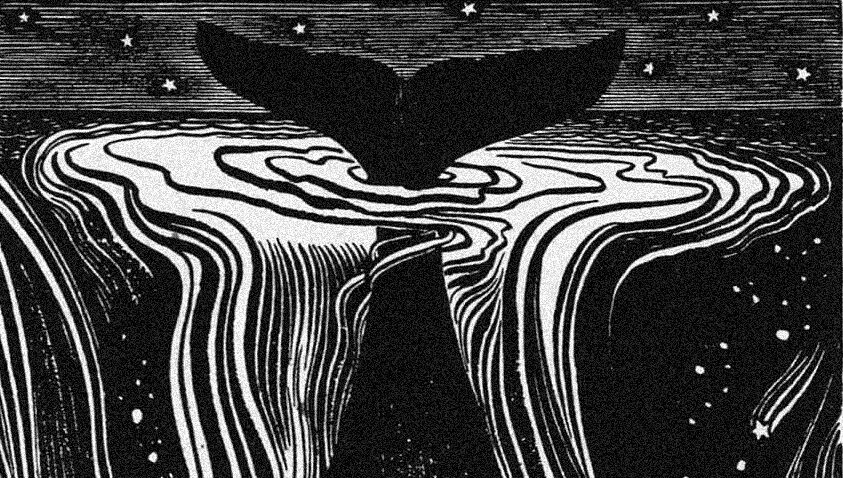
At the heart of Herman Melville’s Moby-Dick lies a profound challenge to the Christian faith. For in the character of Captain Ahab, Melville raises an ancient question that defies easy, pious answers: How can an all-powerful, benevolent God allow such suffering in the world? This problem of pain drives Ahab mad, taking him to the jaws of the deadly sperm whale for which the book is named. If we are honest, it troubles even those of us who believe. We are touched by addiction, abuse, or suicide; we watch our children fall sick or die; we see cruel war and human trafficking, the devastations of earthquake, fire, and flood. It is the only objection to Christianity that has any teeth, and Melville gives anguished utterance to it. Yet part of Moby-Dick’s greatness lies in this: The book refuses unbelief or despair, offering instead mysterious glimpses of what our suffering means.
The story follows the narrator, Ishmael, who joins the whaling ship Pequod, under a brooding captain with a whalebone leg. Whalers hunted the great marine mammals for their oil, but this voyage becomes something more. When Captain Ahab announces his quest for revenge against the mottled albino sperm whale that bit off his leg, his vengeance propels the Pequod across far seas in search of the monster Moby Dick.
Yet for Ahab, Moby Dick is not just a whale. The creature represents something supernatural, perhaps God himself. In a chapter called “The Quarter Deck,” Ahab admits to his mate Starbuck that he considers Moby Dick the hand of some supernatural being that lurks just beyond our material world:
All visible objects, man, are but as pasteboard masks. But in each event—in the living act, the undoubted deed—there, some unknown but still reasoning thing puts forth the mouldings of its features.
To Ahab, that “reasoning thing” is God, a being of “inscrutable malice.” Moby Dick may be the instrument of God or God himself, but Ahab asserts that “be the white whale agent, or be the white whale principal,” he wants revenge.
But Ahab hates the deity for something graver than a lost leg: Early in the novel, we learn that his grievance predates the accident and comes from a serious theological problem. The eccentric stranger called Elijah asks Ishmael and his friend Queequeg if they know the rumors of Ahab’s ungodly past, the “deadly skrimmage with the Spaniard afore the altar,” or “the silver calabash he spat into?” Even before losing his leg, then, Ahab has committed murder in a church. And “calabash” is slang for dish or bowl: Ahab has desecrated the Eucharist by spitting in a silver ciborium. Melville’s tragic hero has long lived in enmity with God.
The book refuses unbelief or despair, offering instead mysterious glimpses of what our suffering means.
Why? Because he realizes the age-old problem of pain, as we learn in the chapter called “The Sphynx.” Ahab stands alone on deck with the head of a decapitated sperm whale—not Moby Dick, for Ahab permits the crew to hunt other whales along the way. In what follows, he has a one-sided dialogue, a Shakespearean soliloquy, with the whale head, called a “Sphynx” because like the mythical monster it withholds the answer to a riddle:
Thou saw’st the locked lovers when leaping from their flaming ship; heart to heart they sank beneath the exulting wave; true to each other, when heaven seemed false to them. Thou saw’st the murdered mate when tossed by pirates from the midnight deck; for hours he fell into the deeper midnight of the insatiate maw; and his murderers still sailed on unharmed—while swift lightnings shivered the neighboring ship that would have borne a righteous husband to outstretched, longing arms. O head! thou hast seen enough to split the planets and make an infidel of Abraham, and not one syllable is thine!
In each of these imagined scenes, we have a riddle: Why do the innocent suffer, and why do the wicked prosper? To Ahab, the whale remains silent like God remains silent, giving no answer to our questions.
It is the problem of the biblical Job, which becomes key to understanding the novel. Melville repeatedly alludes to that text, and the narrator calls Moby Dick “a Job’s whale.” In the Old Testament, the righteous Job suffers horribly, losing his children, property, and health. When he contends with God over the injustice of his suffering, God responds “out of the whirlwind” (King James Version) with a series of rhetorical questions, showing Job that the ways of God unimaginably exceed human comprehension. One of these challenges, in Job 41, is about the whale.
Actually, the Joban beast is “leviathan,” a crocodile or a Canaanite sea monster;1 but in his novel, Melville uses that biblical name for the whale. God’s challenge to Job is this: If humans cannot handle even one of God’s creatures (like the terrifying leviathan), how can we reckon with the doings of the Almighty himself? “Canst thou draw out leviathan with an hook?” God asks Job, “shall they part him among the merchants?” Or “Canst thou fill his skin with barbed irons?” Job finally withdraws his objections, responding to God’s challenge with humility: “Therefore have I uttered that I understood not; things too wonderful for me, which I knew not.” But Melville’s Ahab rejects Job’s humility. If we carefully read God’s challenges, we find the whaling captain’s very job description: harpooning and killing leviathan, then barreling his oil for the Nantucket market. Ahab has answered God’s questions to Job with a defiant yes.
God’s answer to Job, though true, seems cold comfort when we suffer. But Melville’s novel goes further to dramatize a deep Christian mystery: that our sufferings may actually bless us. To do this, Melville compares Ahab to Shakespeare’s King Lear. The aged Lear rashly banishes his loyal daughter, Cordelia, dividing his kingdom between her evil sisters; then in the sublime third act of the tragedy, he finds himself homeless in a colossal storm, soaked to the skin, and losing his mind. Suddenly Lear’s suffering opens his eyes to the pain of others; he grieves for the “poor naked wretches” who face the storm with “houseless heads and unfed sides.” He laments his negligence as their king: “I have ta’en / Too little care of this.” Then, in one of the most moving moments of the play, Lear exclaims: “Take physic, pomp. / Expose thyself to feel what wretches feel.” “Physic” means “medicine”: Lear realizes that suffering is medicine for his unhealthy soul, and he embraces the cure.
If Captain Ahab fails as the biblical Job, he also fails as King Lear. In a terrible storm at sea, Ahab rages at the heavens like his Shakespearean double; then Melville puts Lear’s words in Ahab’s mouth, with a tragic twist. Looking up to the thunder, clouds, and wind, the storm which was “physic” for Lear, Ahab says: “What a hooroosh aloft there! I would e’en take it for sublime, did I not know that the colic is a noisy malady. Oh, take medicine, take medicine!” Ahab warps Lear’s response: He calls the storm a sickness (“colic”), then tells it to take its medicine.
For all its darkness, Melville’s novel does not endorse Ahab’s stubborn belief that suffering is meaningless cruelty, dealt out by an evil or indifferent God. Rather, Melville provides subtle hints of another dimension to suffering—that it brings surprising gifts and may even be part of a design working for good. One of these hints centers on a curious substance called ambergris, which the mate Stubb digs from the carcass of a dead whale. This valuable substance was used in perfume and medicine, and, Ishmael tells us, is “worth a gold guinea an ounce.” In this strange little episode, Melville points to the unexpected treasure—costly and medicinal—of something made through suffering, produced only “in the inglorious bowels of a sick whale!”
The novel’s “Epilogue” gives the most haunting suggestion that our gravest sufferings can bear unexpected fruit. Crazy Ahab pursues his vengeance to the climactic end, where Moby Dick wrecks the Pequod; everyone dies except the narrator Ishmael, who survives clinging to a wooden coffin from the wreckage. Earlier, in a heartbreaking scene, the Pequod had met a ship called the Rachel searching for her captain’s twelve-year-old son, lost at sea; now that same ship rescues Ishmael, but only because her captain is still carefully combing the sea in search of his boy. That tragedy saves Ishmael’s life.
We approach a great mystery here, and Melville refuses to oversimplify. The precious ambergris and the saving of Ishmael do not fully solve the problem of suffering. We still cry out like Ahab for the answer to this riddle. But Melville’s metaphysical sea-tale reveals tantalizing hints that God works to bring good even out of our greatest pain.
1 Job 41:1 (KJV); see Robert Alter, ed. and trans., The Hebrew Bible Vol. 3: The Writings, (Norton, 2019), 573n25.