
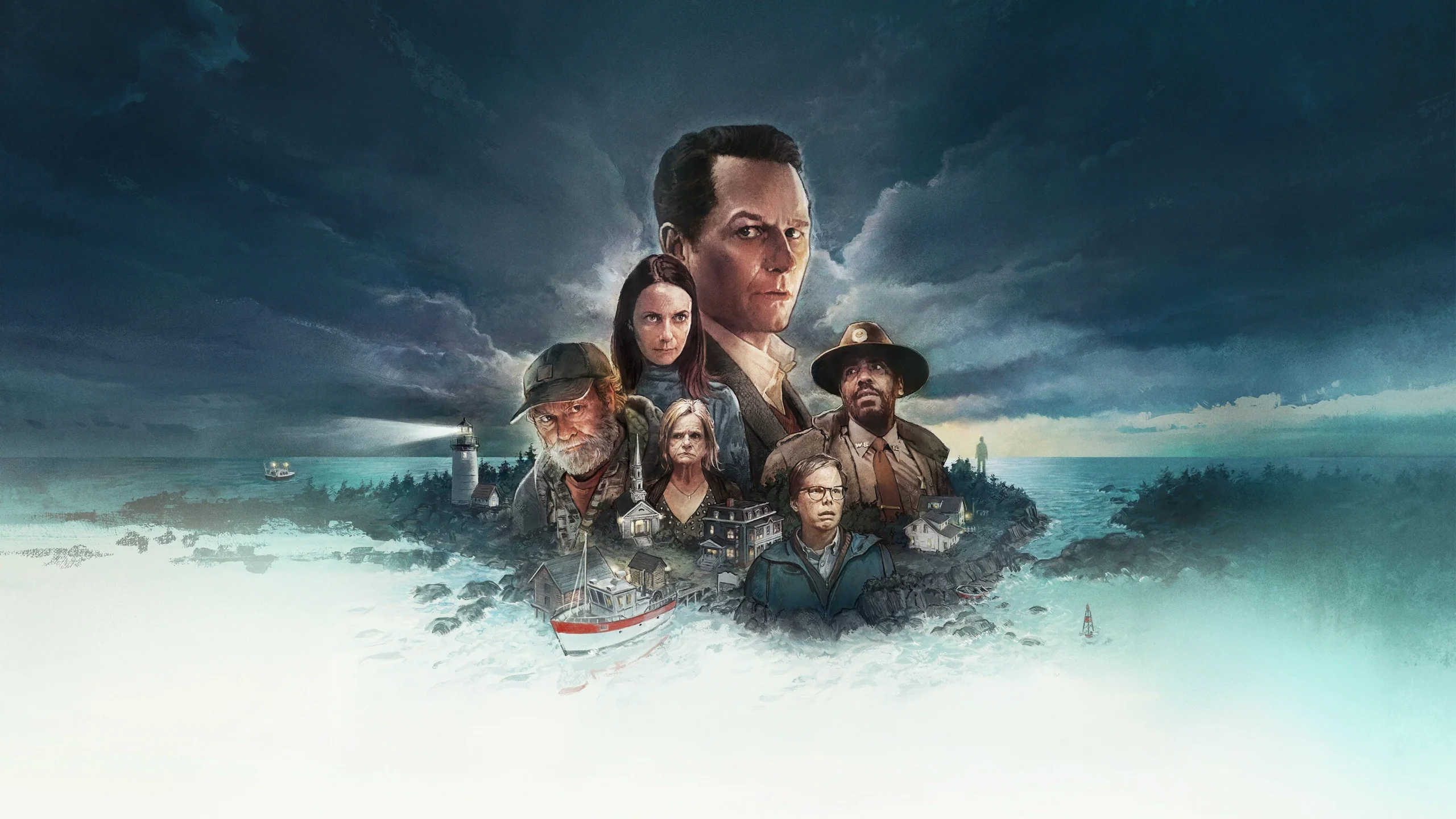
Widow’s Bay, a new miniseries straddling comedy and horror by Apple TV, is clever, funny, and at times successfully terrifying. It effectively adapts many horror tropes, with plentiful allusions to Friday the 13th, Carrie, Scream, The Shining, and more while providing for an ironic distance for humor to break through. It is irreverent and occasionally gratuitous, but mostly in its language and drug use. Widow’s Bay deals with the human condition and what exceeds human power. It testifies to what transcends the bounds of Enlightenment rationalism, which reduces the natural world and everything in human experience to a technical object for use and mastery. In this case, there is a supernatural force at play behind the terrors of Widow’s Bay rather than a technological (e.g., an AI apocalypse). The show reveals an openness to what exceeds human mastery of the mundane, yet its openness is distinctly limited. It lacks awareness of the possibility of the inbreaking of something radically new and good—i.e., the reality of God revealed in Jesus Christ. More importantly, Widow’s Bay witnesses to a post-Christian fatalism that tends toward a nihilistic submission of humanity to forces beyond its control.
Why say this? Here are some spoilers that lay out my case—reader beware! Widow’s Bay is a remote island off the coast of New England whose mayor, Tom Loftis (Matthew Rhys), seeks to make it a tourist destination akin to Martha’s Vineyard. The only problem he faces is the growing unavoidability of its being a haunt, with a plethora of embarrassing customs, odd communal memories, and extraordinary history. Though set in the present day, the town lacks smartphones and generally relies on technology from the ’80s and ’90s (a nice nostalgia for those who remember the era). Rather than merely being behind the times, this technological latency stems from a darker cause. It is gradually revealed that no one who is born on the island can leave it without dying. Loftis himself was born on the continent and only spent his youthful summers there before marrying a local. Not only was his late wife born there but so too their only son.
This horrifying revelation stems from the very beginning of the island’s settlement, which began in desperate circumstances and a fatal Promethean error by its founder, Richard Warren. The colonists who settled the island immediately found themselves on the brink of starvation when Warren happened to find certain mind-bending mushrooms, which brought him to an encounter with the demonic force ruling the island. Warren made a bargain with it to save his life and his community’s—but at the cost of this curse and the beginning of ritual human sacrifice. Unless Warren’s bloodline ends, the curse will continue and no resident can leave the island and live. Moreover, the demon’s appetite for terror and sacrifice apparently ebbs and flows over time, allowing the more extreme oddities experienced by the community to fade a bit from memory and a simulacra of normalcy to return. The story pivots on whether Loftis can make Widow’s Bay a new Martha’s Vineyard. Can he, through sheer willpower and forward-thinking, overcome the island’s increasingly evident servitude? Or will he too succumb to the dominion of the diabolic power?
In Widow’s Bay, we humans are on our own in the fight for self-preservation, even as it is more and more evident that we are overpowered and fated to lose.
The answer is clearly the latter. The climax of the series is rich with moral and spiritual significance, and it represents a case in point. Loftis believes he has identified the last descendent of Warren and can end the curse. Yet, to do so, he must kill his own elderly assistant, Ruth. Can you intentionally kill one innocent elderly woman for the sake of freeing the many from the curse? Can you perform human sacrifice for the sake of an apparent good? (It’s not unimportant that Loftis is contemplating the same action demanded by the island’s demon, yet for an apparently more noble end. Do they not suffer the same scotoma about the inherent dignity of the human person?) Loftis reasons, even explicitly in conversation with an unsuspecting Ruth, that it’s right and necessary to sacrifice one person for the sake of many. He brings up the now-classic trolley problem, an ethical dilemma meant to make one consider one’s moral intuition guiding one’s choice. Do you pull the lever to change the runaway train’s course to kill one innocent or many innocents? It also almost certainly has the effect of justifying consequentialism as really the only ethical framework by which to work out one’s moral agency in the world. Consequentialism is an ethical theory that judges the rightness or wrongness of an act according to what will happen as its result, in contrast to the more classic view that certain kinds of actions (e.g., murder, adultery, theft) are simply never to be done. The trolley problem, like Loftis’s reasoning, only manifests an action under compulsion: Unless you pull the lever, something more or less terrible will happen. (Is one compelled to pull the lever at all? If so, are we genuinely free agents?)
In reply to Loftis, Ruth pays lip service to the classically Christian proscription of doing an evil for the sake of a good. It is never right to kill an innocent, even for a good outcome, she says. Unpersuaded and desperate, Loftis attempts but fails to kill Ruth by an overdose. He only has a change of heart when he learns that her death will not end the curse. Ruth, unbeknownst to him, is actually his mother-in-law and grandmother to his son. Shockingly, she is not the last of the Warrens, but Loftis’s own son is. Now he reverses the trolley’s lever and desperately tries to shield the one from the oncoming train at the expense of the many. Though he sought to follow the rational consequentialist logic, his fatherly love gets the better of him. It’s not that he recognizes the insufficiency of consequentialist ethical reasoning—that perhaps it’s true that to become a murderer is worse than suffering a grave injustice. If the show inadvertently reveals the limits of consequentialism, it seems unintentional. All too understandably, Loftis eliminates the one piece of evidence linking Ruth to the Warrens and thus to his son. He throws a brooch passed down among the Warrens into the sea, never to be found. Yet the result is a fearful capitulation into the prior rhythms of obeisance to the demonic power ruling Widow’s Bay. Human sacrifice is more or less accidentally reinstated, and Loftis’s sheer human will to improve Widow’s Bay and break the curse is revealed impotent.
Why is this post-Christian fatalism, tending into nihilism? Consider what is missing at each momentous step. There is no option for self-sacrifice, and thus no awareness that death is perhaps not the greatest evil human beings face, or that it may not be the cessation of human existence. In short, neither the witness of Socrates nor Christ is in view. There is no sense that the Lord might save Isaac and provide a ram. In Widow’s Bay, we humans are on our own in the fight for self-preservation, even as it is more and more evident that we are overpowered and fated to lose. Might Richard Warren have agreed to exchange his own life for his family and community, rather than be made to live in perpetuity and subject them to the curse? Might Loftis, who himself inadvertently consumes those same mushrooms and encounters the demonic presence, not have offered his own life for his son’s? Or might there be some other means to tie up the strong man and plunder his house—i.e., the power of Christ? Such an option is nowhere in sight. Beneath the tropes and allusions, this is perhaps the show’s deepest horror.
In other words, Christianity itself is occluded from the series’ view. It plays a feckless role, with no effect on the hard reality of servitude to the diabolical power. Everyone already seems to know that it is passé and of no help to deal with such a problem. The one pastor on the island, who of course wears a Roman collar, is certainly not a Catholic priest. His role in the show ends prematurely by suicide after he discovers the resurgent curse and power ruling the island. Christ can do no major signs in his own hometown of Nazareth due to a lack of faith. Widow’s Bay is too like Nazareth in its inoculation to the possibility that the gospel is more than mere myth. Indeed, Ruth quotes Tennessee Williams about the “saving” power of love. But does she understand that love extends even to radical self-abandonment in faith? To say love should be treasured in life—which is a perpetually burning building—seems entirely consistent with the resignation of nihilism. Such a love is incapable of transforming life itself.
In the end, Widow’s Bay is a mixed bag. It’s well made, fun to watch, and, as I said, irreverent and gratuitous. It does well to pick up on the present ebb of interest by many in the West in what transcends human control and mastery. But the show fails to see that Christianity is anything more than a remnant of human history or that it might say and provide something essentially new to human existence. For those on Widow’s Bay, there is no way out of human sacrifice in one form or another. Hence, there is no genuine hope. Post-Christian fatalism prevails; nihilism lurks because the best we can achieve are fleeting moments of happy feeling with a loved one amidst a brutish existence. The show’s openness to what transcends human mastery is laudable, but if the gospel remains out of sight, it is not open enough.