
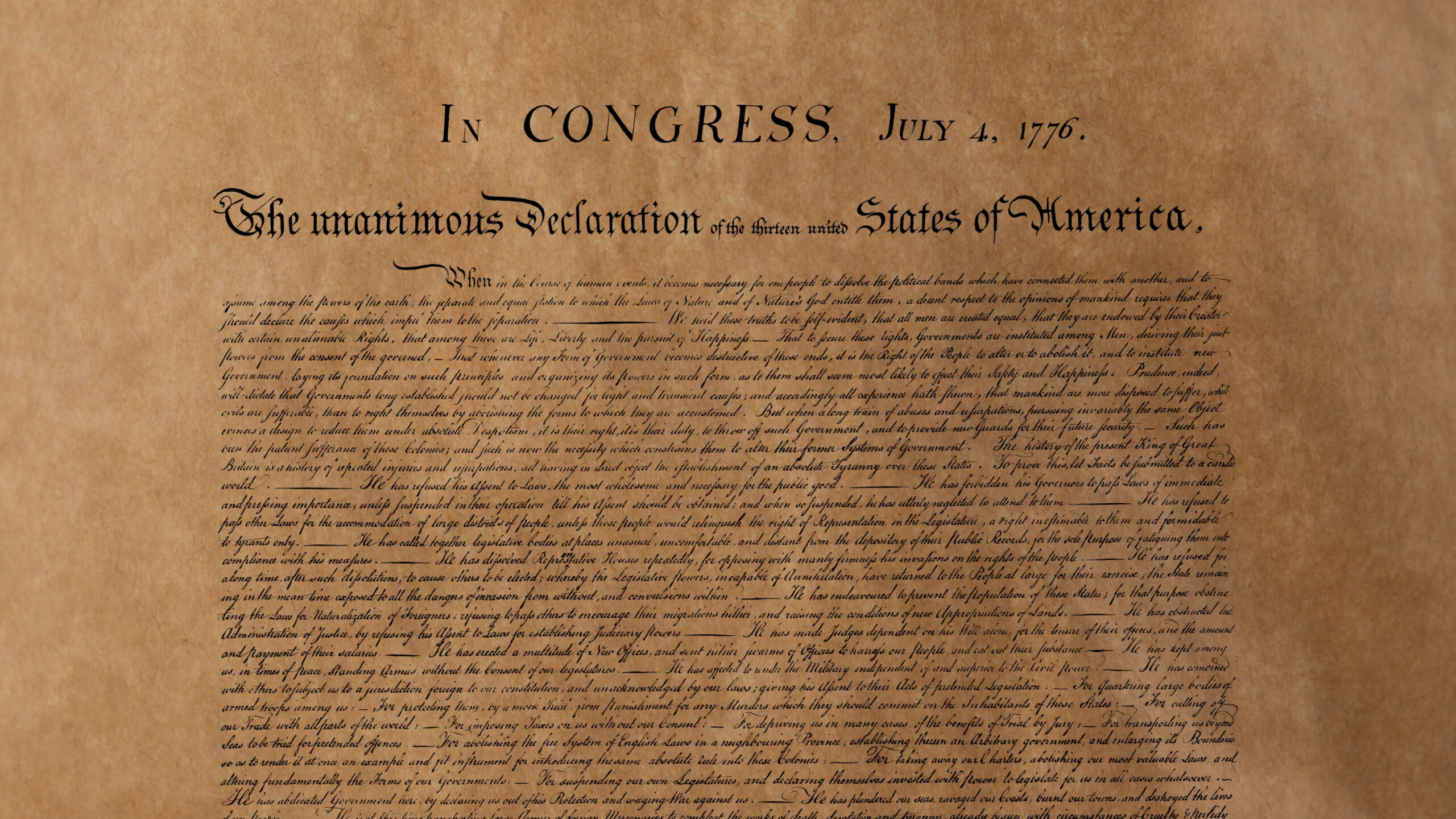
Some might think it odd to speak of a “theology” of the Declaration of Independence. But we really can’t read it without one.
Only two individual characters are identified in the Declaration. One is the all-powerful king of Britain, “marked by every act which may define a Tyrant.” The other is God the creator, lawgiver, and supreme judge of the world. No reader of the Declaration, especially “the good People of these Colonies,” would have missed this comparison of two absolute rulers.
Consider the appearances of God through the document.
In the first paragraph of the Declaration, the American colonists dissolve their political bands with England and assume a “separate and equal station” under the standard of “the Laws of Nature and of Nature’s God.” Notice that there is one set of laws, but there are two sources of authority. There are laws that are “of Nature,” but the same laws are also “of Nature’s God.”
The twofold understanding of the laws of the universe as both rational and divine has deep roots in the Western philosophical tradition. Among the pagan thinkers, Plato presents law (nomos) as a rational framework that reflects the structure of the cosmos, inspired by divine reason (nous). For Aristotle, law is rational, arising from nature, which is ordered by a divine intelligence. Cicero’s law is right reason in agreement with nature, which is governed by God.
With Christianity, this duality takes on a fuller meaning. Augustine writes of rational laws that reflect the divine reason of God and that are accessible to man through his rational faculties. Thomas Aquinas builds a comprehensive view of law that is both an ordinance of reason and man’s rational participation in the eternal law.
The particular phrasing is a reference to both reason and revelation—the two great sources of man’s searching and thinking concerning the truths about man and God, politics and religion, the city of man and the city of God. The “Laws of Nature” references the natural law tradition, going back to the Greeks and the Romans and extending through the whole Christian intellectual tradition. The term “Nature’s God” is not a diminution of God into nature but a recognition of God’s laws over nature, giving divine order to the universe. That, in theological terms, is called general revelation, the concept in scripture by which nature understood by man’s reason proclaims God’s handiwork just as God’s existence, power, and divinity is manifest in creation itself.
The one prominent use of the phrase “Nature’s God” before the Declaration, and quite likely the source of the phrase for the Declaration, makes this very point.
The most popular poet in the colonies at the time of the American Revolution was the English writer Alexander Pope, a Roman Catholic who refused to renounce his faith in a Protestant England that legally and culturally did not tolerate Catholics. Pope’s most widely read poem was “An Essay on Man,” written from 1732–34. In that work, Pope admonishes his friend Henry St. John, Viscount Bolingbroke (an avowed deist and to whom the poem is dedicated), to “Awake” and see that the universe is divinely ordered. Man is part of the great chain of being—the well-known concept of medieval Scholasticism used to explain man’s place in biblical creation—above the plants and the beasts but below the angels and God. When man “looks through Nature up to Nature’s God” he follows the “chain which links th’ immense design” and learns that the final purpose of the human soul is “love of God, and love of Man,” a reference to Christ’s two great commandments in the Gospel of Matthew. Far from a paean to secular rationalism, the language presents nature as the entrée to biblical theism.
Then God appears as the Creator, not just of nature in general but of man in particular—“all men are created equal.” This is the God whose work “we hold” to be self-evident. And men are not only created but “endowed by their Creator” with certain unalienable rights. Toward the end of the document, God appears as the Supreme Judge of the world, to whom the signers appeal for “the rectitude of our intentions.” This God is all-knowing and sees the deepest interior purposes of individual men. And God appears finally when the signers appeal to “the protection of divine Providence.” This God doesn’t merely create the world and then leave it alone but continues to intervene in the affairs of men and sometimes changes the course of human events.
Notice how over the course of the document the deity becomes more personal and intimate: The theological references move from a general, distant, and unknown God to the creator and endower of man as a species, to a personal God who knows the lives and innermost thoughts of each man, to the benevolent God who intervenes to protect those who rely on God’s providence.
That hardly seems a statement of secular rationalism.
The Declaration’s terms are not those of Enlightenment skeptics bent on replacing religion with the findings of material science. Nor is the God of the Declaration the deistic watchmaker who constructs the mechanism of the cosmos and then ignores it. The language is general, nonsectarian, and nondenominational, to be sure, written for the full range of believers and all men of good faith so as to avoid sectarian conflicts and prevent any religious intolerance. But it is clearly and notably theological, recognizing God first by reason and general revelation, through human nature and creation, and then augmenting that knowledge with an acknowledgment of God’s judgment and providence in human affairs.
The theological substance, growing out of the whole Western philosophical and biblical tradition, is unmistakable.
At the same time, the theology of the Declaration does not define articles of faith. The Declaration’s language is not specifically or distinctly Christian. It doesn’t mention the divinity or resurrection of Christ, the doctrine of the Trinity, or any particular tenets of the Christian religion. This is not the living God of the Gospels, the God who made his dwelling among us. Yet the theological substance, growing out of the whole Western philosophical and biblical tradition, is unmistakable.
The theology of the Declaration is a natural theology to begin, but it consciously points beyond that. The Declaration’s theology is not a ceiling meant to confine man’s search for transcendence but a solid foundation upon which man can pursue the greatest of goods and highest truths of faith as well as reason. By appealing to the precepts common to both faith and reason, the Declaration defines the preconditions of and even invites a more complete understanding of and faith in a Creator God who makes laws, endows rights, gives judgment, and oversees human events.
Now, Thomas Jefferson was clearly and admittedly unorthodox in his religious beliefs. He thought Christ was a great moral teacher but not divine, and that Christianity was the highest expression of natural religion but rejected supernatural revelation and miracles. Yet Jefferson was nevertheless a theist who held that there was a creator God and a divine moral law. His draft of the Declaration reflected that view. The Continental Congress made additional theological edits— about which there are no recorded objections or complaints at the time or later from Jefferson or any other delegate— that were assuredly and knowingly intended to underscore and solidify the document’s overall theological substance. In this context, the earlier reference to “Nature’s God” should be read as the divine logos, and “the Laws . . . of Nature’s God” as man’s rational understanding of a general revelation that remains open to further revealed truths. These are not ornamental words with no meaning but preconditional foundations, or what Aquinas called preambular fidei, the preambles of faith.
It is unfathomable that a Congress that publicly prayed together and worshiped together (regularly attending different church services in Philadelphia) and issued proclamations calling for days of prayer and fasting would approve an antireligious or even a purely secularized Declaration. Whatever Jefferson may have thought, the Continental Congress undoubtedly meant the God they all knew and which the Declaration’s “good people of these colonies” and the soldiers of Washington’s army in the field would recognize as the God they prayed to on a regular basis.
So, in addition to being an inspiring political document, the Declaration also is a powerful theological document. It is impossible to read the Declaration without this understanding. Its theism—a creator God manifest in this world as the source of law and rights as well as an eternal guide to man’s highest ends—is the theistic foundation of the whole Judeo-Christian tradition. It reflects a reasoned argument about God that is not simply the ancient or classical rational account but one that was developed by the Christian West. And these theological presuppositions are deeply intertwined with and cannot be separated from the Declaration’s political arguments.
It is in the friendship of politics and religion—of reason and revelation—that is to be found the central chord that harmonizes the document Jefferson called “an expression of the American mind.”