
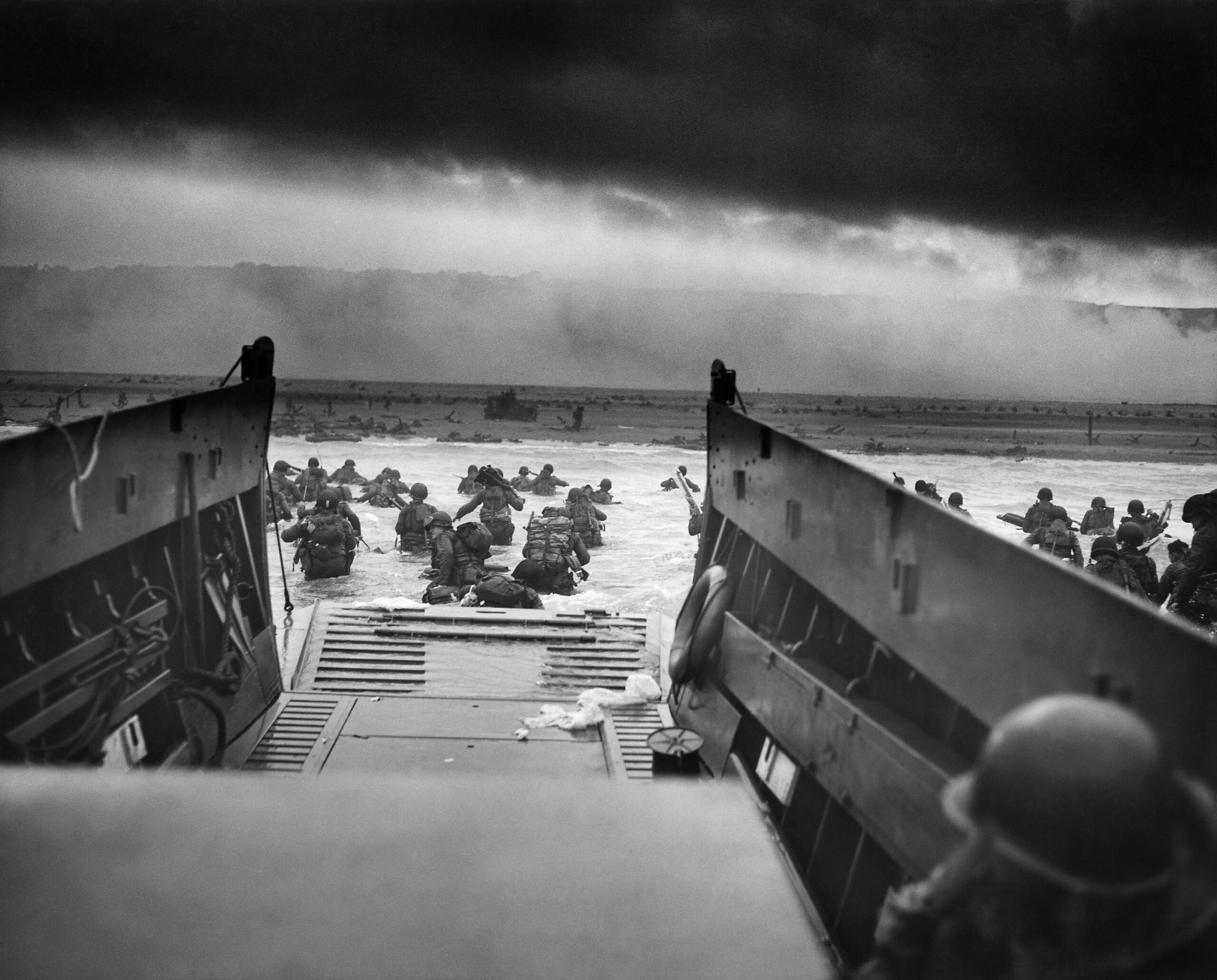
The 2026 film Pressure ends with a quote attributed to Dwight D. Eisenhower. John F. Kennedy, on the day of his inauguration, is said to have asked Eisenhower why D-Day succeeded. Eisenhower responded, “The Allies had better meteorologists than the Germans.”
It is strange to consider that something as mundane as the weather could have an effect on the largest amphibious invasion in history. And yet, the Allied invasion of Normandy depended on the weather.
D-Day needed specific conditions at once: a full moon, spring tides, low tide near dawn, and usable weather. Low tide exposed German beach obstacles—mines, stakes, ramps, and other defenses—while the rising tide later would carry crafts and supplies inland. But the timing also created urgency: The first soldiers would cross longer stretches of open beach under heavy fire.
There were three days on which the landing could occur: June 5, 6, or 7. Eisenhower, supreme commander of the Allied Expeditionary Force, wanted certainty.
In the film, Irving Krick had supplied Eisenhower with what seemed like perfect forecasts for decisive battles in North Africa. Krick was confident he could do the same in northern Europe. Churchill, however, recommends Group Captain James Stagg as the finest meteorologist in Great Britain.
Three days before the invasion was set to begin, Stagg left his heavily pregnant wife to offer his weather predictions.
While Krick relied on analogue forecasting, comparing the present sky to weather maps from the past, Stagg required copious amounts of real-time data. He demanded every scrap the weather would give him: pressure falling off Ireland; wind moving across the Atlantic; cloud thickening over the Channel; fog on the coast; sea conditions; tide tables; reports from balloons, ships, stations, and men watching the sky from places nowhere near Normandy.
It is strange to consider that something as mundane as the weather could have an effect on the largest amphibious invasion in history.
As the data poured in, Stagg placed dots on maps and tracked their movement, trying to see not only the weather as it was but what it might become. Stagg stood at one point in time with only partial knowledge. Across from him stood a commander desperate for certainty, asking him to claw the future into the present.
But Stagg could not and would not give certainty. He could only read the dots.
Up close, the dots were marks on a map or numbers on a page. Pressure, wind, cloud, fog, tide. When Stagg stepped back, the marks began to move together. He could see systems forming. He could judge what might happen next.
Pointillism functions in a similar way: Nose to the painting, the eyes see only mottled dots; step back, and the dots gather into an image.
But history is not a painting. Here, a dot is a life.
The film keeps Stagg near the soldiers who will soon have to live or die inside the weather he is trying to read. He watches them sing and dance—men still caught in ordinary life before history reaches them. The dots on his maps are not yet bodies on beaches, but they are already linked to the dots.
Fewer than six weeks earlier, Allied troops had rehearsed for Normandy in Exercise Tiger. Operation Overlord was too large to improvise. Men had to practice shipping schedules, radio procedures, communications, and the handling of landing craft before they ever saw Normandy. Precision was key.
The exercise went wrong.
Men died in friendly fire. A wrong frequency meant warnings of German S-boats went unheard. LSTs burned and sank. By morning, 749 American soldiers and sailors were dead.
Pressure opens in the aftermath of Exercise Tiger. The film begins with blood in the water, survivors scrambling, and Eisenhower looking on, already haunted by failure—dots that did not connect. Dots with names, mothers, wives. Dots wearing boots, water in their lungs. Exercise Tiger was a warning, not just a wound they were carrying. A missed signal, a wrong frequency, a failure to read and relay what was coming became bodies in the water.
Stagg did not command the invasion, but his forecast would help decide when men were sent into the Channel. He could not save them by being right. But he could kill them by being wrong. So when the dots told him June 5 would be dangerous, Stagg said so. He warned that June 5 would bring rough seas, wind, low cloud, and poor visibility. The crossing and the landing would be too dangerous. The Allied invasion would have to wait.
After Eisenhower halts the invasion, Stagg shuts himself in his office until morning. He opens the windows to a calm, sunny sky. British and American commanders make their way to the chapel for Sunday service. They sing “All Creatures of Our God and King.” Krick seems vindicated—Stagg, devastated.
In the film, birds chirp, the air seems calm, and then the wind picks up. Dark clouds roll across the sky and rain begins to fall. Stagg no longer looks perturbed.
A reading came from Blacksod Point on the northwest coast of Ireland. A postal clerk and weather observer recorded rising pressure after the passage of a cold front. The reading points to a small gap in the weather. Conditions would not be perfect, but they might be good enough for a June 6 landing.
If Eisenhower waited again, the invasion would likely be pushed nearly two weeks to the next narrow convergence of moon and tide.

Enough was all he had. Enough is not certainty. But the command could not wait until certainty arrived. Eisenhower had to decide inside the gap Stagg had found: not clear skies, not safety, not promise, but a narrow permission. The crossing could be attempted. The men could be sent.
The weather did not become good. It became enough.
If mercy appeared there, it did not appear as ease; it appeared as an opening.
The weather did not make the invasion safe. Men still died on the beaches and in the air. The weather made June 6 possible, not safe.
D-Day succeeded, but the war was not over. Winter would come, along with hunger, shelling, the Battle of the Bulge. There were still camps to be found. Victory could expose evil, but it could not undo what evil had already done.
This is where pointillism almost fails. Distance can help the eye. It can also make the eye cruel. Step far enough back from a battlefield, and bodies become movements. Step far enough back from suffering, and the wounded begin to look like color.
A dot is not color. A dot is a life.
Providence cannot be held in the moment you’re inside it. You might see it later in the pattern. But seeing it is not the same as understanding it. To write about providence at all is to risk arranging the dots too soon.
Christianity does not silence the cry of why. Christ himself cries it: “My God, my God, why have you forsaken me?” The cry does not make every dot legible to us.
At the end of Pressure, Eisenhower’s answer sounds too simple for the event it explains: better meteorologists. But perhaps that is the point. D-Day did not hinge on certainty. It hinged on men reading what they could, refusing what they could not know, and acting inside a narrow permission.
The mercy was not clear skies.
It was a small gap in the weather.