
A women’s convention in Rochester slays on urgent bioethical topics but squanders power in its attachment to feminism.
On the feast of St. Hildegard of Bingen—a Benedictine poet, philosopher, mystic, and one of four female Doctors of the Church—a group of women gathered in Rochester, New York, for a “Declaration of Interdependence,” a convention, not a conference, somewhat in homage to the women’s rights conventions in the area in 1848. The setting was the beautiful 1850s Lyon Mansion in the city’s East Avenue Historic District, and the aim: to consider “A Better Way Forward for Women” given today’s moral, technological, and economic challenges.
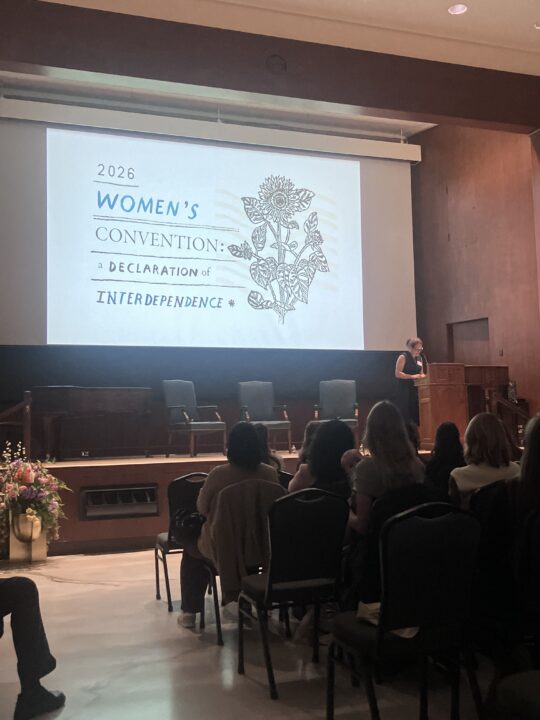
Erika Bachiochi, a legal scholar and founding editor of Fairer Disputations, kicked off the convention with welcome remarks and a pitch for a renewed women’s movement rooted in human dignity and female embodiment. There was much to cheer for—like the unapologetic pursuit of female excellence and the embrace of healthy disagreement. But I was skeptical of other framing elements, including whether feminism itself, even reconstructed with Catholic bioethics, is the right framework for the task at all. I was similarly skeptical of Bachiochi’s treatment of the internet’s “rising masculinist backlash” as a serious and growing threat to women, rather than a mostly fringe phenomenon in the darkest corners of the internet—and one arising, at least in part, as a reaction to institutional norms increasingly disadvantaging men (Helen Andrews’s “Great Feminization”).
But some of Bachiochi’s points, particularly on what market forces, technological advances, and the sexual revolution have done to women, were superb. These conditions have primed women to mistrust their own powers, she observed. But after decades of feminism promoting women’s empowerment, she asked, how can that be? The answer does not just relate to tidy ways to mitigate biological differences between the sexes (a sentiment captured by Gloria Steinem, who said if we just “didn’t have wombs, we’d be fine”). Rather, it is rooted in those differences—in celebrating and honoring the powers they confer. The form of feminism “now hegemonic for decades in the West,” Bachiochi explained, “assumes a series of technological incursions into the body of a young woman such that she can become the equal of a man.” How, then, could she not doubt herself and her physical capabilities after such a campaign? “A lifetime on contraceptive pills, abortion at the ready, the availability of now egg freezing and other reproductive technologies, all to ensure that she can engage in the bedroom and the marketplace along the normative patterns of a man,” Bachiochi explained.
Bachiochi was followed by remarks from bestselling author Louise Perry, former politician Miriam Cates, and Catholic University of America professor Angela Franks, culminating in a panel discussion with the three, ably moderated by visibly pregnant Fairer Disputations editor Serena Sigillito. (Similar to a Center for Ethics and Culture gathering at Notre Dame or an American Compass conference, pregnant women and newborn babies were blessedly overrepresented among convention attendees.)
“We’re not made for the machine, for the market, or for men’s desires.” We are, she continued, “transcendent beings made ultimately for union with God.”
Perry’s talk focused on physical and personality-based differences between the sexes and the perennial, paradoxical need for unusually agentic women to advocate for other women, given that traits like assertiveness and lower agreeableness—more commonly found in men—tend to translate into better leadership. Cates focused on motherhood as a school of advocacy for the vulnerable, making the provocative case that if more women were mothers, the interests of women and children would fare better in the public square. Non-mothers, she argued, often have more time to shape policy—but less understanding of families’ needs and vulnerabilities. The resulting “advocacy gap” means female compassion is often channeled into policies that appear humane but oftentimes work against their interests, she explained, citing support for open borders as a stark example. And Franks spoke about protection from disordered male desire as a necessary condition for greater virtue, intellectual excellence, and flourishing between the sexes.
Something that was interesting was what emerged from the Q&A portion: For a gathering devoted to renewing the women’s movement, some of the most pointed questions were strikingly defensive of men—and skeptical of a feminism that casts women primarily as victims in need of protection from them. One woman asked whether male strength, rather than being treated as a problem, might be cultivated toward good ends, for example. The discussion that followed emphasized the need to affirm good men, recover a positive vision of masculinity, and strengthen fatherhood and marriage.
Other questions turned the feminist critique back on women themselves. One attendee, invoking Lindsay Clancy, objected to feminism’s tendency to place women permanently in victim roles and asked what responsibility women bear when they victimize others (including the unborn in their wombs). Later, a Canadian attendee asked if male vice tends to manifest in recognizable forms that society knows how to punish, what then restrains “female tyranny.” Echoing Cates’s comments on the confused empathy that feeds support for progressive border policies, she pointed to euthanasia in Canada as an example of what she regarded as female-coded misplaced compassion.
It seemed, then, that I wasn’t the only fish somewhat “out of water”—albeit amiably so—with the feminist framing. Some of us, at least, appeared less interested in recovering a sense of sisterhood with our suffragist predecessors than in figuring out what modernity is doing to both sexes: how technology, economics, and the sexual revolution can deform relations between them. That concern brought me back to Bachiochi’s best line from the opening remarks: “We’re not made for the machine, for the market, or for men’s desires.” We are, she continued, “transcendent beings made ultimately for union with God.” That proposition seemed to me, in that moment, closer to the animating concern of many women in the room than feminism did, exactly.
Of course, other questions complicated that impression—and, amusingly, reinforced Perry’s argument about the difficulties of women representing women and the paradoxes of finding the right women for the job. During her remarks, Perry had memorably and hilariously said, “I’m calling on the female freaks and weirdos, some of whom are here tonight, to take on a paradoxical challenge. We have a duty to use whatever influence we have to advocate for other women, but we can only do this by remembering that we are unusual in all sorts of ways, including in terms of personality.” Perry could perhaps have used the more flattering term “unicorn,” although “freak” sufficed. But when the Q&A portion began, one woman questioned her language, worrying that calling agentic women “freaks” or “freakish” might discourage precisely the qualities the movement ought to nurture in girls and women. Another objected to Cates’s categorization of women into mothers and non-mothers, worrying that it could make childless women feel less female. I found these critiques frustrating—and, in a way, reinforcing of what Perry and Cates were saying. The gist of their pitches rang unequivocally true to me, and the discomfort their formulations immediately produced seemed almost to prove their point. A movement that requires female leadership cannot become so sensitive and solicitous of every possible discomfort. (For the record, I’ve attended enough male-dominated gatherings to see men ask equally counterproductive questions in different contexts, and this is just what happens at conferences as attendees wrestle with new and sometimes uncomfortable ideas.)
The gist of their pitches rang unequivocally true to me, and the discomfort their formulations immediately produced seemed almost to prove their point.
The next morning, attendees heard from Notre Dame professor Abigail Favale, who, drawing on powerhouse philosopher–nun Prudence Allen, surveyed contemporary ways of understanding sexual difference—each of which, she argued, fails to hold together two essential truths: the equal dignity of both sexes, and the meaningfulness of sexual difference. Against these, Favale proposed a more holistic anthropology, one that recognizes the reality of sexed bodies and their “generative potential” while also making room for interiority, human agency, and social formation. Women, by this account, are neither reducible to reproductive functions nor separable from the anatomical features that make motherhood possible. Any adequate framework, then, must make room for what Favale called “maternal potential”—not as the sum total of womanhood but as a meaningful feature of the female body instead of an inconvenient biological fact.
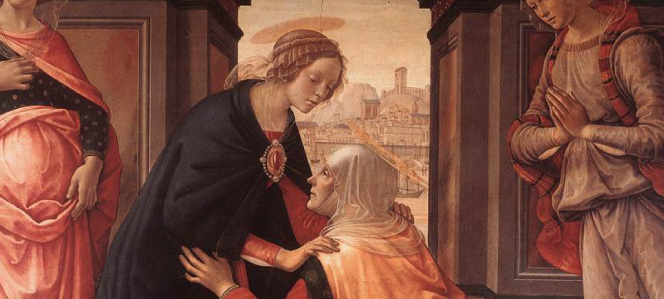
On that score, the convention then turned to perhaps its most urgent theme: accelerating reproductive biotechnology and transhumanist implications for the female body. UnHerd editor Mary Harrington supplied the panel’s governing image, a fourteenth-century Visitation sculpture depicting the pregnant Mary—the Theotokos or “God-bearer”—and Elizabeth, their crystal wombs evoking the unborn Christ and John the Baptist within. For Harrington, the image captured an understanding of personhood increasingly obscured by technological modernity: The women are fully themselves yet profoundly relational, their bodies capably nurturing other human beings within. She contrasted this vision with the technological mindsets of autonomy, mastery, and contract, particularly within surrogacy. Her solution was not Luddism but a rightly ordered relationship to technology: “Place Mary and Elizabeth back at the heart of our understanding of what people are and what we’re doing all of this for.”
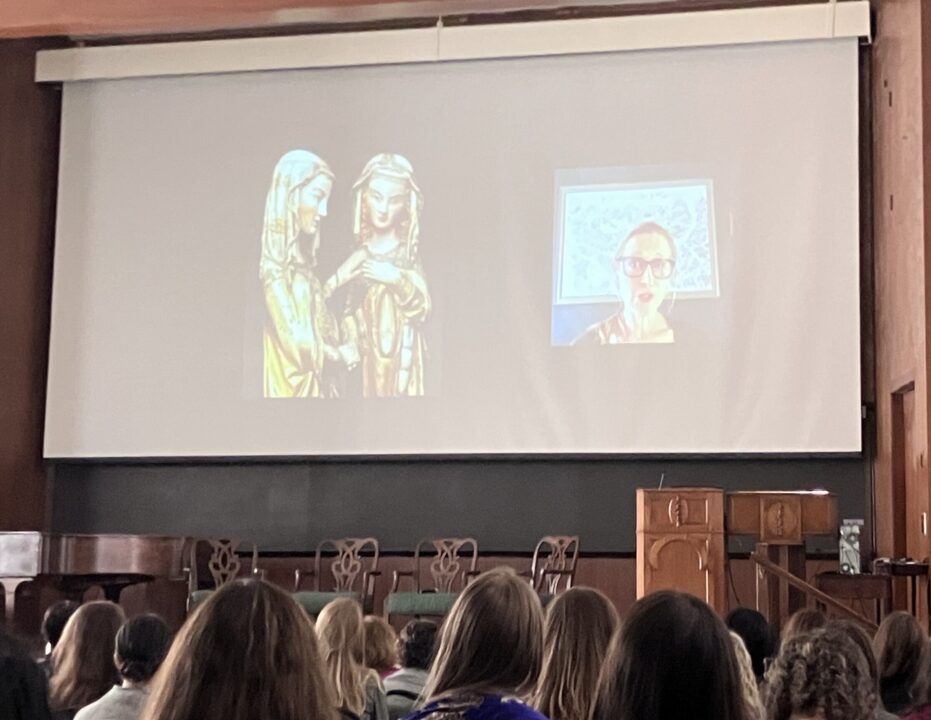
Jennifer Lahl, a registered nurse and bioethicist, extended this critique, essentially arguing that our approach to infertility is riddled with category errors. When fertility is impaired, we increasingly seek engineering workarounds rather than asking whether the underlying pathology driving dysfunction can be healed. Lahl contrasted such “band-aids” that bypass root causes—like IVF, egg freezing, donor eggs, surrogacy, and embryo selection (approaches often at best sub-effective and at worst unethical)—with root-cause approaches like NaPro Technology, which seek to restore the body’s original reproductive function.
But a second category error emerges when even those attempts at restoration, frustratingly, fail. Infertility then tends to be treated as a technological malfunction still awaiting more advanced laboratory breakthroughs, rather than a form of human suffering that may not be solvable at all. “A culture that cannot tolerate an unresolved sorrow will always reach for a mechanism instead of a companion, because the mechanism promises to make the sorrow stop, and the companion only promises to stay,” Lahl explained. Once infertility is treated as “a defect awaiting an engineering fix,” rather than a call for accompaniment, we have already “lost the plot,” deciding something consequential about what women’s bodies are for—and about how we respond to a neighbor’s suffering.
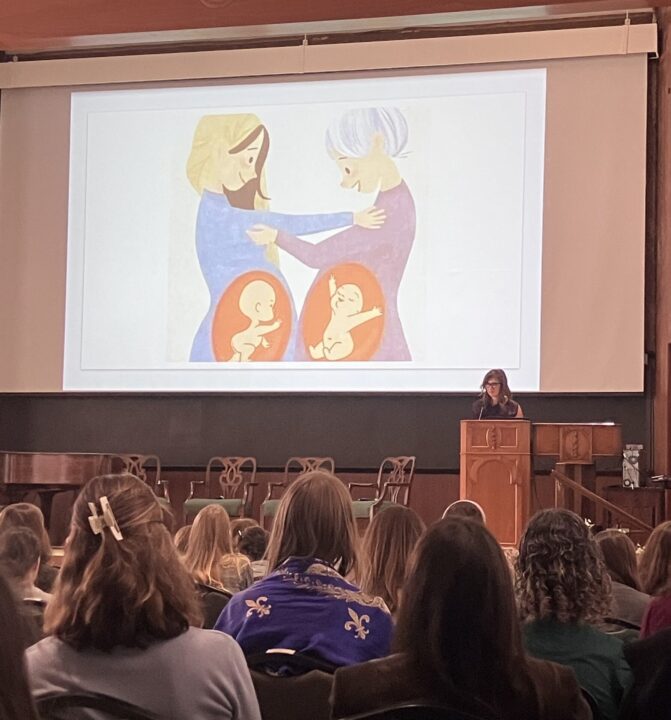
Following Lahl, Dr. Kristin Collier, a medical-school professor, similarly used an image of the Visitation, lamenting the paucity of language—particularly within a medical culture that now takes assisted reproduction for granted—honoring maternity’s sacredness. Across the three talks, Mary and Elizabeth thus became more than devotional motifs. They represented an anthropology of embodied dependence against the temptation to treat fertility, motherhood, and the female body as problems to be fixed with hacks, algorithms, or technological feats.
But the market pressures on women are not limited to the commodification of their bodies—the sale of their eggs for cryogenic storage or their wombs through surrogacy. They extend to women’s emotions and time. The iPhone has vastly expanded market access to both. This was the central point of The Free Press contributor Freya India, drawing from her May 2026 book, GIRLS. Platforms like Instagram and TikTok provide advertisers and influencers unprecedented access to girls’ attention and insecurities, creating endless opportunities to sell beauty products and cosmetic procedures for supposed imperfections. But it’s not just corporate advertising: The digital world increasingly encourages girls to conceive of themselves as products too—constantly in need of Facetuning, editing, and optimizing.
This kind of self-branding now begins astonishingly early, with girls as young as middle school already thinking of themselves as “brands”—about how to present and package themselves. And it comes at a cost to childhood. India said she had hoped we might preserve “that time to be playful and fun.” Instead, “I think that girlhood today is so serious.” Recalling herself at thirteen, she described “essentially managing my own personal brand,” stewing “over my Instagram grid” and wondering, “Is it all the right aesthetics? And how am I going to package myself up?”
India’s concerns also raised a deeper question: What happens when girls encounter themselves—and the world around them—primarily through images? Philosopher Nina Power had explored similar questions earlier in a wide-ranging, somewhat esoteric talk on images and iconoclasm that was fascinating, if at times difficult to follow. Less a linear argument than a survey of the strange power images exercise over us, Power’s talk ranged from Byzantine icons and suffragette vandals to pornography and tradwives. The question that stayed with me was how we learn to discern between images that elevate us and images that merely mesmerize, degrade, or consume us.

Power began with the strange paradox of images in modern life: They have never been more abundant or powerful—nor ever treated as less so. Throughout history, Power explained, periods of iconoclasm have erupted precisely because people understood images to possess tremendous power. She quoted Jean Baudrillard’s observation that iconoclasts, supposedly contemptuous of images, may actually have been those who “accorded them their true value” after all.
Today, we’re on the opposite side of the spectrum, our relationship to images almost the reverse. “The general response to images is one of numbness, a kind of nihilism,” Power said, explaining that, in the face of pornography, violent imagery, and ambient streams of online images, “we have to tell ourselves that images don’t really affect us that much”—but we’re lying. Instead, much like Instagram images affecting young girls, what we see is “extremely, extremely powerful,” shaping desire, imagination, and the models we imitate, for better or worse.
What is a woman’s relationship to all of this? It’s complicated. In one sense, I gathered from Power that women are some of the world’s most sensitive, brave, essential stewards of images—images that have important cultural and even spiritual power. In that regard, she cited the Byzantine empresses Irene and Theodora, who restored the Christian veneration of icons after their iconoclast husbands had died. Women emerged in these stories not simply as subjects of beautiful images but as their protectors—custodians of beauty, memory, and cultural inheritance.
Similarly powerful was Power’s discussion of the Virgin Mary. Much like Harrington and Collier, Power put an image of the Blessed Virgin on the screen, this time as a Hodegetria, or “she who shows the way.” The icon’s beauty does not terminate in itself but directs the viewer toward something higher, she explained. Likewise, our Blessed Mother points beyond herself, a “portal” toward contemplation, charity, and virtue.
But in other cases, women have also participated in iconoclasm, demonstrating—like the husbands of Theodora and Irene—confused, misguided reactions to powerful imagery. Here, Power cited suffragette Mary Richardson’s 1914 slashing of Velázquez’s The Rokeby Venus. Richardson said she had attacked “the picture of the most beautiful woman in mythological history” in protest over the treatment of another suffragette—but later admitted that she also objected to the way men regarded the female nude (a reaction that, to me, registered as jealousy). A century later, a female activist and fellow protestor deliberately targeted the same painting, striking its protective glass with hammers, as if to say, according to Power, that “we should feel bad for spending our time reflecting on beauty when the world is in such a mess.”
The juxtaposition raised larger questions running throughout Power’s talk: What are the purposes of icons and images? What should an image of a woman direct us toward? What do these images teach women to desire and become? In an image-saturated culture of pornography, social media, and “tradwife” aesthetics, an image can elevate, become an object of consumption, or provoke the impulse to destroy. Far from being utilitarian (as in the apparent belief system of The Rokeby Venus’s 2023 attackers), contemplation is not a frivolous retreat from the serious work of moral formation; it’s an essential, spiritual component of it. Images teach us what to admire, desire, and imitate. That’s why an icon of a saint can prompt the viewer to ask, “Can we be more patient? Can we be more loving?” A renewed women’s movement, therefore, must recover women’s roles as discerning stewards of beauty and cultural inheritance—preserving images and models of womanhood that elevate rather than consume the female person.

But this brings us to the inimitable Mary Eberstadt—one of the smartest thinkers of the twenty-first century—who made essential points during the convention that I think got overlooked in the larger conversation. Eberstadt’s talk, delivered remotely and with adorably questionable production value, was a call for women to use their distinctive power strategically in relations between the sexes—to use their leverage—to reverse the sexual revolution’s catastrophic consequences. Taking Aristophanes’s Lysistrata as her organizing metaphor, she reminded attendees—somewhat to deaf ears, in my opinion—that “women have the power to set the agenda between the sexes.” In that vein, she then revisited her arguments in Adam and Eve After the Pill—that contraception and the sexual revolution have produced devastating repercussions for men and women—arguments that she said were disregarded when she first made them but which have become increasingly salient as alarm over hookup culture, pornography, and marriage rates has grown.
“A lot of men don’t have the energy demanded by a wife and children,” she explained. “And the reason they don’t is that they’ve been sedated and anesthetized by smut.” Her practical prescription? Make pornography—a form of biochemical warfare we are waging on ourselves—socially unacceptable and, in the service of that goal, teach young women to exercise sexual and romantic leverage rather than surrender it. Reject pornography in prospective partners, she said. Dump boyfriends who don’t commit. Her larger point was that women are not mere casualties of a degraded sexual culture: They possess considerable leverage to change its norms by changing what they tolerate and reward in men. Reversing the sexual revolution will require recognizing that.
There’s some tension here, perhaps, with Eberstadt’s prescriptions (which to me were both brilliant and obvious) and with the convention’s occasional discomfort with conspicuous aesthetic expressions of femininity—potshots at “tradwife” influences, and modestly-clad Ballerina Farm, in particular, with two different panelists connecting tradwife content to pornography and fetishization. But I couldn’t help wondering if embracing female beauty is part of the Lysistrata strategy, and if suspicion of such displays reveals a blind spot or even, at times, a trace of insecurity—a discomfort with forms of female power that are beautiful, mysterious, and therefore a little terrifying—akin to what Richardson’s attack on The Rokeby Venus brought to my mind.
If women possess distinctive leverage in relations between the sexes, as Eberstadt argued, surely some part of that Lysistrata power is bound up with feminine beauty—the type tradwives aim to emphasize (however imperfectly) within marriage, motherhood, and domesticity. Here I do not mean the anxious, optimized, commodified beauty wrought from a punishing regime of hair extensions, GLP-1s, miniskirts, and Botox—the type India rightly questioned. I mean something more timeless and enigmatic: the stupefying beauty and mystery a woman of nineteen or ninety-one can possess when she understands her own dignity and forms herself after worthy female models—Mary, Elizabeth, Hildegard of Bingen.
In any case, because of the adorably comical production value of Eberstadt’s remote remarks, she appeared as a floating head projected on a screen—a little like the Magic Mirror in Shrek—literally disconnected from her body. To me, this became an amusing metaphor for how much of what she said ended up—sadly, and to its impoverishment—disconnected from the convention’s final conclusions. The final Q&A on day three devolved into a chaotic grievance session, with participants fretting about policy levers, votes, laws, representation, and other mechanisms of political power. These things matter, of course. But they’re technicalities beside the enormous embodied and relational power women already possess. Indeed, I was struck by how quickly the conversation reverted to power as something conferred—or withheld—by institutions. Eberstadt had raised the more interesting possibility that women already possess terrifying, intrinsic forms of power that politics can neither confer nor fully take away. Why waste time fixating on trivialities—forms of power we must petition institutions give us (and which, in most cases, we already have)—when we are leaving so much of our own power on the table?
Ayaan Hirsi Ali, the final long-form speaker, possessed just that type of magnetic, mysterious feminine beauty that comes from a woman knowing fully who she is, pursuing poise and virtue, and deriving confidence from charity and Christian faith.
Why waste time fixating on trivialities—forms of power we must petition institutions give us (and which, in most cases, we already have)—when we are leaving so much of our own power on the table?
First, in recounting her Christian conversion, she gave a hilarious, wise, human voice to the “defense of white men” sentiment that had emerged in the first night’s Q&A. What made her defense particularly compelling was that she could hardly be accused of naïveté about male domination. Having grown up in an oppressive Islamic culture, she had been astonished upon arriving in the West to encounter male self-control around women. She eventually came to understand this not merely as an achievement of secular liberalism, as she had initially assumed, but as part of a deeper Christian inheritance. Her conversion, in other words, had changed not only her understanding of Christianity but also her understanding of men.
Christianity, for Hirsi Ali, did not abolish strength differences or pretend men and women were interchangeable; it taught what strength was for. She agreed with a formulation Bachiochi supplied: Christianity insists the strong serve the weak. Furthermore, rereading Genesis and the New Testament as a Christian, Hirsi Ali observed, “I don’t find anything there that is an assault on the dignity of women.” Indeed, she had come to see Christianity as an inheritance the West was wasting, like someone who “inherits this incredible wealth” only to squander it. “Every time you go back to ‘what did Jesus say,’ it becomes even more attractive,” she said.
Interestingly, this realization also reduced Hirsi Ali’s patience for a feminism that regards “white males” as principal threats. To label diminutively as “white” and “cisgender” a man formed, in her telling, by virtues of self-restraint, patriotism, and protective instincts is to alienate precisely the sort of men women should want around. Remove them and exploitation and predation remain—but with “no men to protect us.” (She drew laughs—and perhaps some uncomfortable seat-shifting—when she went so far as to say she wished there were more “Christian nationalists.”)
It became clear that for Hirsi Ali, women are neither helpless victims nor honorary men. Likewise, acknowledging that women possess agency and responsibility does not require dismissing female vulnerability nor male strength. This Christian anthropology struck me as the “better way forward for women” the conference was seeking all along—even if Bachiochi felt the need, after the recording ended, to temper some of Hirsi Ali’s remarks with a pesky “well ackchyually” qualification of her strong-borders stance.
Overall, even to this non-feminist, the “Declaration of Interdependence” convention was joyfully brimming (much like the wombs of many of the attendees, my own included) with intellectual rigor, abundance, and a real space for women, children, and men to become fully themselves in God’s image. There were moments of friction—including that final, chaotic Q&A session, as well as my own “freak-like” contrarian need to defend tradwives—but as Bachiochi said from the outset, debate is healthy. I couldn’t cover ever speaker and subject—topics like farming, teaching ESL, mentorship, running a pro-life pregnancy center, caregiving, female friendship, urbanism, and the “bowling alone” principle all surface and were treated thoughtfully—nor sign the concluding document at Seneca Falls. But one final takeaway resonated. As women who care about excellence and intelligence in the spirit of our beloved female Doctors of the Church—but also about honoring our embodied natures and “maternal capacities,” both spiritually and physically—we are not just freaks (or perhaps “unicorns”). As Helen Roy put it in the final panel, we are also “happy warriors.” “I’m just like the other girls,” Roy said joyfully, through tears, “and that is an honor!”