
I spent the spring of 2011 at the University of Dallas’s Due Santi campus, so called for a well where Sts. Peter and Paul once stopped for a drink. Today, the well sits in the midst of a vineyard, and it’s not hard to imagine the keepers of the sword and the keys leaning there a moment in the evening sunshine glinting off the Tyrrhenian Sea, with Mount Albano gazing down on them and the Appia Antica a few yards off, waiting to bear them the last twelve miles into Rome. The texture of life in those months seemed at once thicker and more diaphanous than usual. Every inch of Italy bore witness to the passage of some saint or sage, and their bones and their relics rose up all round. With grim love I gazed on St. Catherine of Siena’s head. I saw the chains of Paul, Peter’s bones. I climbed the Scala Santa, brought over from the Holy Land by St. Helena. I looked up at Keats’s window and stood before his grave. I longed to touch Bernini’s Pluto and Apollo. I seemed to hear the voices of Ignatius and Francis Xavier and Philip Neri. I stood in Santa Maria Maggiore, whose form Our Lady outlined in the August snow, where Christ’s crèche glows all golden beneath the altar.
Is it possible to count the relics of Rome? To number the miraculous sights, sacred and profane? To catalogue the crutches left at altars in thanks for miracles? There the things of the world seem all to have been touched with divinity till the whole fabric of reality shimmers, intimating a world impossibly bigger and more lively than we know. So it seemed to me—or seems in these memories which have become my life—that life has been shaped by miracles, by relics, by the saints.
Just after my tenth birthday, my mother enjoyed an apparently miraculous healing through the intercession of Bl. Francis Xavier Seelos after a stroke left the right side of her body paralyzed. The morning after our pastor brought her Bl. Seelos’s relic, my father hung it around her neck and left her to watch Mass on television in her hospital room. At the final blessing, she tried to make the Sign of the Cross and found that her hand and arm worked again. She rose from bed and played the Ode to Joy on a therapy keyboard in the corner. She was healed.
Still, I confess that after a certain point, the reliquary torrent of my Rome semester evoked a touch of skepticism. Isn’t it all too much? I wondered. Is it really so likely those bedazzled sticks of sycamore could be the manger of the Christ? I said as much to a classmate one evening in the mensa over pasta and bread and oil. This was a fellow of great zeal—particularly where fun was concerned—intense appetite, not least with respect to the juice of the grape and the grain, and stentorian voice, now directed full blast against me.
“Why wouldn’t you believe it anyway?” he said.
I dithered half-heartedly.
“Why wouldn’t you want something good that’s offered to you?” he went on.
If to encounter Christ is at certain moments to be put perfectly at ease, it is at others to be left uncertain of almost everything except that he is Lord.
In the moment, a dozen arguments occurred to me, as they occur to me still, yet in such cases, reason often matters rather little. A voice within said, “He’s right, you know.” And whatever else might be said on the matter, my friend’s words reframed the way I met the many wonders that would continue to greet me that semester. I was the better and the happier, and I was all the more ready for an encounter that would come in the middle of spring with the face of Christ.
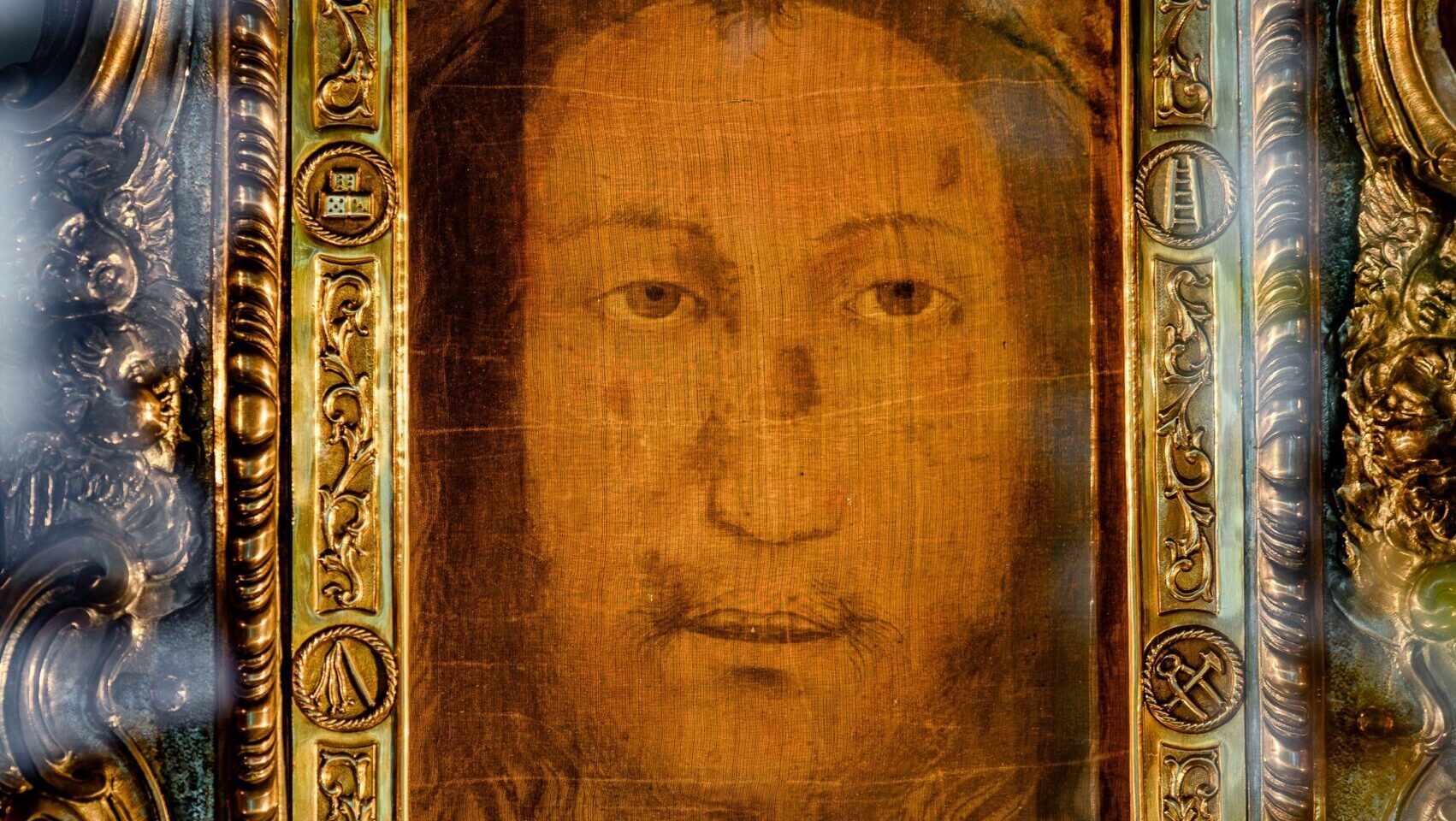
A classmate, having read of il Volto Santo di Manoppello, the veil bearing a miraculous image of the face of the Crucified and Risen Christ, arranged a class visit thereto. A charter bus bore us out early one morning from beneath the umbrella pines, and as the sun came up out of the far Adriatic, we made across the spine of the Apennines for the town—modest by Italian standards—of Manoppello. We arrived, we processed into the church, we trooped around to the shrine at the back of the altar and knelt and prayed, or stood and wept, or gazed a moment and went on back into the spring sunshine, back to the bus, back to Rome.
I was encouraged to keep a journal that semester and did so. It sits high in a closet, and I pull it down from time to time and console myself—it’s a funny little artifact, full of high sentences and a bit obtuse. Beneath the heading “Manoppello” lies a lone sentence—the quarter-inch gravestone of that day—“I have just seen the face of God.” Several blank pages follow. No doubt I meant to wax away, and perhaps that bare space was merely the portal to the present musings.
What I did not set down during all the bus ride back to Due Santi was how deeply the face of God had unsettled me. If to encounter Christ is at certain moments to be put perfectly at ease, it is at others to be left uncertain of almost everything except that he is Lord. The latter feeling haunted me like the very sun that tracked our passage toward the coast and settled down ahead of us on the horizon and plunged into the sea as the bus eased beneath the sheltering pines of campus. Christ’s face seemed to loom up in the dark, confronting me in the midst of what I had to that time called beauty—what I still see as the beauty of Michelangelo’s sculpture, Waugh’s prose, Velasquez’s painting—calling me to the little lower layer, as Ahab puts it. For the face I met behind the altar in Manopello, the face Padre Pio apparently sat before by means of bilocation on the day of his death, was not a face I would at first call beautiful, “so marred was his appearance, beyond human semblance, and his form beyond that of mortals” (Is 52:14). Nor was the strangeness of that face a mere function of the marks of Christ’s passion. Even beneath the blows and the bruises, below the blood and spittle, the face was plain. The man who gazed at me was not one who would have called me to follow him by the compulsion of the beauty the eye finds unassisted.
Yet Christ is the beautiful one. Beauty, St. Thomas tells us, is “quod visum placet,” that which, having been seen, pleases. The beauty of the face of Manoppello, the beauty of the Crucified Christ, serves as a reminder that the way of beauty is not automatic, that the perception of the most beautiful things does not rely simply on the senses but on the harmony between the senses and the intellect, and that this harmonization takes time and effort and good counsel. St. Peter’s Basilica may compel my wonder, but it takes, for some of us, a lifetime’s discipline to enter upon the awareness of Christ’s beauty as it appears to us on the altar of the humblest country church, in the tabernacle of a lowly chapel, in the bruised body oozing on the tree of the cross.
That face comes frequently to me now as I consider, as a teacher, as a writer, as a father, as one struggling along in search of the Way, how to evangelize. The numbers, it would seem, are against us. Here and there may shine some spark of revival, but on the whole, the tale of declining church attendance, of disbelief in Christ’s real presence, of disaffiliation with religion, lies open for the reading in graph after graph after graph. Those statistics are surely important. They should not go ignored. Yet I can’t help feeling—with something of the feeling of that strange face in Manoppello—that to frame our efforts at evangelization in terms of the statistics is in some way to miss the mark. Post after post on social media suggests that if we could just get it right, if we could just build the right way, decorate the right way, preach the right way, faith would necessarily follow. But the Gospels are themselves frequently catalogues of revelation rejected. Christ calls the crowds to eat his flesh. They turn away. He reprimands their fickle hearts. They seek to kill him. He is lifted up upon the cross. They scatter. The Word himself bears witness to the light, and we choose instead the darkness.
“Quantitative judgments don’t apply” in matters of the spiritual life, says Peregrine Crouchback in Evelyn Waugh’s Sword of Honor trilogy. With due respect to the statistics, I nonetheless submit, in light of the Holy Face of Manoppello, that where faith is concerned, it’s the anecdote that counts, the moment of contact with the Christ which from then on orders all other moments, the need to tell others and to seek him in every crease and wrinkle of creation. Our minds find comfort in abstraction. Il Volto Santo recalls us to the deep, to the shaking that keeps us steady.
We love to repeat, with Prince Myshkin, that beauty will save the world. But we know better. We know that beauty has already saved the world and that he continues his labor of salvation moment by moment. We ought, by all means, to build beautiful churches, to learn to preach the good news with every ounce of art at our disposal, to shape what lies within our purview to adumbrate the loveliness of Christ, remembering, though, that his loveliness is often at work in secret, that glory shines forth in the stripes of his affliction, that even he watched the crowds get up and shake their heads and walk away.
He has already saved the world. Bruised, he gazes still, gleaming in secret, inviting us to be recalled to life.
A version of this essay appears in The Wheel and the Clay: The Inner Lives of Christian Artists, launching September 30 from Ignatius Press and featuring essays by Sally Read, Dana Gioia, James Matthew Wilson, Arvo Part, and others.